


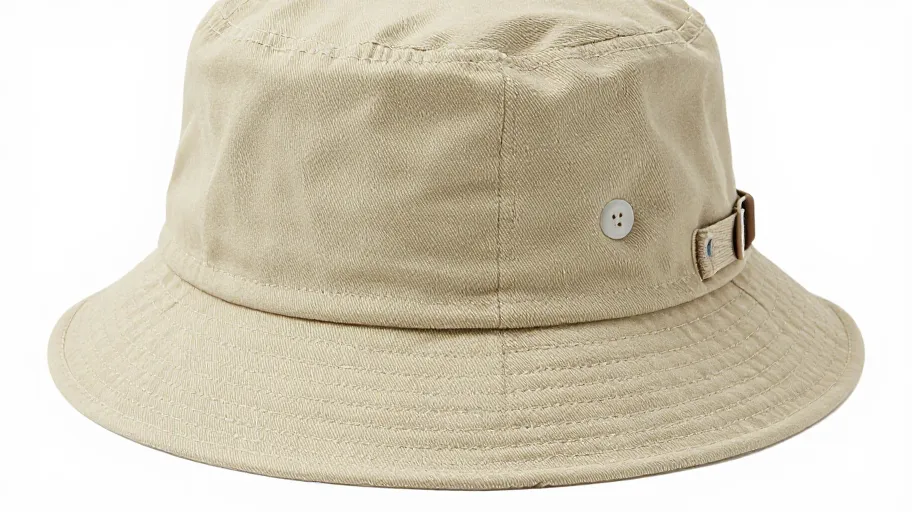
When your bucket hat factory sends the first sample, your job is not to judge whether you like it — it is to verify, zone by zone, that the sample matches the agreed specification and that the construction will survive bulk production. A practical method is the S.T.R.A.W. Sample Gate: review Stitching, Trim, Reproduction, Assembly and Wear in sequence, document every finding, and approve in writing only when all queries are closed.
Why the first sample is a decision gate, not a souvenir
Many buyers treat the first sample as a preview. It is closer to a contract. Everything you approve on that sample — panel shape, brim wire behaviour, lining attachment, print registration, label placement — becomes the reference the factory works to at bulk. Anything you notice but do not query in writing becomes something you accepted.
The goal of a first-sample review is therefore documentary as much as sensory: you are building a paper trail that says "this is what we approved, and here is how we approved it." A bucket hat is a deceptively simple product — few panels, one brim — but its perceived quality lives in exactly the zones where first samples can quietly diverge from spec: crown shaping, topstitch alignment, brim edge finish, and the interior.
Before the review, assemble three things: the agreed specification sheet, the approved artwork or tech pack, and a physical space with daylight, a measuring tape, a camera and a note-taking method. Then work through the five S.T.R.A.W. zones in order.
The S.T.R.A.W. Sample Gate, zone by zone
S — Stitching
Stitching is where a bucket hat factory's real workmanship shows. Examine:
- Seam alignment: do crown panels meet cleanly at the seams, or do they step?
- Topstitch lines: are they parallel to seams and consistent in distance from the edge?
- Stitch density: is it consistent across all seams, including under the sweatband where few buyers look?
- Thread match: does thread colour match the agreed spec on every seam, including interior seams?
- Start and stop points: are they backstitched or buried, or do they leave loose tails?
Photograph any seam that raises a question, with a ruler or reference object in frame for scale.
T — Trim
Trim covers every component that is not the main body fabric:
- Brim wire or brim interlining: does the brim hold the agreed shape when flexed and released?
- Eyelets: are they clean-cut and reinforced, positioned per the artwork, and correctly aligned left-to-right?
- Sweatband: is it attached evenly, with no puckering, and does the join sit where the spec places it?
- Labels, hangtags and care labels: verify position, spelling, colour, stitching method and attachment — an incorrect label is one of the most expensive defects to discover after bulk shipment.
- Buttons, cord stops, drawcords or reflective piping, if specified: confirm each against the approved sample brief, not against memory.
For every trim item, ask the factory to confirm the exact material and specification in writing. Do not assume the sample trim and the bulk trim are identical unless the factory states so.
R — Reproduction
Reproduction is fidelity to your artwork:
- Colour: compare against the approved colour standard under both daylight and indoor light. Ask the factory to confirm the colour-matching method used.
- Print, embroidery or patch: check registration, edge quality, thread or ink colour, and placement measured from defined reference points — for example, the distance from the seam to the edge of the logo. Record the measured placement so the bulk run can be checked against the same numbers.
- Logo scale: measure the logo dimensions and record them, rather than judging "looks right."
Ask the factory which finishing and pressing steps will be applied at bulk, and whether the sample received the same finishing. This is a question to confirm directly — finishing policies differ by supplier and must never be assumed.
A — Assembly
Assembly is the three-dimensional integrity of the hat:
- Does the crown sit symmetrically when placed on a flat surface?
- Does the brim roll evenly around the circumference, without flat spots or twists?
- Are the lining and shell attached without tension that will pull or pucker after repeated wear?
- Do seams at the crown junction open cleanly, without bulk or skipped stitches?
- Does the hat hold its shape after light handling, or does it collapse in one zone?
W — Wear
Wear is the functional test. Have two or three different people put the sample on:
- Comfort at the sweatband and crown.
- Whether the brim obstructs vision at the intended wearing angle.
- Sizing feel versus the labelled size — record head circumferences of your test wearers alongside their verdicts so the feedback is usable.
- Whether any component — eyelet, patch, brim edge — shows immediate wear after handling.
One wearer's opinion is anecdote; three documented wear tests are evidence you can send back to the factory.
Decision table: turning observations into actions
| Observation | Classification | Action |
|---|---|---|
| Seam stepping or misaligned topstitch visible at arm's length | Reject zone | Query in writing with photos; request re-sample of that zone before approval |
| Minor stitch density variation in a hidden interior seam | Query zone | Ask factory to confirm bulk stitch spec in writing; note in approval document |
| Logo placement differs from artwork by a visible margin | Reject zone | Measure, photograph, request correction and updated sample |
| Colour reads differently under indoor light | Query zone | Ask factory to confirm colour-matching method and standard; compare against agreed swatch |
| Brim shape recovers fully after flexing | Pass zone | Photograph, record as approved reference |
| Sweatband join sits on the opposite side to spec | Reject zone | Correct before approval; join position is bulk-reproduced exactly as sampled |
| Sweatband slightly firmer than expected feel | Query zone | Confirm material specification in writing; approve only with written confirmation |
| Hat holds crown shape through three documented wear tests | Pass zone | Record wearers' notes and verdicts in the approval file |
Concrete approval questions for the factory
Put these in writing and require written answers before you approve:
- Is the trim and brim material in this sample identical to what will be used at bulk? If not, what differs and why?
- Which colour-matching standard or reference was used for this sample, and will bulk be matched to the same standard?
- What finishing and pressing process did this sample receive, and will bulk receive the same?
- What is your process if the bulk run differs from the approved sample in a specific zone — and how should we document such a claim?
- What are your current revision terms: how many revision rounds are included before charges apply, and what is your current policy on revision timelines?
For every one of these, the answer is project-specific. No published article can state a supplier's current policy; the buyer must confirm terms directly, in writing, before relying on them.
Documentation and sign-off discipline
Close the review the way auditors close an audit:
- Compile a query list with photographs and measurements, numbered, with one owner per item on the factory side.
- Require written responses to every query — verbal assurances during a call are not traceable.
- When corrected samples arrive, re-run only the affected S.T.R.A.W. zones plus a quick full-hat pass.
- On final approval, sign and date a one-page approval record that references the sample batch, the query list and its closure, and states that bulk must conform to the approved sample.
- Retain the physical approved sample, sealed and labelled, and keep the photographic record in the project file.
This discipline protects both sides. A well-documented approval gives the factory an unambiguous target and gives you a defensible reference if anything drifts at bulk.
FAQ
Should I request a re-sample after every query, or only for reject-zone findings? Reject-zone findings warrant a corrected sample. Query-zone findings can be closed with written specification confirmation. Use the decision table to sort findings before requesting revisions, so each round has a clear purpose.
How many people should review the sample? At least two: one focused on construction (S.T.R.A.W. zones S, T, A) and one on brand fidelity (R), plus two or three wear testers for the W zone. Documented, multi-person feedback is harder to dispute than a single impression.
Can I approve a sample with open queries if the timeline is tight? Approving with open queries transfers risk to you. If commercial pressure demands it, approve conditionally in writing: list the open items, state that bulk must close them, and get the factory's written acknowledgement. Confirm scheduling implications directly with the supplier.
What should I measure and record on every first sample? Logo placement from defined reference points, logo dimensions, brim width at multiple points around the circumference, crown height, and labelled size versus test-wearer feedback. Recorded numbers let you compare the bulk run against the same reference, not against memory.
How do I handle a sample that is close but not exact? Convert every "not quite" into a written query with a photograph and measurement. Vague feedback produces vague corrections. Precise feedback — "topstitch deviates here by this much, please correct to spec" — produces precise revisions.
Get the Bucket Hat Enquiry Brief
Before you request your first sample, structure the conversation. The Bucket Hat Enquiry Brief gives you a complete supplier-question template covering specification, sampling terms, bulk confirmation and quality documentation — so your enquiry arrives organised and your review starts from a documented baseline.
[获取 Bucket Hat Enquiry Brief →]
Download the sample-review checklist
Want the S.T.R.A.W. Sample Gate as a printable one-page checklist you can hand to your buying team? Get the free checklist and run every first sample through the same documented gate.
[Download the first-sample review checklist]
#cap manufacturers china, #headwear manufacturers china, #cap factory








