


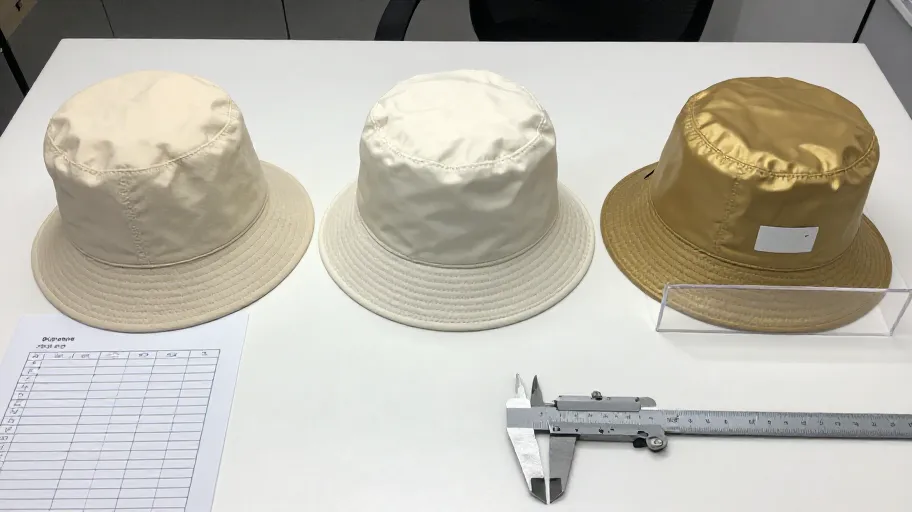
Photos flatten everything that matters in a bucket hat. Stitch density, brim stiffness, crown shape retention and seam alignment simply do not survive compression into a two-dimensional image — and every factory's photography makes its own sample look acceptable. The reliable method is physical, structured and documented: inspect every sample against the same named checklist, score it side by side with competitors' samples, and lock the approved unit in as a written golden sample. This article gives you that inspection sequence in full.
Why photos fail as sample evidence
A photograph is a marketing asset, not an inspection record. It cannot tell you:
- Whether the brim holds its shape under its own weight or after handling.
- Whether topstitch rows are parallel and evenly spaced, or visually corrected in post-production.
- Whether the crown panels meet cleanly at the apex or hide puckering in shadow.
- How the fabric actually behaves when folded, stretched or exposed to moisture in transit.
- Whether the inner lining, sweatband and seam finishing match the outer quality — the area where cost cutting hides.
Photos are still useful, but only as a screening step and as a record of what you asked for. They should never function as the approval itself.
The SHAPE-CHECK framework: a physical inspection sequence
Run this same sequence, in the same order, on every sample from every bucket hat factory you are comparing. Consistency of method — not gut feel — is what makes the comparison valid.
| Letter | Check | What to do | What you are testing |
|---|---|---|---|
| S | Stitch | Examine topstitch rows under daylight; run a fingertip along seams | Spacing consistency, thread tension, skipped or broken stitches |
| H | Hardware | Inspect eyelets, toggles, buttons, drawcords on every sample | Attachment security, finish quality, plating or coating integrity |
| A | Alignment | Fold the hat in half through the centre seam; check symmetry | Panel alignment and pattern matching at seams |
| P | Panel | Inspect each crown panel joint, inside and out | Seam bulk, puckering, reinforcement |
| E | Edge | Flex the brim; check binding or taped edges along the circumference | Edge finishing, brim structure, delamination risk |
| C | Crown | Press the crown gently and release | Shape retention and interfacing quality |
| H | Hatband | Examine sweatband attachment and internal seam finishing | Interior consistency — where cost differences hide |
| L | Loop and label | Check hanging loop, care label and brand label attachment | Small-component quality and branding execution |
| E | Embroidery / print | Inspect logo application at close range and after light abrasion | Registration, density, backing, durability |
| C | Keep (packing) | Note how each sample arrived and its condition | Packing standards — a preview of bulk shipping behaviour |
Score each item on a simple three-point scale — pass, conditional, fail — and photograph every finding next to a ruler or reference object, in the same lighting, with the factory name visible in frame. These photographs are your evidence base; they are also what you send back to the factory when requesting corrections.
Decision table: comparing samples from multiple factories
| Criterion | Weight (your choice) | Factory A | Factory B | Factory C |
|---|---|---|---|---|
| Structural checks (S, P, E, C) | High | |||
| Cosmetic checks (A, L, E) | Medium | |||
| Interior quality (H, hatband) | High | |||
| Brand execution (E, L) | Medium | |||
| Sample matched requested spec | High | |||
| Communication quality during sampling | Medium | |||
| Policy clarity (sample terms confirmed in writing) | High |
Weight the structural rows above the cosmetic ones. A slightly uneven label stitch is correctable in production; a brim that will not hold shape is a design or materialing problem that repeats across the entire bulk order.
Structural vs. cosmetic: what predicts bulk outcomes
Cosmetic findings — a stray thread, an imperfectly trimmed label — tell you about finishing discipline, and they are worth raising, but they are correctable through inline feedback. Structural findings are different. Puckered crown panels, weak brim construction, misaligned eyelets and loose hatband attachment are symptoms of machine settings, patterns or materials that will replicate across every unit in a bulk run. When a sample shows a structural defect, treat it as a question about process, not a request to fix one hat.
Golden samples and written approvals
Before any bulk commitment, document the approved sample:
- Both parties sign or otherwise confirm in writing that a specific physical sample is the reference standard.
- Retain one golden sample yourself and confirm the factory retains its counterpart.
- Record the specification — fabric, construction method, logo application, colour reference — in the same document.
- Agree in writing how any deviation found in bulk will be measured and against which sample.
This turns a future disagreement into a comparison against an object, rather than an argument about memory.
Approval questions to send any bucket hat factory
Send these before you place a deposit. The questions matter more than any individual answer — how clearly and quickly a factory answers is itself evaluation data:
- What is your current sample policy, including any fees and how they are handled? (Confirm directly; do not assume.)
- What is your current MOQ for this construction and decoration method?
- What is your current production lead time for this specification, and what factors could change it?
- Can you confirm bulk consistency against the signed golden sample, and how is that verified?
- Which certifications or test reports relevant to my destination market can you currently evidence for this product — and can I see the documents rather than a claim?
- What is your current process for handling defects found after delivery, and where is it documented?
- Can you produce a pre-production sample from bulk materials before the full run begins?
Any answer that arrives as a vague promise rather than a document should be treated as a gap to close, not a reason to walk away — but it must be closed in writing before approval.
FAQ
How many samples should I request before comparing bucket hat factories? Request at least one sample per factory built to the same written specification. Identical specs are what make the comparison valid; samples made to different briefs cannot be scored against each other.
Can video calls replace physical sampling? Video can verify that a physical sample exists and let you watch it being handled — brim flex, crown press, seam close-ups. It cannot replace having the sample in hand, but it is a useful intermediate step before committing to a fuller sampling round. Ask the factory to perform the SHAPE-CHECK items live on camera.
What if two factories' samples both pass? Move the comparison to the non-sample criteria: written policy clarity, responsiveness, spec-matching precision and how each factory handles your correction requests during sampling. Sampling behaviour is a preview of production communication.
Should I keep samples from factories I reject? Yes. Retain them labelled and photographed. They anchor your quality baseline, and if a winning factory's bulk later slips, you have documented evidence of what comparable quality looked like at the sampling stage.
获取 Bucket Hat Enquiry Brief — a structured enquiry document that embeds the SHAPE-CHECK criteria, the approval questions and the golden-sample language, so your next factory conversation starts from evidence rather than photos. Request it through the enquiry form.
Low-friction option: Start today with the ten-point SHAPE-CHECK inspection checklist above — copy it, print it, and score your next incoming sample before you reply to the factory.
#cap manufacturers china, #headwear manufacturers china, #cap factory








