


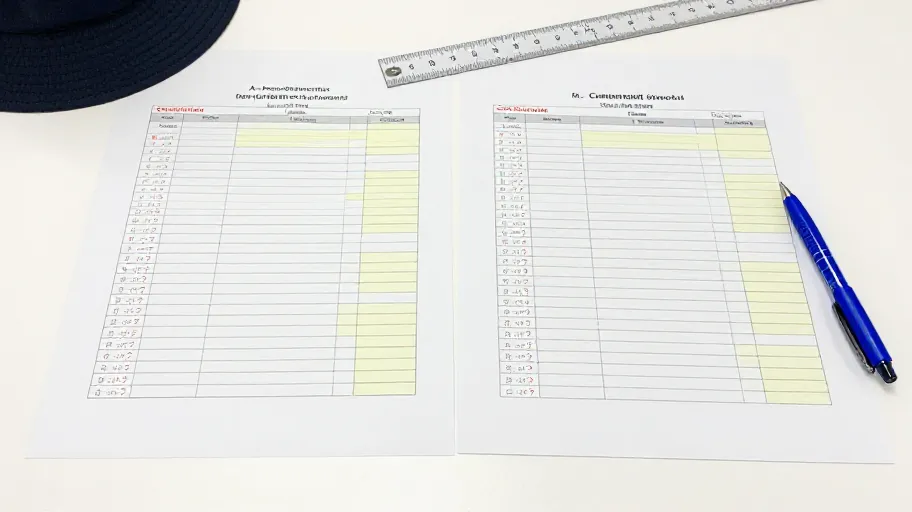
When you compare two bucket hat factory quotes, put every line into four columns — Specification, Scope, Cost Structure and Commercial Terms — and treat anything either supplier leaves blank as a question, not an assumption. This turns two unequal documents into one comparable record and shows you exactly what you are actually buying.
Why bucket hat quotes are hard to compare
If you have sourced custom headwear before, you already know the problem: two suppliers respond to the same enquiry and send back documents that look nothing alike. One sends a formal quotation sheet; the other replies in an email thread with a unit price and a note. Neither is wrong, but neither can be compared against the other without work.
For a bucket hat programme the gap is wider than for a simple cap. Bucket hats involve a brim construction, crown panels, optional eyelets, linings, sweatband choices, stitching density on the brim, decoration methods on the crown, and labeling requirements. Every one of those choices can change the unit price, and every one of them can be missing from a quote.
Buyers who compare on headline unit price alone discover the differences later — at sampling, at pre-production, or worse, at goods-in. The fix is not to demand a standard format from every supplier; suppliers will not all adopt yours. The fix is to build your own comparison record and normalise each quote into it yourself.
The Four-Column Quote Comparison
Before you read either quote, set up a table with four columns:
- Specification — what the product is made of and how it is constructed, as each supplier has interpreted it.
- Scope — what each supplier says the price does and does not include.
- Cost Structure — every chargeable line, not just the unit price.
- Commercial Terms — order, payment, documentation and delivery conditions, described as offered.
The discipline matters more than the labels. Anything a supplier has not stated goes into the column anyway, marked "not stated." An empty cell is not a saving; it is an open question you have not asked yet.
Comparing two quotes line by line: a decision table
Use this table as your working sheet. For each row, write what Supplier A offered, what Supplier B offered, and whether the two are directly comparable.
| Comparison line | What to capture | If the two quotes differ | What you must confirm in writing |
|---|---|---|---|
| Fabric and weight | Material named by the supplier and how it is described | Ask which spec each price is based on; do not merge the two | Exact fabric description, construction and weight as each supplier prices it |
| Brim construction | Stitching pattern, interlining or reinforcement reference | Treat as different products until specs match | Whether the quoted price covers the brim construction you require |
| Lining and sweatband | Whether included, and material if stated | Treat as separate cost lines | What material is included at the quoted price and what the alternative costs |
| Decoration method | Embroidery, print or appliqué as quoted | Confirm both are quoting the same artwork at the same size/placement | Which artwork version, size and placement the price covers |
| Labelling | Main label, care label, hangtag handling | Treat as separate line items | Whether labels are included, supplied by you, or priced separately |
| Unit price | Price and what quantity it is tied to | Do not compare prices quoted at different quantity tiers | The exact quantity each price assumes |
| Quantity break structure | Tiers offered and their step sizes | Normalise to your target order size before judging price | Prices at your actual intended quantities from both suppliers |
| Tooling or setup charges | Any setup, digitising, screen or mould charge | List separately, never amortise silently into unit price | Whether a setup charge applies to a repeat order, and on what basis |
| Sample arrangement | What the supplier offers; do not assume any fee or shipping arrangement | Ask each supplier to state its current sample policy in writing | Current sample policy, including who arranges shipping, confirmed directly |
| Packing | Polybag, carton spec, shipping mark handling | Compare on the same packing assumption | Packing method included and any change cost if you alter it |
| Payment terms | As offered | Evaluate cash-flow impact alongside price, not after it | Exact terms, in writing, before order confirmation |
| Documentation | What commercial and shipping documents each supplier commits to produce | Note gaps now, not at customs | The document list each supplier will provide for this order |
Two rules govern the table. First, never average: if Supplier A quotes at 1,000 pieces and Supplier B at 3,000, you cannot compare either number until both requote at your target quantity. Second, never let a supplier's silence become your assumption. "Not stated" must become a written answer before you approve anything.
Questions to ask each supplier before approving anything
A bucket hat quote is only as reliable as the questions behind it. Before you approve a sample or an order, send each supplier this list and ask for written answers:
- Which exact fabric and construction specification does this unit price assume, and what happens to the price if I change it?
- Does this price include lining, sweatband and labels, or are any of those excluded?
- What decoration method and artwork version does the price cover, and what charge applies if I revise the artwork?
- At what quantity tier is this price valid, and what are the prices at my target quantities?
- Are there any setup, digitising, printing or tooling charges on this order — and on a repeat order of the same design?
- What is your current sample policy for this project, including who arranges shipping? (Ask this of each supplier and record the answer separately; do not assume both are the same.)
- What documents will you provide with this shipment?
- What are your payment terms for a first order from us?
- How will we set the approval standard for the pre-production sample, and who signs off on it?
- What inspection or quality-control steps will take place before shipment, and what evidence of them will I receive?
Notice what these questions have in common: each one converts an ambiguous quote line into a documented commitment. A supplier's willingness to answer in writing is itself a data point for your comparison.
A reusable documentation checklist
Before you finalise a supplier, make sure every line below has a written answer in your comparison record:
- Final fabric, lining and sweatband specification agreed in writing
- Brim construction and stitching detail confirmed against a reference sample
- Artwork version, decoration method, size and placement documented
- Label and packing specification written into the order
- Unit prices quoted at your actual target quantities
- All setup or tooling charges identified and quantified
- Sample policy confirmed directly with each supplier in writing
- Payment terms agreed in writing before order confirmation
- Document list for the shipment agreed
- Pre-production sample approval standard and sign-off process defined
- Quantity, delivery condition and any agreed milestones recorded in the order document
If any box stays empty, you do not yet have a comparable quote — you have a proposal.
FAQ
Can I just compare the unit prices? Only if everything behind each price is identical, which you cannot verify until both suppliers have confirmed specification, quantity tier, inclusions and charges in writing. A lower unit price on a thinner spec is not a lower price — it is a different product.
What if one supplier's quote is much more detailed than the other's? Detail is information, not a verdict. Put both quotes through the same four-column table and ask the less detailed supplier the same questions you can already answer from the other document. How each supplier responds to specific questions tells you more than the original formatting.
Should I tell each supplier what the other quoted? It is cleaner to compare on your own record than to broker between quotes. If a supplier asks about competing offers, you can say you are evaluating several quotes on specification, scope and terms together — which is true, and keeps the conversation on your comparison framework.
Do sample policies differ between suppliers? They can, and you should not assume any arrangement applies to both. Ask each supplier to state its current sample policy for your project in writing, including how samples are arranged and shipped, and record the two answers separately in your comparison.
What should I do before approving production? Set the pre-production sample as your written approval standard: confirm which sample version is the benchmark, what will be checked against it, and who signs off. Then confirm that approval process in the order document itself, so it survives any change of contact at the factory.
Get the Bucket Hat Enquiry Brief. Our enquiry brief formats your bucket hat requirements — specification, quantities, decoration, labelling and documentation — into a single document you can send to any supplier, so every quote you receive comes back structured and comparable. Request it from New Generation and put your next round of quotes on the same footing.
Prefer to start smaller? Copy the documentation checklist above into your sourcing file and use it on your current quotes today — no enquiry needed.
#cap manufacturers china, #headwear manufacturers china, #cap factory








