


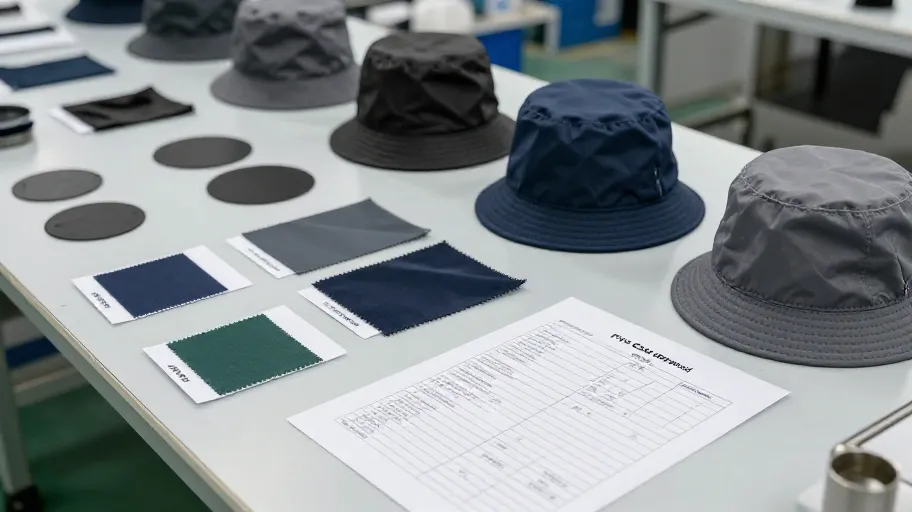
Before you approve bulk production at any bucket hat factory, you should have written answers on specification, sample status, approved materials, process controls and release criteria — a sequence we call the Five Gate Approval. Treat any unanswered gate as an open risk, and resolve it in writing before the production go-ahead.
Why bucket hats are harder to approve than they look
A bucket hat looks simple: a crown, a brim, some stitching. That simplicity is exactly why approvals go wrong. Buyers compare a single counter sample against a photo, sign off, and only discover at goods-receipt that the brim on production units sits differently, the twill weight changed, or the eyelets were replaced with a cheaper substitute. Because bulk runs are made on different cutting tables, different operators and sometimes different fabric lots than the sample, the only protection is documentation. The question set below turns that protection into a repeatable routine you can send to any bucket hat factory before you approve bulk.
The Five Gate Approval framework
The framework has five gates. You pass through them in order, and nothing moves forward until the previous gate is documented.
| Gate | What it covers | What must be in writing before you pass it |
|---|---|---|
| 1. Specification | Measurements, brim width, crown depth, panel count, stitching density, hardware | A measurement sheet with the tolerances you and the supplier have agreed, referenced to the approved sample |
| 2. Sample | Counter sample, fit sample, pre-production sample | Which sample version is the golden sample, who approved it, and the date of approval |
| 3. Materials | Fabric weight and composition, lining, brim insert, labels, trims | Approved material references or physical swatches, plus a written rule for how substitutions are handled |
| 4. Process | Cutting, sewing sequence, embroidery or print placement, washing or finishing | A brief process outline and the inspection points the factory will apply during the run |
| 5. Production Release | Final go-ahead, inspection standard, shipping readiness | A release checklist naming who inspects, against what document, and what happens if findings exceed the agreed limits |
The value of the framework is not its elegance; it is that every commercial and technical condition becomes an explicit, confirmable question rather than an assumption.
Gate-by-gate: questions to resolve before you approve bulk
Gate 1 — Specification
- Can the factory supply a measurement sheet for the bucket hat, and have you agreed the allowable tolerance for brim width, crown depth and head circumference in writing?
- How is the brim constructed and finished — and who supplies the brim insert, and to what specification?
- What stitch density and seam construction apply to the crown panels and brim join?
Gate 2 — Sample
- Which sample version is the golden sample, and is it labelled and dated as such by both parties?
- Has a pre-production sample been made from the actual bulk fabric lot, or only from material sourced for sampling?
- Who keeps a sealed reference set, and where is it stored?
Gate 3 — Materials
- Is the fabric you approved available in the bulk quantity, or will a substitute lot be used — and if so, what is your approval process for that substitute?
- Are labels, care instructions, hangtags and any packaging components approved as physical proofs?
- If the factory proposes any material change mid-run, does it require your written consent first? Make that a stated condition, not a courtesy.
Gate 4 — Process
- Which inspection points will the factory apply during production — at cutting, at inline sewing stages, and before packing?
- How will embroidery or print placement be checked against the approved artwork?
- If finishing such as washing or garment dyeing is involved, how is shrinkage and colour verified against the golden sample?
Gate 5 — Production Release
- What inspection standard and sampling plan will be used for the final inspection, and who performs it — the factory's QC team, a third party you appoint, or both?
- What are the agreed acceptance limits, and what happens if the inspection result falls outside them?
- Which documents must exist before goods are released: final inspection report, packing list, shipping mark confirmation, and your written release approval?
Pre-approval decision table: risk signals and what to require
| Signal during sampling or quoting | Why it matters | What to require before approving bulk |
|---|---|---|
| Only one sample version exists, and the buyer holds nothing | No reference to measure bulk against | A sealed golden sample set retained by both parties, dated and signed |
| Measurement sheet missing or approximate | Disputes become a matter of opinion | Agreed tolerances written into the spec sheet |
| Material descriptions given verbally | Substitutions happen silently | Physical approved swatches or written material references |
| No mention of inline inspection | Defects are found only at the end | Named inspection points in the process outline |
| Release criteria undefined | You depend on the factory's judgement alone | A signed release checklist with agreed acceptance limits |
Frequently asked questions
How many sample rounds should I expect before bulk production? There is no fixed number that applies to every project. It depends on complexity, artwork changes and how quickly feedback loops close. The useful question is not "how many rounds" but "what conditions end sampling" — agree with the factory what a final pre-production sample must demonstrate before you release bulk.
Should I rely on the factory's inspection or appoint my own? Confirm what the factory offers, and compare it against the risk profile of your order. Many buyers combine the factory's internal QC with an independent inspection of their choosing. Whatever you decide, name the standard, the sampling plan and the acceptance limits in writing before release.
What should the golden sample be made from?
How do I handle material substitutions if a fabric becomes unavailable? Establish the rule before it happens: any substitution requires a written proposal, a physical or photographed proof where practical, and your written approval. Confirm the factory's current substitution policy directly — do not assume it matches another supplier's.
What documents should I keep on file after approval? At minimum: the measurement sheet with tolerances, the dated golden-sample record, approved material references, the process outline, and the signed release checklist. Together they form the evidence base if a dispute arises after shipment.
Get the Bucket Hat Enquiry Brief
Before you send your next enquiry, put the Five Gate questions to work. Our Bucket Hat Enquiry Brief is a fill-in document covering specification, sample, materials, process and release criteria — send it to any factory you are evaluating and compare the answers side by side.
[Get the Bucket Hat Enquiry Brief →]
Quick pre-approval checklist
If you only have a few minutes, run this list:
- Measurement sheet with agreed tolerances received and confirmed
- Golden sample labelled, dated and retained by both parties
- Bulk material lots identified; substitution rule agreed in writing
- Inline and final inspection points documented
- Release checklist signed, with acceptance limits stated
[Send me the checklist as a printable one-pager →]
Related reading: approvals for baseball caps and other custom headwear programmes follow the same gate logic — see our linked guides before publishing.
#cap manufacturers china, #headwear manufacturers china, #cap factory








