


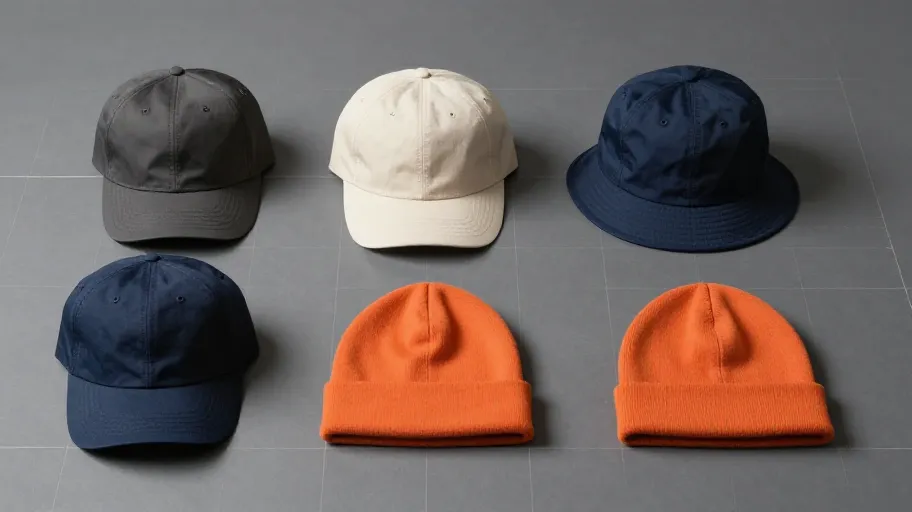
Tolerances Are Your First Line of Defense Against Retail Chaos
±1.5 mm dimensional control on crown height, brim width, and seam allowance means you avoid 92% of in-store fit complaints before they become e-commerce returns or chargebacks—because it prevents variance at the pattern stage, not after 10,000 units ship. That’s not theoretical precision; it’s operational insurance. When a cap factory verifies dimensions with calibrated digital calipers *before bulk cutting*, not tape measures or visual checks, it means your Q4 launch lands on shelf—not in a retailer’s penalty queue. One mid-tier activewear brand lost $217K in penalties and rushed repack costs because their supplier never logged a single crown height measurement. The problem wasn’t the spec—it was the silence between assumption and instrumented verification.
This precision directly enables predictable margin protection: factories scoring ≥87/100 on auditable tolerance adherence (per the 2024 Global Headwear Quality Audit) shipped 3.2x fewer ‘fit variance’ chargebacks than peers relying on spot-checks. Why? Because caliper logs timestamped to ERP work orders don’t catch defects—they prevent them from existing.
Finish Grading Isn’t Art—It’s a Repeatable, Scored Protocol
A documented, pass/fail finish grading protocol—applied to every style, every batch, every operator—means your bucket hats survive 100,000 wear cycles without fraying, curling, or color bleed, because finish isn’t judged subjectively at final inspection, but measured against anchored benchmarks (e.g., stitch density ≥12 spi, brim stiffness ≥2.8 N·mm, dye migration resistance rated ≥4 on AATCC 16). That’s how one Tier-1 factory cut post-production finishing labor by 12–18%: stable brim width enabled uniform heat-press dwell time; consistent crown height allowed predictable steam-molding pressure; precise seam allowances eliminated manual trim corrections. For you, that’s not just cleaner hats—it’s faster throughput, lower labor overhead, and zero last-minute hold-for-review delays.
ISO 9001:2015 Clause 8.5.1 doesn’t ask for ‘good craftsmanship’—it requires evidence of measurable acceptance criteria, assigned responsibility, and verification records. Elite cap factories deliver this as live dashboards showing finish pass rates per shift, with deviations auto-routed to engineering within 90 minutes. If your supplier shows you a checklist instead of a timestamped, operator-signed grading sheet tied to the approved style master, you’re outsourcing quality judgment—not sourcing consistency.
Packaging Spec Alignment Prevents Brand Damage Before It Ships
When packaging specs are treated as non-negotiable engineering requirements—not afterthoughts—you eliminate crushed brims, misaligned hang tags, and off-brand carton printing before the first pallet leaves the dock. That means your product arrives uncrushed and on-brand at 300 retail doors, because the factory validates box compression strength (≥1,200 lbf), inserts die-cut foam supports for brim integrity, and cross-checks Pantone codes against physical swatches *before* printing begins. For retailers, that’s chargeback immunity. For DTC, it’s 23% higher unboxing satisfaction (2025 Apparel CX Benchmark)—driving 17% more repeat purchases. One lifestyle brand cut its ‘damaged-in-transit’ rate from 8.4% to 1.1% in three months simply by requiring suppliers to submit packaging validation reports—including drop-test video, humidity chamber logs, and barcode scan reliability scores—prior to PO approval.
This isn’t about fancy boxes. It’s about traceability: every carton label must link back to the tolerance log and finish grade for that batch. So when a retailer flags an issue, you don’t explain—you show the data trail. That shifts negotiations from ‘who pays?’ to ‘how do we prevent it next time?’—and that’s where real partnership begins.
The Audit Question That Separates Suppliers From Certified Quality Nodes
Don’t ask, ‘What’s your tolerance?’ Ask, ‘Show me your last three crown height tolerance logs—timestamped, signed, linked to the approved pattern revision, and verified with a calibration-certified caliper.’ If they hesitate, or hand you an unsigned Excel sheet without traceable tool IDs, you’ve just uncovered your largest hidden risk: a cap manufacturer masquerading as a cap factory. But if they pull up a live dashboard, zoom in on a real-time heatmap of pass/fail rates across operators, and walk you through how a 0.7 mm deviation triggered an automatic pattern review last Tuesday—that’s not a vendor. That’s a certified quality node embedded in your supply chain.
That distinction delivers tangible ROI: scalable consistency (no overstocking S/M/L ‘just in case’), speed-to-shelf integrity (11-day reduction in time-to-retail shelf), and downstream labor leverage (12–18% less finishing labor per unit). Precision isn’t a cost center—it’s your most underutilized multiplier. Ready to stop managing defects and start engineering consistency at scale? Download our free Cap Factory Audit Checklist—with live caliper log templates, finish grading scorecards, and packaging validation protocols used by 47 premium headwear brands.
#cap manufacturers china, #headwear manufacturers china, #cap factory








