

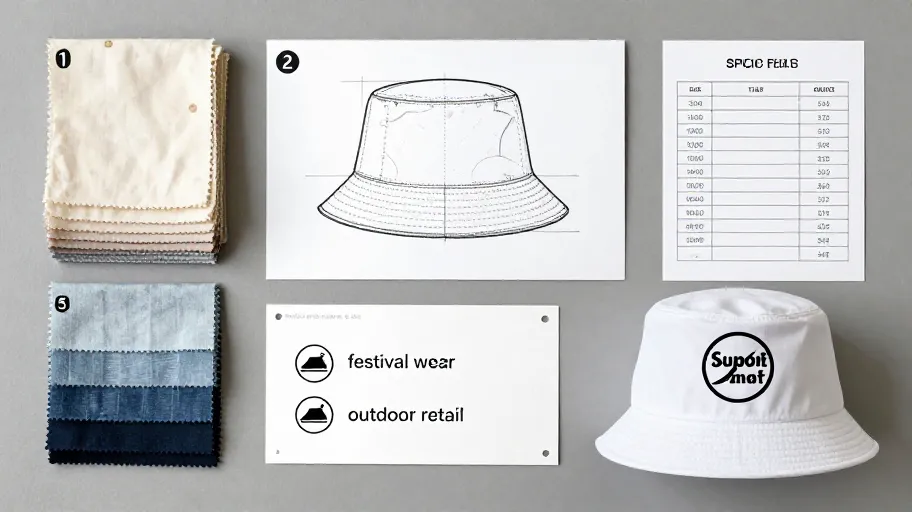
A bucket hat factory can only quote accurately when it has five things from you: quantity, end usage, material and construction options, your target price or budget position, and approved artwork or branding references. Send these together and you get firm, comparable numbers instead of loose ranges that stall your budget approval.
The QUOTA Framework: five inputs every factory needs
Vague enquiries produce vague quotes. When a factory has to guess fabric, quantity brackets or branding method, it protects itself with a wide price range — and a wide range is useless for internal budgeting or supplier comparison. Before you contact any bucket hat factory, assemble what we call the QUOTA Framework:
- Q — Quantity: total units, plus whether you may reorder.
- U — Usage: retail, uniform, event or promotional giveaway — this shapes spec recommendations.
- O — Options: fabric, crown construction, brim width, lining, closure, packing.
- T — Target: your landed-cost target or budget ceiling, shared as a position rather than a demand.
- A — Artwork/Approval: logo files, placement, colours and the approval steps you require.
Decision table: what happens when each input is missing
| Missing input | What the factory must do | Effect on your quote | Your move |
|---|---|---|---|
| Quantity (Q) | Bracket pricing across assumed volumes | Multiple prices; hard to compare suppliers | State exact units and whether reorders are planned |
| Usage (U) | Guess a spec level | Over- or under-specified recommendation | Describe end use and end user |
| Options (O) | Assume a generic construction | Quote may not match what you actually need | List fabric, brim, lining, closure and packing preferences |
| Target (T) | Quote conservatively | Higher quoted price than your budget allows | Share a target range as a discussion point |
| Artwork (A) | Exclude branding costs | Late cost additions and re-sampling | Attach logo files, sizes, placement and colour references |
Each missing input doesn't just slow things down — it removes a variable you control, and hands pricing power to the supplier's assumptions.
Q — Quantity: the number that shapes everything
The same custom bucket hat priced at two different volumes can carry materially different unit economics — tooling, cutting efficiency and fabric utilisation all shift with run size. That is a question for each supplier to answer in writing, not an assumption for you to make.
Approval questions to ask:
- What quantity tiers do you quote at, and what is your minimum order quantity for this specification? Confirm the current figure directly.
- Does the quoted price change at higher tiers, and at which break points?
- Is a reorder treated as a repeat order, and does pricing hold for repeat runs? Ask them to document the answer.
- How is the order split if you want multiple colourways within one run?
U — Usage: context that changes the specification
A bucket hat for a beach-retail brand, a construction uniform and a one-day event giveaway are three different products, even if they look alike in photos. Usage tells the factory which spec to recommend — and whether to prioritise durability, washability, hand feel or unit cost.
Approval questions to ask:
- Based on this end use, what fabric and construction do you recommend, and why?
- Which construction details affect price most for this application — brim width, panel count, lining, or stitching method?
- If this is for resale, what labelling, hangtag and packaging requirements should be built into the quote?
- If this is a promotional item, which spec elements can be simplified without losing the look? Ask for a documented comparison.
O — Options: lock the variables before you compare suppliers
Comparing quotes only works when every factory prices the same specification. Fix these variables in your enquiry document: fabric type and weight, crown construction and panel count, brim style and stiffness, lining, sweatband, closure or adjuster, embroidery versus print for branding, and packing method.
Approval questions to ask:
- Which fabrics can you source for this construction, and can you provide fabric swatches for approval?
- What branding methods do you offer — embroidery, woven labels, patches, screen print, transfer — and which suits my artwork? Confirm available options directly.
- How is colour matching handled against my Pantone or physical reference, and what approval step confirms the match?
- What packing options exist — polybag, hangtag, boxed — and how does each affect the quote? Ask for the current policy in writing.
T — Target: share a position, get a real counter-proposal
Buyers hesitate to share targets, fearing the supplier will simply quote the ceiling. The alternative is worse: the factory quotes high because it has no signal of where you need to land. Frame your target as a position for discussion — a landed-cost goal or a budget band — and ask the supplier to propose how to reach it. A capable OEM/ODM partner responds with spec trade-offs; a weaker one responds with silence or a fixed number. Either answer tells you something.
Approval questions to ask:
- Given my target, what spec adjustments move the price toward it?
- Which price components are fixed versus negotiable — and are any costs quoted separately (tooling, sampling, packing)?
- What are your quoted trade terms, and which costs sit outside the unit price? Confirm current Incoterms directly.
A — Artwork and approval: where projects drift
Branding is where most miscommunication happens. A logo that looks fine on a flat file can behave differently embroidered on curved panels. Define artwork as data, not vibes: file format, physical size in units, placement (front panel, side, under-brim), thread or print colours referenced to a standard, and the approval gates you require.
Approval questions to ask:
- What is your sampling process, and what does a pre-production sample require from me before bulk starts? Confirm the current policy and any fees directly.
- Can you supply a digital mock-up, then a physical sample, before production — and what does each step require to proceed?
- What inspection or quality-control documentation will I receive before shipment? Ask them to describe and confirm it in writing.
- If a bulk sample deviates from the approved reference, what is your correction process? Request the current policy.
Checklist before you send the enquiry
- Exact quantity stated, plus reorder intent
- End usage and end user described
- Fabric, construction, brim, lining, closure and packing specified or flagged as "recommend"
- Target price or budget band included as a discussion position
- Logo files, sizes, placement and colour references attached
- Sampling and pre-production approval steps listed as requirements
- Trade terms, MOQ and lead time explicitly marked as "please confirm current policy in writing"
- Same specification document sent to every supplier you are comparing
Frequently asked questions
Why did my last bucket hat quote come back as a range?
Should I tell the factory my target price? Sharing a target as a position, not a ceiling, invites the supplier to propose spec trade-offs. Withholding it entirely forces the factory to quote defensively. Decide based on how much negotiation you want, but document whatever you share.
How many factories should I quote against? Enough to compare meaningfully — and only with the identical specification document, otherwise the comparison is invalid. Three to five quotations built on the same brief is a workable starting point for most category sourcing cycles; verify what suits your own process.
What if I don't know which fabric I need? Say so explicitly: "recommend options for this usage." A factory that responds with reasoned options and swatch availability is demonstrating ODM capability. A factory that quotes a single assumption without asking questions is telling you something too.
How do I confirm a factory's production and shipping timelines? Ask each supplier to state current production time and transit assumptions in writing as part of the quote, and make written confirmation a condition of order placement. Timing depends on your specification, quantity and season, so treat any figure as project-specific until the supplier confirms it.
Get the enquiry right the first time
[获取 Bucket Hat Enquiry Brief] — a structured document covering all five QUOTA inputs, the approval questions above, and the confirmation prompts you need before placing an order. Send it to every supplier so your quotes come back firm, complete and genuinely comparable.
Prefer to start smaller? [Download the pre-enquiry checklist above] and run it against your next sourcing brief before you press send — it takes minutes and saves rounds of clarification.
#cap manufacturers china, #headwear manufacturers china, #cap factory