


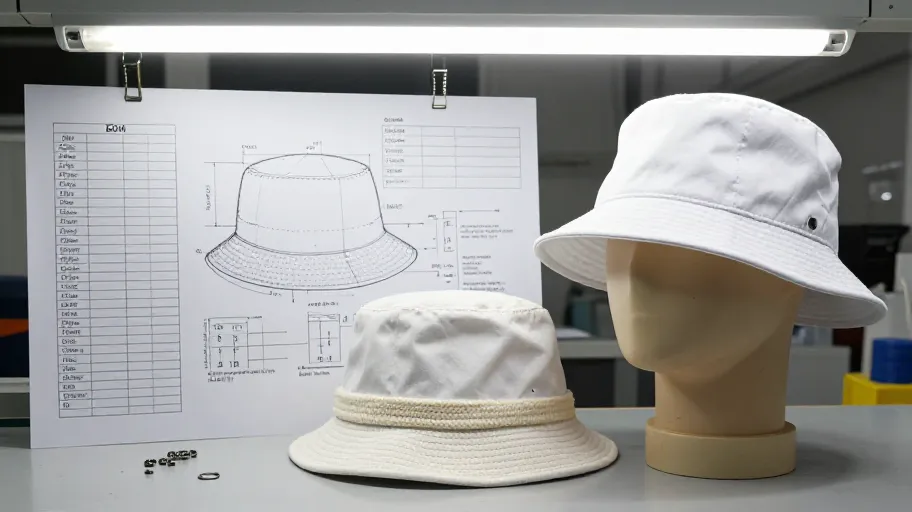
When you approach a bucket hat factory, the fastest way to a comparable quote and a clean sample is to separate your specification into three documents: a drawing (geometry and construction), a BOM (every material, trim and consumable, with placement), and approval notes (what you will sign off, at which stage, against which criteria). This Draw–BOM–Approve (DBA) Specification Stack lets the factory quote against your intent rather than its assumptions — and lets you audit every later deviation against something you wrote down.
Why three documents beat one long email
Most sourcing friction at a bucket hat factory does not come from the factory's capability. It comes from ambiguity: the buyer's idea of "medium brim, soft crown, washed cotton" contains dozens of unstated decisions, and each one the supplier makes on your behalf is a risk you will discover at sample stage or inspection.
Splitting the specification does three things:
- The drawing fixes geometry and construction — anything a pattern or sample maker must physically build.
- The BOM fixes materials and sourcing — anything procurement must buy or stock, including trims buyers forget to name.
- The approval notes fix process — which stages require your written sign-off, and against what criteria.
If a detail appears in two documents, note which one governs. Disputes at inspection are rarely about the spec itself; they are about which version of the spec counted.
What belongs in the drawing
The drawing is the geometry and construction document. It should capture, without imposing numeric tolerances you have not agreed with the factory:
- Crown shape and panel count, and how panels meet at the seam
- Brim shape, brim width (as a stated target, not a tolerance) and whether the brim is soft, structured or wired
- Whether the crown is lined, half-lined or unlined, and where the lining attaches
- Seam types and topstitching location, including whether topstitching shows on the face
- Eyelet positions and quantity, if used
- Sweatband construction and how it terminates at the seam
- Closure or adjuster geometry, if any, and its attachment method
- Label, flag and embroidery placement marked relative to seams, not just "centred"
- Decoration zones: which areas are printable or embroiderable, and how artwork scales to panel geometry
Two rules keep drawings honest. First, state dimensions as targets and ask the factory to propose achievable tolerances in writing — never assume a tolerance the factory has not confirmed. Second, mark the artwork placement yourself; artwork positioned by the factory is one of the most frequent sources of re-sampling.
What belongs in the BOM
The BOM is the material and trim inventory. Its job is to remove sourcing ambiguity so quotes are comparable across suppliers. Include:
- Main fabric: fibre content, weight class, weave or knit, finish (washed, brushed, coated), colour reference system
- Lining fabric, if used, with the same attributes
- Interfacing or structure materials, including where applied
- Thread: colour matching rules (to main fabric or to trim), and whether contrast stitching is decorative or specified
- Sweatband material and whether it matches or contrasts
- Trims: eyelets, buttons, adjusters, cords, toggles, zipper or pocket hardware if the style has one
- Labels and hangtags: main label, size label, care label, origin marking, flag label — who supplies artwork, who supplies the physical label, and who applies it
- Packaging: polybag, insert, carton marking, and who decides the packing ratio
For each line, record: item, specification, colour reference, placement, and owner — buyer-supplied, factory-sourced from named mill, or factory-sourced at discretion. Unowned lines are where cost surprises and substitution disputes live.
The table below helps you assign ownership explicitly rather than leaving it implicit in a quote.
Decision table: component ownership
| Component | Buyer supplies spec only | Buyer supplies materials | Factory sources, buyer approves sample | Left undefined — risk |
|---|---|---|---|---|
| Main fabric | ✔ Safe default | ✔ For brand-certified fabric | ✔ Ask for lab dip + fabric swatch approval | Substitution, colour drift |
| Thread | ✔ Colour rule stated | — | ✔ Match card approval | Mismatched tone at seams |
| Brim wire / structure | ✔ Type and effect described | — | ✔ Physical sample approval | Wrong stiffness in wear |
| Woven main label | ✔ Artwork + placement | ✔ If brand-controlled | ✔ Strike-off approval | Trademark error, wrong fold |
| Care / origin label | ✔ Required content list | — | ✔ Pre-production photo approval | Compliance content missing |
| Trims (eyelets, adjusters) | ✔ Finish and colour stated | — | ✔ Sample approval | Finish colour differs from artwork |
| Packaging | ✔ Format and carton marks | ✔ Printed inserts | ✔ Mock-up approval | Wrong carton marking at export |
What belongs in the approval notes
Approval notes define the process, not the product. They tell the bucket hat factory which decisions are locked, which need your signature, and what evidence you require at each gate. Put in writing:
- Which stages require your written approval before the factory proceeds (for example: artwork strike-off, lab dip, trims sample, pre-production sample, shipment sample) — the specific stage list must be agreed with your factory, not assumed
- What each approval is based on: physical sample, photo set from agreed angles, or measurement report — and who records it
- Which document version governs, and how revisions are numbered
- What happens to open questions: every open point gets an owner and a deadline, in writing
- How deviations are handled: a deviation from the approved sample requires your documented acceptance, not verbal agreement
- Which policies are project-specific and must be confirmed directly with the factory in writing: sample charges and terms, sample shipping, MOQ, unit pricing, lead time, tooling or digitising fees, and payment terms. Do not carry assumptions from previous projects; ask for the current policy each time
Approval questions to put in writing before quoting
Send these to your shortlisted factories with the drawing and BOM:
- Which of the BOM lines will you source yourself, and will you submit the material for our approval before bulk cutting?
- What tolerances can you hold on the stated dimensions, and will you confirm them in writing on the quote?
- Which sample stages do you propose, and which require our sign-off before production continues?
- If the pre-production sample differs from the drawing, what is your documented revision process?
- What is your current policy on sample charges, sample shipping, MOQ, lead time and payment terms for this specific project?
- Who owns label application and placement verification, and how is it evidenced at final inspection?
- What documentation will accompany the shipment so we can verify the goods against the approved sample?
A factory that answers these questions precisely, in writing, is telling you something about how the relationship will run after the first order.
FAQ
Do I need a full tech pack to approach a bucket hat factory? No — but you need the three layers of the DBA stack: geometry, materials and approval process. A brief that is thin but internally consistent gets better quotes than a thick file with contradictions.
Can the factory create the drawing for us? Many OEM/ODM factories will develop the drawing from a reference sample or sketch. If so, mark it "factory-proposed, buyer-approved" and review it as carefully as your own work — the approved drawing becomes the reference for every later dispute.
Should I state tolerances in the drawing? State target dimensions; ask the factory to propose achievable tolerances in writing. Never import a tolerance figure from a previous project or another supplier without confirmation.
How detailed should colour specification be? Use a reference system both parties can physically check — a named standard or an approved physical swatch — and make lab dip approval an explicit gate in your approval notes.
What if the factory's quote references different materials than my BOM? Treat it as a flag, not a failure. Ask them to re-quote line by line against your BOM, or annotate their substitutions so you can compare quotes on identical content.
Get the Bucket Hat Enquiry Brief
Turn this framework into your next enquiry. 获取 Bucket Hat Enquiry Brief — a ready-to-fill document that structures your drawing checklist, BOM ownership table and approval questions before you contact any bucket hat factory.
Before you send: five-minute self-check
- Drawing marks artwork and label placement relative to seams
- Every BOM line has an owner: buyer, factory-named, or factory-approved
- Tolerances requested from the factory in writing, not assumed
- Approval stages listed, each with an evidence type
- Sample, MOQ, lead time and payment questions written down for the factory to answer directly
If all five are ticked, your enquiry is ready to compare on substance rather than on price alone.
#cap manufacturers china, #headwear manufacturers china, #cap factory








