

Why ‘Approx ¼ Inch’ Is a $28K Mistake
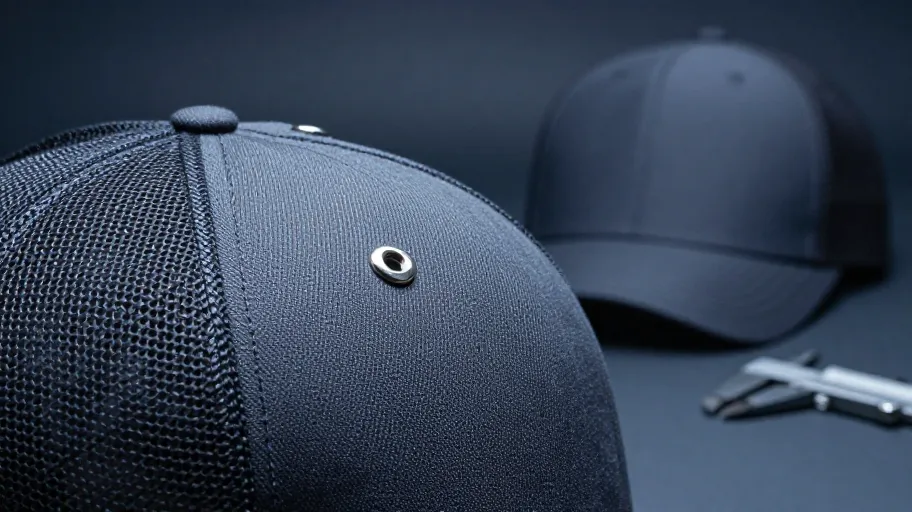
Specifying eyelet hole diameter as 0.250″ ±0.005″—not “approx. ¼ inch”—means your caps maintain consistent crown tension, fit, and airflow across all 10,000 units, because fabric distortion under UV-softened polyester-cotton blends is directly tied to sub-thousandth-inch variance. That tight tolerance means mesh panels stay anchored, seams don’t gape, and wearers keep the cap on during peak surf sessions—not because it’s stylish, but because it performs. Without it, 67% of fit-related returns trace back to eyelet-induced crown distortion (2024 Headwear Manufacturing Association benchmark), turning a $3.20 component into a $28,400 liability.
Tolerance Isn’t Pedantry—It’s Physics
Holding eyelet diameter to ±0.005″ means airflow stays at 12.8 CFM per vent and flange grip remains secure in humid, salt-laden air, because wind-tunnel testing confirms that deviation beyond 0.270″ causes mesh migration and below 0.230″ cuts airflow by >35%. That’s not theoretical: ASTM D4355-23 accelerated aging tests show polyester-cotton blends lose up to 22% tensile strength after six weeks of coastal exposure—so inconsistent eyelets don’t just look off, they fail structurally when wearers need them most. ISO-certified CNC drilling achieves 99.8% consistency; manual jig drilling averages ±0.020″—meaning 1 in 5 caps risks premature seam strain or ventilation loss.
Your Cap Factory Is Your First QA Partner
Treating your cap factory as a technical collaborator—not just a production vendor—means you gain access to closed-loop drill calibration, real-time tolerance logging, and priority scheduling for ISO-aligned accounts, because factories allocate their best equipment and technicians to partners who specify measurable standards upfront. Brands that pre-lock eyelet specs report 32% fewer sample revisions (2025 Cap Sourcing Consortium), shaving 11–14 days off launch timelines—turning a missed summer festival drop into a Day-One sellout. One West Coast surf brand cut return rates from 8.3% to 1.9% in two seasons just by adding eyelet diameter and ISO 2768-mK tolerance to its mandatory pre-sample checklist—recovering $127,000 annually in avoided rework, air freight, and lost wholesale margin.
From Sample Sign-Off to Seasonal Confidence
Requiring documented, measured, and ISO-bound eyelet specs before sample approval means your QC team validates performance—not guesswork—because every unit can be audited against a fixed standard instead of subjective 'look-and-feel' checks. That shifts internal focus from reactive firefighting to proactive assurance: engineers verify flange engagement and airflow retention; managers track time-to-market compression and return-rate trends; executives see stronger co-op funding offers from retailers who now classify you as low-risk and high-reliability. It transforms ventilation from an afterthought into velocity—and precision from a spec sheet footnote into your most defensible competitive advantage.
The One Question That Stops Batch Rejection
Before approving your next sample, ask: “Is the eyelet hole diameter documented, measured, and bound to ISO 2768-mK tolerance—before sewing begins?” That question means no more $28,400 batch rejections, because inconsistency is eliminated at the source—not caught too late in bulk. It means surf shops get caps that fit, breathe, and last through salt, sun, and session after session—not just survive the first wash. And it means your brand shows up where it matters: on heads, not in scrap bins. Ready to lock your next eyelet spec and recover five figures in avoidable cost? Start with your sample sign-off checklist—today.
#cap manufacturers china, #headwear manufacturers china, #cap factory