


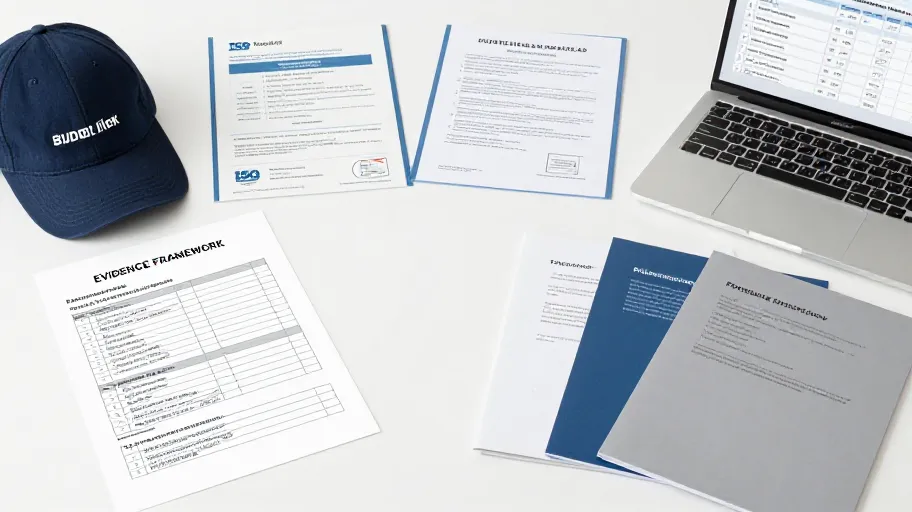
Comparing a cap manufacturer in China starts with documents, not claims. Use the EVIDENCE Framework — Evaluate credentials, Verify capacity, Inspect documentation, Demand samples, Examine communication, Note escalation, Confirm compliance, Evaluate exit terms — to audit every candidate on identical criteria. Ask each supplier the same written questions, score the answers, and keep the evidence on file. This article gives you the comparison structure, the decision table and the approval questions to do it.
Why documentation, not promises, should drive your supplier choice
When you source custom caps and headwear from China, the gap between a strong website and a reliable production partner is evidence. A supplier can describe capabilities in confident language; only documents, written answers and inspected samples let you verify those descriptions.
This matters more in headwear than in many categories. Custom caps involve structured panels, visor construction, closure systems, embroidery or heat-transfer decoration, colour matching and packaging — many points where an unapproved assumption becomes a costly error. A documentation-first process closes those gaps before a deposit is paid.
One boundary applies to this article: no specific MOQ, price, lead time, capacity figure, certification, sample policy or client reference is claimed here, because none was supplied. Treat every commercial specific as an open question for the supplier.
The EVIDENCE Framework, step by step
E — Evaluate credentials. Request the business licence and manufacturing registration details. Confirm the entity named in the licence matches the entity you would sign with and pay.
V — Verify capacity. Do not accept stated capacity as fact. Ask which lines would run your order, what evidence supports the claim, and whether production is in-house or partly outsourced. Outsourcing is not automatically disqualifying — but undisclosed outsourcing is a planning risk you should know about.
I — Inspect documentation. Quality control procedures, inspection reports from previous work, and written specifications should exist in some form. Ask what documentation accompanies each shipment — inspection records, packing lists, specification sheets — and who signs it.
E — Examine communication. Speed matters less than precision. A capable supplier answers technical questions with specifics — panel count, thread type, closure spec — rather than restating that "quality is good." Track whether answers arrive in writing.
N — Note escalation paths. Ask who owns your account, who handles quality disputes, and how a rejected shipment would be escalated. A supplier with a clear answer has handled the situation before.
C — Confirm compliance. If you need certificates — for materials, safety, or destination-market requirements — ask for the certificate number, scope and validity dates, then verify them against the issuing body. Never accept a certificate image alone as proof.
E — Evaluate exit terms. Read the terms for order cancellation, design changes, quality failure and rework before signing. Ask what remedy applies if goods fail inspection, and get it in the contract.
Decision table: scoring candidate manufacturers
Score each candidate 0–3 per row (0 = no answer, 1 = verbal only, 2 = partial documents, 3 = complete, verifiable documents). Compare totals; investigate any row scored 0 before proceeding.
| Criterion | Evidence to request | Score 0 | Score 3 |
|---|---|---|---|
| Business identity | Licence, registration, signatory match | Refused or mismatched | Full match, verified |
| Manufacturing role | Line details, in-house vs outsourced scope | Vague "we make everything" | Specific, evidenced answer |
| Quality documentation | QC procedures, inspection report samples | None offered | Provided unprompted |
| Pre-production samples | Sample policy in writing | Policy unstated | Clear written policy with approval step |
| Technical communication | Spec-level answers to your questions | Generic reassurance | Precise, referenced answers |
| Compliance evidence | Certificate numbers, scope, validity dates | Images only | Verifiable, current, in scope |
| Dispute and exit terms | Written quality and cancellation clauses | Verbal promises only | Contractual, specific clauses |
Use the same table for every candidate. The point is not a perfect score — it is comparability, and a documented record of what each supplier committed to.
Approval questions to put in writing before ordering
Send these to each candidate manufacturer and keep the replies as the baseline for your order:
- Which legal entity will sign our contract, and can you share the registration documents for that entity?
- What is your current MOQ, unit pricing basis, and lead time for a design like ours — and what drives variation in each?
- What is your sample policy: cost, timing, and how the approved sample is referenced in production?
- Which parts of production are in-house, and which are subcontracted? Who is accountable for subcontracted steps?
- What inspection documentation accompanies each shipment, and can we appoint a third-party inspector?
- Which certifications relevant to our destination market can you evidence with certificate numbers and validity dates?
- What written remedy applies if goods fail final inspection?
- How are colour, decoration placement and dimensional specifications approved and locked before bulk production?
If a supplier answers these clearly and in writing, you have something to enforce. If they deflect, you have learned something just as valuable.
Red flags worth acting on
- Credentials that cannot be verified against an issuing body or registry
- Refusal to identify subcontractors or to allow third-party inspection
- Commercial terms that exist only in chat messages, never in a document
- Pressure to skip the pre-production sample approval step
- Certificate images with no number, scope or date you can check
None of these proves bad faith on their own — but each one removes your ability to verify, and verifiability is the entire basis of a sound sourcing decision.
FAQ
How do I know whether a cap manufacturer in China is a factory or a trading company? Ask directly, then check the answer against business registration documents and your questions about production lines and subcontracting. Either model can serve you; the risk is not knowing which one you are contracting with.
What documents should a supplier provide before I place an order? At minimum: business licence matching the contracting entity, written commercial terms (MOQ, pricing basis, lead time — all to be confirmed with the supplier), a written sample policy, specification sheets for your design, and any compliance certificates relevant to your market, with verifiable numbers and dates.
Should I inspect the factory or hire a third party? If your order size justifies it, yes — either an in-person audit or an independent third-party inspection. Ask the supplier which inspection arrangements they accept; their answer is itself useful evidence.
How do I compare two suppliers with similar prices? Compare evidence, not prices alone: documentation completeness, sample quality, communication precision, compliance proof and written remedy terms. Use the decision table above so the comparison is structured rather than impressionistic.
Can I lock specifications before production starts? Yes — through an approved pre-production sample and a signed specification sheet. Confirm with your supplier exactly how the approved sample is referenced during bulk production and final inspection.
Your next step
Before your next enquiry, get the full question set in one place.
[下载供应商证据清单] — the supplier evidence checklist covering credentials, capacity, sampling, compliance and exit terms, ready to send to every candidate manufacturer.
Or start lighter: pick the eight approval questions above, send them to your current candidate supplier today, and judge the reply as documentation, not salesmanship.
#cap manufacturers china, #headwear manufacturers china, #cap factory








