


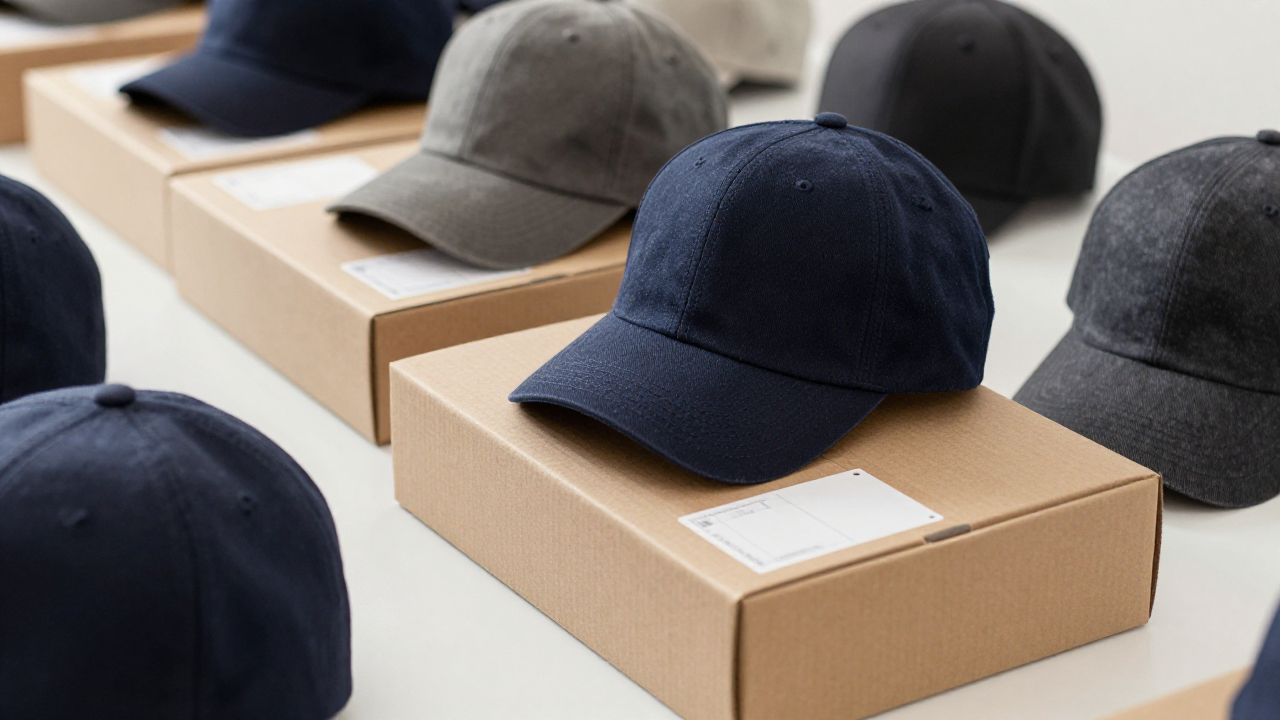
The lowest unit price almost never protects your margin. Compare cap manufacturers on four things instead: product fit, production reliability, total landed cost, and supplier accountability.…
Miss any one of those and the savings come back as rework, air freight, chargebacks, and inventory you cannot move.
How Do You Compare Cap Manufacturers Without Giving Up Margin?
That framework holds whether you are buying stock blanks, decorating locally, or running a full custom cut-and-sew program. It matters more in headwear than in most apparel categories. A cap is a small, high-visibility item with a structured front panel, a closure that has to survive thousands of open-and-close cycles, and a logo customers inspect from eighteen inches away. A six-cent-per-unit gap between two quotes is noise. A two-millimeter logo shift or a navy dye lot that reads purple in daylight is a markdown.
The buyers we work with split into four groups, and they weigh these dimensions differently. Promotional distributors live on ship dates — a late order to a trade show is a total loss. Private-label brands care about construction consistency across reorders. Retailers want test reports and compliance paperwork before the PO is signed. Small DTC brands want low MOQ and fast replenishment, which pushes them toward stock blanks and domestic decoration.
MOQs across the category run from 12-unit in-stock orders up to 500-unit custom runs and beyond, and sampling timelines swing by weeks depending on design complexity. That spread is exactly why one scorecard beats shopping on price.
The Seven Buyer Checks We Run Before Any Deposit
Seven checks, in this order. Skipping any one of them is how a good unit price turns into a bad order.
Check 1 — MOQ realism. Ask whether the MOQ applies per colorway, per fabric, or per total order. A supplier quoting "300 pieces" usually means 300 per color. Run three colorways and you are at 900. Stock blanks start at 12 to 24 units; domestic decoration on blanks typically starts at 24 to 72. Check 2 — Physical sample approval. Never approve from a digital mockup. Request a pre-production sample, wear it, and photograph it in daylight and under store lighting. Then seal it, sign it, and keep one copy on each side. We started requiring a signed tolerance sheet on every sampling approval back in 2019, after a 6,000-unit order shipped with a crown half an inch shorter than the sample everyone had nodded at. Check 3 — Quote completeness. Demand a line-item quote: fabric, cut-and-sew, embroidery or print, digitizing and setup, labels and hangtags, polybags, cartons, inland freight, export documents, ocean or air, duty rate, and a stated Incoterm. "FOB Ningbo, duty excluded" and "DDP Dallas" are two different businesses, and the gap is often 18 to 25 percent of unit cost. Check 4 — Fabric and fit spec. 100% cotton twill, cotton-poly blend, and performance polyester behave nothing alike. Weight in oz/yd² decides drape — an 8.5 oz brushed twill sits nothing like a 5.5 oz lightweight. Pin down crown height and profile (low, mid, high), closure type (plastic snap, metal buckle, snapback, hook-and-loop), and whether you want structured or unstructured front panels. Check 5 — Construction and decoration accuracy. Front-logo embroidery typically lands between 8,000 and 11,000 stitches at 40-weight thread. 3D puff needs 2 to 3 millimeters of foam and a proper underlay, or the letters collapse after the first wash. Ask for the stitch file and how many needles the machine runs. Then look inside: seam taping, buckram in the front panel, and whether the sweatband is cotton or moisture-wicking. Check 6 — Documented quality control. AQL 2.5 sampling under ANSI/ASQ Z1.4-2003 is the working default in this category. Ask who runs the inspection, factory QC or a third party. Independent inspection on a 500-plus unit order generally runs $250 to $350, and it is the cheapest insurance in the whole transaction. Check 7 — Compliance and response speed before the deposit. CPSIA applies to kids' caps, California Prop 65 governs labeling for anything sold into that state, and OEKO-TEX Standard 100 covers fabric chemistry. Then test the supplier: send three questions on a Friday afternoon and see what comes back by Monday. Pre-deposit responsiveness is the best predictor of post-deposit responsiveness we have found. Depressing, but reliable.Matching Your Order Size to the Right Cap Program
One thing the table hides: caps cube out long before they hit weight limits. A 40-foot high cube holds roughly 50,000 to 55,000 caps, so your freight math is CBM-driven, not kilogram-driven. (That range comes from our own carton specs plus load plans from two forwarders — closure type and carton count will move it.)
Two Hidden Parameters Sales Teams Don't Volunteer
The approved sample is a construction document, not an artwork approval. Most buyers treat sign-off as "the logo looks right." It is not. The signed sample has to define crown profile, visor curvature, closure type, sweatband material, logo placement in millimeters, and acceptable tolerances for each. Ask for a written tolerance sheet: color variance held to ΔE ≤ 1.0 under D65 lighting, crown height plus or minus 3 mm, logo position plus or minus 2 mm. If a supplier cannot produce that sheet, they are not measuring anything. "Lead time" starts when the last clock starts, not the first. Reps quote 30 days. What they mean is 30 days after sample approval, deposit receipt, fabric confirmation, and artwork sign-off — whichever lands last. Those four milestones can sit two to three weeks apart, and the quoted number quietly restarts at each one. Get the sequence in writing with dates attached to each milestone.Red Flags, Vetting Steps, and One Expensive Lesson
The mistakes repeat. Choosing on unit price alone. Approving a digital mockup instead of a physical sample. Ignoring colorfastness — a cap that fades after six weeks of summer sun generates returns you pay for twice. Accepting "we will ship around the 20th" as a delivery commitment.
Our worst one: in April 2023, a promotional distributor in Columbus, Ohio was three weeks from a 12,000-unit employee-appreciation order. Everything looked clean on paper. They ran a 150-unit pilot first and two caps failed a simple sweatband pull test. Turned out the subcontractor had switched to a thinner binding tape without telling anyone. The pilot cost them about $900 and saved the account.
So run the vetting process in this order. Ask for factory evidence — business license, export records, machine list, photos of the actual floor. Call two references who ordered in the past twelve months, not the ones the supplier picks from 2019. Place a pilot order and open the cartons yourself. Compare what arrives against the sealed golden sample, side by side, under the same light. It is boring, and it works.
Choose A if you need lower MOQ, faster replenishment, and simpler decoration — stock blanks with domestic embroidery normally wins on speed and cash flow, and you can reorder in days. Choose B if you need exclusive construction, scalable volume, and tighter control over materials and branding — full custom offshore production is the only route that gets you a proprietary crown, custom-milled fabric, and unit costs that survive retail margin math.The honest version: most brands eventually run both, using stock programs to cover in-season demand while custom production carries the core line.
Frequently Asked Questions
What MOQ should buyers expect from cap manufacturers?
Stock blanks ship from 12 units. Domestic decoration on blanks usually starts at 24 to 72 pieces. Custom cut-and-sew programs typically quote 300 to 500 units per colorway, and multi-color orders multiply that number. Always confirm whether the MOQ applies per color, per style, or per total order.
How long does custom cap production take?
Sampling runs 7 to 14 days domestically and 10 to 21 days overseas. Bulk production takes 10 to 15 days for decorated stock blanks and 25 to 45 days offshore, then 28 to 35 days of ocean transit to a U.S. port. Add customs clearance and inland drayage.
What should a cap quality inspection include?
Measure crown height, visor curvature, closure function, and logo placement against the signed golden sample. Check stitch density, loose threads, dye lot consistency under D65 lighting, and sweatband attachment. Verify AQL 2.5 sampling, carton labeling, and packing quantity before the shipment leaves the factory.
Are U.S. cap manufacturers worth the price premium?
For runs under roughly 500 units, yes. Domestic lead times of 10 to 18 days beat a 90-day offshore cycle, and you skip duty, ocean freight, and cash sitting in inventory. Above 3,000 units, offshore landed cost usually wins by 30 to 45 percent.
How do I compare quotes from overseas and domestic cap suppliers?
Convert every quote to a landed cost per unit at your distribution center: unit price plus decoration, setup, freight, duty, and inspection. Then weigh lead times and defect rates together. A quote that is 12 percent cheaper with a 4 percent defect rate is more expensive than it looks.








