


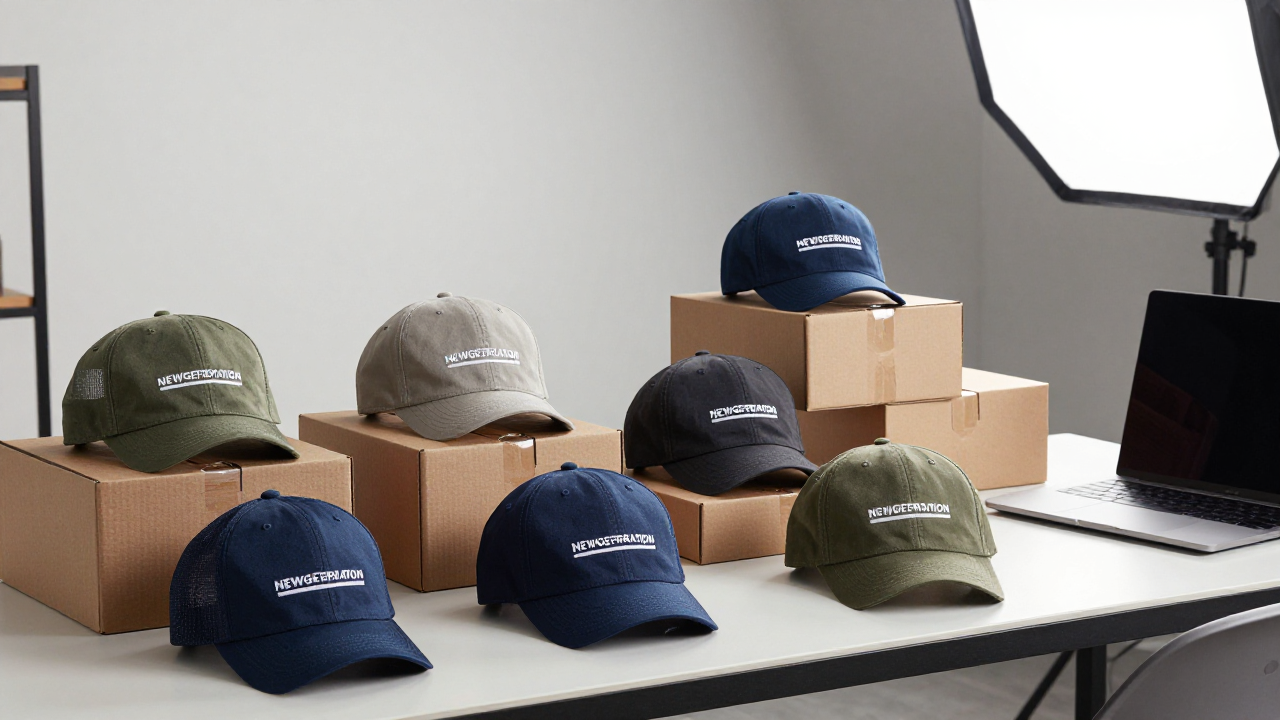
Comparing cap manufacturers on unit price alone misleads U.S. buyers almost every time. In custom cap programs we've audited since 2019, a quote at $4.75 against $6.…
00 landed 15% to 30% higher once freight, duty, defects, rework, and dead inventory were counted — with cash tied up six to ten weeks longer.
How to Compare Cap Manufacturers Beyond the Lowest Unit Price
The U.S. market splits into three sourcing models, and they are not interchangeable on price. Published buying benchmarks put decorated domestic runs at roughly 24 to 144 units, while fully custom cut-and-sew programs typically require about 720 units per style. Production runs 3 to 4 weeks for embellished caps and 8 to 12 weeks for fully custom orders *before* ocean freight.
A cap factory is not one product. Some run knitting lines for beanies, some embroider blanks they buy from a third party, and a smaller group owns the whole chain from cotton twill weaving through cut-and-sew, 3D puff embroidery, woven labels, polybagging, and carton packing. Ask which of those your quote actually covers. The factories that answer slowly are usually the ones outsourcing the front panel.
New Generation has sewn caps in China since 2008, and we lose deals every month to quotes $0.80 lower. Some of those deals should go elsewhere. Many shouldn't.
The Costs That Never Show Up on a Cap Quote
On a typical 1,000-piece custom cap order, explicit costs account for roughly 55% to 70% of the true total. The rest hides in defects, rework, rush freight, dead stock, and the hours your team spends babysitting production it never planned to manage.
Explicit costs are the ones on the invoice: unit price, sampling and digitizing fees ($75 to $250 per logo, sometimes waived at volume), setup and screen charges for patches, packaging upgrades, freight, duty, warehousing, and payment terms. Add Section 301 tariffs if the caps are Chinese-origin — headwear lines have carried add-ons ranging from 7.5% to 25% depending on HTS classification, stacked on the base duty rate. Any supplier who quotes you a single unit price without naming the HTS line is telling you they don't handle their own paperwork. Hidden costs are the ones that decide whether the program made money:On March 14, 2022, a Portland, Oregon brand called us at 6 a.m. Pacific. Their 4,000-cap order — placed with a factory quoting $0.55 less per cap than ours — had been consolidated into a shared container that got held at the Port of Long Beach over another shipper's customs paperwork. Their trade show opened April 2. They air-freighted 600 caps at a cost of $3.57 each, on top of $1,410 in port fees. The $2,200 they "saved" on unit price was gone before the plane took off.
Here's where buyers get the arithmetic wrong most often. They compare a factory FOB quote against a fully landed domestic price, then declare the import route 40% cheaper. FOB excludes ocean freight, duty, drayage, customs brokerage, and the 4% to 7% of units that arrive unsellable. It also ignores color splits — a 720-unit minimum often means 120 units per color across six colorways, and half of those will be the wrong colors for your market. I wrote earlier that freight belongs in the hidden bucket. It doesn't; freight is invoiced. The hidden part is the ten days you spend arguing over who pays for the re-shipment when 60 caps arrive with the wrong back closure.
Contribution margin per sellable unit is the number that matters. A $6.09 landed cap that sells through at 92% at $22 beats a $7.61 landed cap that sells through at 78%, even though the second one had the prettier quote.
Running the ROI Math on Cap Manufacturers
ROI = (incremental gross profit − total investment) / total investment × 100, calculated on sellable units rather than ordered units. In the 1,000-cap scenario below, the $6.00 supplier returns 161% and the $4.75 supplier returns 89% — the cheaper quote destroys roughly $2,140 of gross profit on a single order.
The formula, written out:
ROI = (gross profit on sellable units − total cash invested) / total cash invested × 100
Assume both programs sell at $22 retail with a 40-units-per-week sell-through and 1,000 units ordered.
Now the part almost nobody models: cash timing. Option A ships in 3 weeks, so your money is out by day 35 and goods are on the shelf by day 45. Break-even on cash lands around day 111. Option B needs a 30% deposit on day 0, a 70% balance before vessel departure around day 70, and freight and duty cleared by day 96. Goods arrive day 110. Break-even lands near day 197 — roughly 12 weeks later than Option A.
Twelve weeks of delayed cash recovery is a financing cost, and it hits hardest exactly when a young brand can least afford it. The six numbers I'd put on a one-page dashboard before signing anything: landed cost per sellable unit, defect rate at receiving, 8-week sell-through rate, gross margin after returns, reorder lead time from PO to shelf, and working capital tied up at peak.
When the Cheapest Cap Manufacturer Is the Wrong Investment
Walk away when projected gross profit on the order is less than three times your estimated hidden-cost exposure. That's a rule of thumb, not gospel, but it has kept more programs alive than any negotiation tactic I know.
Red flags worth treating as disqualifying:
Don't invest at all when demand is unvalidated and the MOQ exceeds what you can realistically sell in 16 weeks; when cash reserves can't absorb a 30-day delay without missing payroll; when the customization adds little the customer can actually perceive; or when expected gross profit can't cover the hidden-cost estimate even at optimistic sell-through. No amount of factory automation fixes ambiguous specs — a fully automated line will produce the wrong cap faster and more consistently.
The sourcing rule I'd tattoo on every buyer's forearm: choose the lowest *reliable* total cost. Then put quality standards, inspection rights, replacement terms, and milestone payments in the purchase order. Approve a physical pre-production sample before the bulk run. Document measurements and decoration placement in millimeters, not adjectives. Wash-test one cap three times and check for shrinkage and color bleed. Confirm carton counts and dimensions in writing — a 100-piece carton of structured caps runs just under 6 cubic feet, and that number is your freight quote. Set a reorder trigger at 30% remaining stock, not 10%.
Frequently Asked Questions
What MOQ should a startup request from a cap manufacturer?
Start with 24 to 144 units through a U.S. decorator working on blank six-panel caps. Move to a 500 to 720 unit custom cut-and-sew run only after you have 8 to 12 weeks of sell-through data on a similar silhouette.
Is a U.S. cap manufacturer cheaper after landed costs?
Below roughly 300 units, usually yes. Domestic decorated blanks at $14 to $22 carry no duty, no ocean freight, and a 5 to 10 day turnaround. The crossover to overseas custom pricing generally sits between 400 and 700 units per style.
How long do custom caps take from sample approval to delivery?
Allow 3 to 4 weeks of production for embellished caps and 8 to 12 weeks for fully custom cut-and-sew. Add 4 to 6 weeks of ocean freight and port handling into a U.S. warehouse — 12 to 18 weeks door to door.
Should a brand use decorated blanks or fully custom cut-and-sew caps?
Use decorated blanks until a silhouette proves it sells. Switch to cut-and-sew when you need proprietary panels, custom closures, or a fabric weight no blank supplier stocks. The 720-unit MOQ only pays off after that proof exists.
What should a cap manufacturer quote include?
Demand FOB and DDP pricing, per-color and per-closure minimums, embroidery stitch counts, sampling and digitizing fees, carton dimensions and counts, defect tolerance, inspection rights, and replacement terms — all in writing before any deposit leaves your account.








