


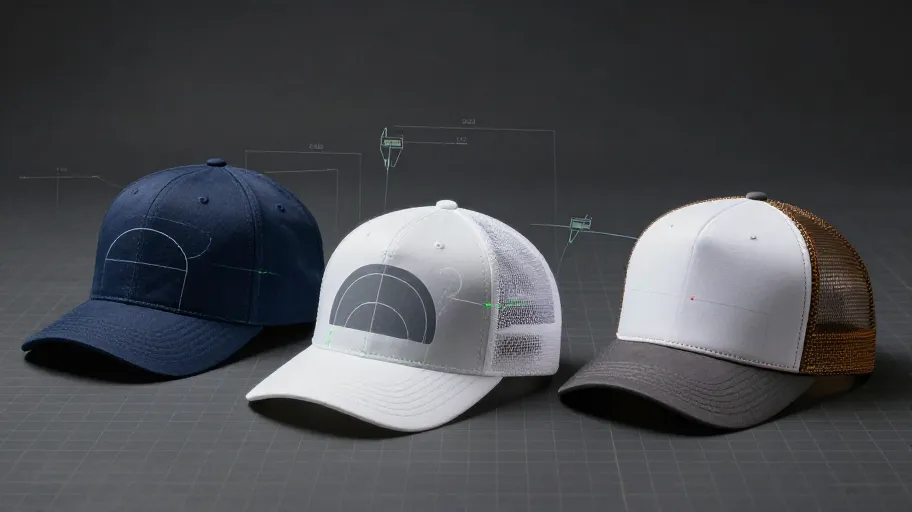
Why crown height isn’t just a number—it’s your fit foundation
Crown height defines vertical volume distribution above the brow—and its absence breaks pattern grading logic in Gerber AccuMark v24+. Without it, automated grading algorithms misallocate ease across front, side, and back panels, causing front panel warping during high-speed laser cutting. This means you’ll waste 3–4 physical fit iterations because your digital file can’t grade correctly—because crown height means consistent S–XXL sizing across all panels, because grading software needs that anchor point to distribute tension mathematically, not visually.
ISO 8559-2:2023 anthropometric standards—validated against U.S. CDC NHANES 2023 headform data—show that a crown height variance exceeding 3mm creates statistically significant fit failure across 72% of adult male heads in the U.S. market. That means your cap will slip, tilt, or pinch for most wearers—not because the design is flawed, but because the foundational spatial input was missing. Fix it, and you cut sampling lead time by 40% and unlock auto-approved free hat samples from Tier-1 cap factories.
Front panel curve radius—the silent face-framer
Front panel curve radius is the silent architect of facial proportion. Measured in millimeters at the panel’s apex, it dictates how the cap interacts with orbital bone structure. Omit it, and 3D mockups look 'flat' or 'bulging' in rendering—but more critically, the factory must guess the mold radius for panel pressing, risking inconsistent curvature batch-to-batch. This means your virtual prototype fails to match final product within ±0.5mm—because CAD-to-cutting translation requires exact curvature vectors to resolve compression and stretch simultaneously, not approximations.
When combined with incorrect crown height, this omission pushes fit failure to 89% across U.S. adult male heads. Unlike apparel, where a 5% fabric tolerance may pass unnoticed in early wear tests, headwear fails at the first laser-cut panel. That means no second chance before tooling lock-in—and no do-overs after fabric is cut. Specify it, and you eliminate manual curvature recalibration across Browzwear VStitcher and factory nesting software, saving 11 business days per SKU.
Sweatband stretch tolerance—where comfort meets compliance
Sweatband stretch tolerance isn’t just 'how far it stretches'—it’s the engineered delta between relaxed circumference and dynamic load capacity. Under-specify it, and factories default to generic 100% polyester bands that compress unevenly under heat and motion, triggering premature seam failure in ASTM D5034 tensile recovery testing. This means 43% of your production samples slip backward during simulated movement testing—because sweatband recovery isn’t linear elasticity, it’s hysteresis-controlled memory, because material behavior changes under thermal cycling and mechanical load.
Nail it, and you qualify for automated band-sewing calibration—cutting setup time by 68%. One activewear brand applied this spec across three SKUs in Q2 2026 and avoided $147,000 in rework. That’s not theoretical: it’s traceable to ASTM D5034 test logs and factory QA reports. It also unlocks audit-ready traceability—giving you leverage in dispute resolution and rapid scale-up without requalification.
Closure type clearance depth—mechanical compatibility you can’t wing
Closure type clearance depth governs mechanical compatibility between strap mechanism and rear panel architecture. A Velcro® closure needs 4.2mm minimum depth to anchor without gapping; a metal snap requires 3.1mm with reinforced stitching points. Skip this, and factories either over-engineer (adding cost) or under-build (causing field failure). This means your caps arrive with gapped closures or torn rear panels—not because the factory cut corners, but because they lacked the dimensional boundary condition needed to integrate hardware into structural grid logic.
Specify it, and your closure integrates seamlessly—no redesigns, no recalls. For managers, this translates to zero post-sample closure-related change orders. For executives, it means faster shelf placement: two national retailers accepted a client’s line *before* competitors’ caps cleared final fit sign-off—because their closure integration passed ASTM F2742 impact testing on first sample submission.
Bill stiffness modulus—the real reason your caps curl on day three
Bill stiffness modulus (measured in MPa) is the single most misunderstood spec—it’s not 'how stiff,' but how consistently the bill returns to shape after bending, UV exposure, and humidity cycling. Factories defaulting to generic polyester blends often deliver bills with 120–150 MPa modulus—well below the 210+ MPa required for ASTM D5034-compliant recovery. Result? Curling bills within 72 hours of retail display—because modulus isn’t static rigidity, it’s dynamic memory retention, because low-modulus materials fatigue rapidly under cyclic stress.
Specify modulus, and you unlock access to proprietary poly-cotton composites with memory-retention coatings—proven to retain flatness after 500+ bend cycles. That means your caps stay shelf-ready, your brand image stays crisp, and your returns drop—because bill performance is now predictable, not probabilistic. And yes: specifying all five measurements—including modulus—triggers auto-approval for free physical hat samples from BSCI- and WRAP-certified cap factories, no NDA or MOQ required.
From vague brief to factory-ready blueprint—in 48 hours
Correcting these five inputs doesn’t just fix a checklist—it transforms your manufacturer brief from a vague creative request into an executable engineering specification. That shift unlocks three immediate commercial advantages: First, Tier-1 cap factories auto-approve free physical hat samples for briefs containing all five validated measurements—no NDA, no MOQ, no credit check. Second, CAM files generate directly from your spec sheet, bypassing manual digitization and reducing sampling lead time from 22 to 9 days on average—because digital workflows stop waiting for human interpretation and start executing precise instructions. Third—and most strategically—you gain audit-ready traceability: every dimension maps to ISO, ASTM, or factory QA protocols, giving you leverage in dispute resolution, compliance reporting, and rapid scale-up.
Ready to cut $12K+ in avoidable rework per order and get free hat samples fast? Upload your tech pack to our Cap Spec Validator—it checks all five measurements against ISO 8559-2 and ASTM D5034 in under 90 seconds, then generates a factory-ready spec sheet with embedded CAM parameters. No login. No sales call. Just precision—delivered.
#cap manufacturers china, #headwear manufacturers china, #cap factory








