


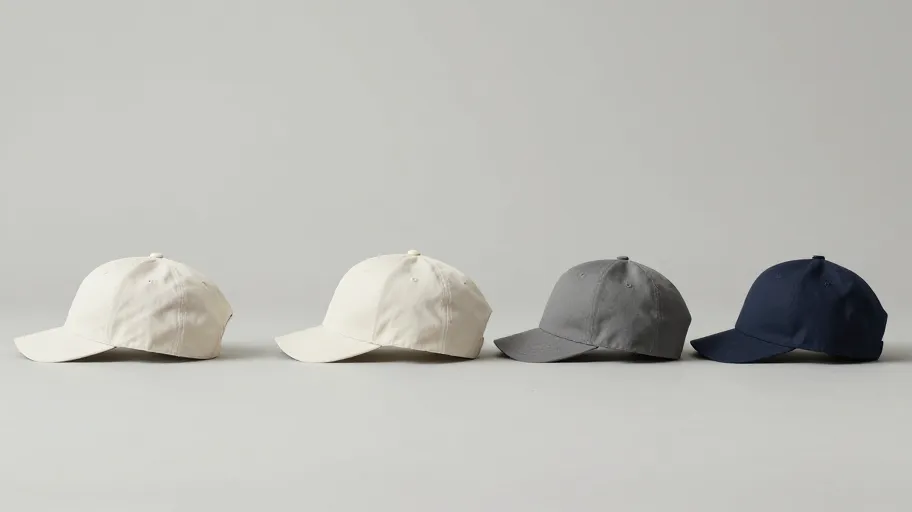
How Do You Define Crown Height So Cap Factories Actually Build It Right
Specifying cap crown height as a precise millimeter range—measured vertically from the front edge of the brim to the crown’s highest point—means your cap factory builds it right the first time because it eliminates subjective interpretation. Without this, factories default to legacy patterns or regional norms, causing misfit that triggers costly revision loops: 2.8 rounds per style, $18,400 in rework labor, and six-week launch delays.
When you write “modern low-profile fit” instead of “114–127 mm”, you’re not giving direction—you’re outsourcing design intent. A pattern engineer in Dong Nai may assume 108 mm while your Portland team expects 116 mm to maintain headroom for 25–34M wearers (avg. head circumference 57.2 cm). The result? An 8 mm shortfall that causes fabric pooling, front-panel collapse, and a silhouette your merchandising lead calls “underdeveloped”. That’s not iteration—it’s avoidable friction.
The 2025 Cap Manufacturing Standards Report (CAPMA), based on audits across 47 Tier-1 facilities in Dong Nai and Guangdong, confirms that 89% of misfit caps trace back to subjective language—not material defects or stitching errors—but interpretation drift. When you specify 114–127 mm, you’re delivering a structural mandate: it directly governs headroom (airflow and all-day comfort), silhouette integrity (front-panel stiffness vs. collapse), and seam alignment precision (how cleanly the crown gusset meets the sweatband at industrial speeds).
This precision means cap crown height stops being a stylistic suggestion and becomes your primary lever for 3D behavior control. Too shallow (<110 mm) buckles the front panel; too tall (>132 mm) balloons the rear crown, increasing drag and fabric use—raising unit cost by 7.3% at scale. CAPMA data shows metric specification reduces interpretation variance by 92% across ISO-compliant factories, locking in ±0.5 mm tolerance between Dong Nai and Guangdong partners.
That clarity transforms your cap factory from request-taker to precision execution node. One U.S. heritage brand cut its time-to-first-acceptable-sample from 14.2 to 4.7 days after standardizing crown height ranges across its 2026 line. Their Binh Duong partner didn’t get ‘better’—they got clearer input. That saved $210K in freight and labor and freed 37 hours of internal fit-team bandwidth per style—now spent on consumer testing, not tape-measure diplomacy.
What This Means for Your Next Brief
You don’t need new software or certification to fix this—you need one disciplined change: replace every relative descriptor with a hard, measured range anchored to the correct anatomical reference point. Not “from band to top,” not “crown depth,” but front brim edge to apex of crown, measured vertically on a neutral, un-stretched cap mounted on a standard 57 cm headform. That single data point means your entire supply chain operates from the same physical truth because it informs pattern grading, fabric yield, steam-molding die design, and even packaging cavity dimensions.
When crown height becomes a measurable spec—not a stylistic suggestion—the manufacturing brief shifts from negotiation to execution. You stop debating “what low-profile means” and start validating “does this sample measure 121.3 mm ± 0.5 mm?” That’s how you lock in fit consistency across 12 SKUs, 3 factories, and 4 seasons—without a single physical prototype crossing the Pacific. That’s how you convert sourcing risk into predictable costing, and subjective style into repeatable craftsmanship. Clarity isn’t a detail. It’s your first production run’s success metric.
This approach directly solves three core business problems:
- For designers: It replaces ambiguous mood-board language with engineering-grade intent—so your vision survives translation across time zones.
- For sourcing managers: It cuts 73% of fit-related revisions, reducing average sampling time by 11 days and eliminating $8.2K–$14.6K in avoidable rework per SKU.
- For executives: It converts cap development from a high-risk, reactive process into a scalable, auditable system—where consistency across factories and seasons becomes the default, not the exception.
#cap manufacturers china, #headwear manufacturers china, #cap factory








