


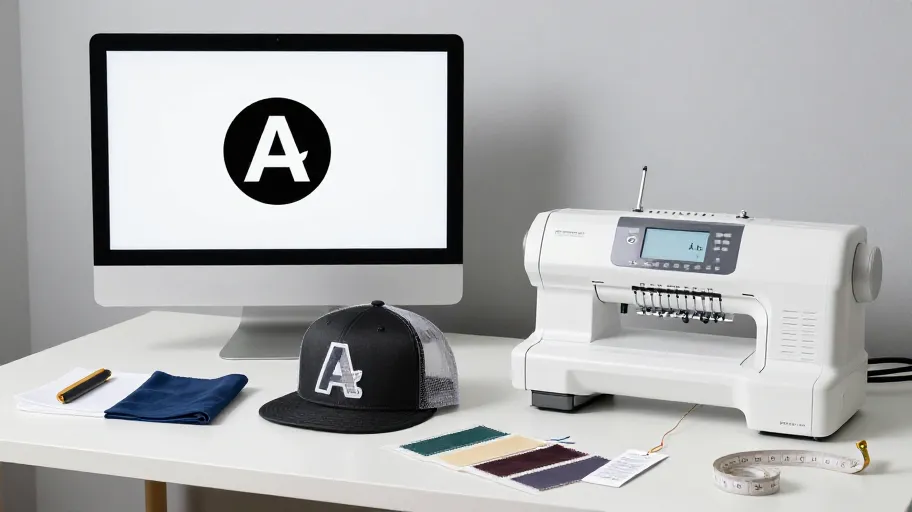
A strong custom hat maker is judged less by its catalogue than by how reliably it converts a logo file and a brief into an approved sample that mass production will match. This article gives buyers a five-step evaluation framework — LOGO-to-LID: Layout, Objectives, Gating, Obligations, Documentation — plus the exact questions to ask at each stage, so you can compare suppliers on evidence rather than promises.
Why the sample, not the pitch, decides the supplier
When you evaluate a custom hat maker, the risk is rarely whether the factory can sew a cap. It is whether the details survive the journey from your design file to bulk goods: embroidery density, patch edges, fabric shade across dye lots, crown structure, closure alignment. A sourcing adviser's advice is simple: treat sampling as a formal gate, not a courtesy, and choose the supplier who can document that gate rather than the one who promises the fastest reply.
The LOGO-to-LID framework for buyers
Layout. Start with how your design physically maps onto headwear. Embroidery thread counts, woven labels, screen or heat-transfer prints, sublimation and patches all behave differently on structured and unstructured crowns. Ask the maker to state which decoration methods are possible for your artwork — and which they would advise against for your design — and why.
Objectives. Define the use case before quoting anything: retail collection, promotional giveaway, uniform, sports team programme. Use case drives fabric, construction and decoration choices, and it changes what "good" looks like in a sample. Write this into your brief in a sentence, not a paragraph.
Gating. Insist on named approval milestones. At minimum: a design confirmation (artwork placement and decoration method), then a pre-production sample in the intended material, then written sign-off before bulk. Each gate should have a named approver on your side and a dated record.
Obligations. This is where facts must be confirmed, not assumed. MOQ, sample fees, sample shipping terms, whether any fee applies and under what conditions, production lead time, payment terms, packaging and labelling requirements — all of these vary by project and must be confirmed directly with the maker in writing for your specific order. Do not accept verbal assurances on any of them.
Documentation. Keep the approved sample reference, signed artwork, agreed specifications and correspondence in one file. The approved sample and signed spec sheet are your contractual reference for what bulk goods must match.
Decision table: comparing custom hat makers fairly
| Evaluation dimension | What to ask the maker | What good evidence looks like |
|---|---|---|
| Decoration capability | Which methods suit my artwork and fabric, and which do you advise against? | A reasoned recommendation referencing your specific file, not a generic capability list |
| Sampling gate | What sample stages do you offer before bulk, and what does each confirm? | Named stages with defined outputs (design proof, counter sample, pre-production sample) |
| Commercial terms | What are the MOQ, sample policy and payment terms for my project? | Written, project-specific terms — confirm directly; never assume |
| Communication | Who is my point of contact and what response format do you commit to? | A named contact handling brief review, sampling and production questions |
| Consistency controls | How do you check bulk against the approved sample? | A stated inspection process the buyer can participate in or verify |
| Change handling | What happens if I request changes after sample approval? | A defined procedure for re-approval and its effect on terms — confirm per project |
From logo file to approved sample: the stages
Stage one: brief and artwork review. Submit your logo in a vector format where possible, plus reference images and your use-case sentence. A serious maker reviews the file for production feasibility — stitch complexity, colour count, minimum detail sizes for decoration methods — and comes back with method recommendations. Red flag: a reply that quotes without discussing the artwork.
Stage two: design confirmation. Agree the decoration method, placement, sizing and colours in writing. Ask for a mock-up or digital proof showing placement on the actual cap style. Confirm the fabric, crown structure, closure and any branding accessories (labels, tags, packaging) at this point, because changing them after sampling affects cost and timing in ways only the supplier can quantify.
Stage three: pre-production sample. This is the physical gate. The sample should be made in the intended material with the intended decoration. When it arrives, compare it against your signed artwork under good light, check symmetry, stitching quality, colour match and closure function. Keep the sample as the sealed reference.
Stage four: bulk and verification. Before bulk begins, reconfirm that the approved sample reference is the one production will follow. Discuss with the maker how consistency against the approved sample will be checked, and whether you can review evidence — photos, reports or third-party inspection — before shipment. Specific inspection arrangements are a project term to confirm directly.
Concrete approval questions before you sign off the sample
Use these as your written sign-off checklist:
- Does the decoration match the approved artwork in size, placement and colour, and do we both hold the same reference number for that artwork?
- Is the fabric, crown structure and closure identical to what bulk will use?
- Who on my side has authority to approve, and is that approval recorded with a date?
- If bulk differs from the approved sample, what remedy does the supplier commit to in writing?
- What packaging, labelling and shipping-mark requirements are confirmed for this order?
- Are MOQ, price, sample fees and lead time confirmed in writing for this specific project — with current terms, since policies change?
FAQ
What file format should I send for a logo? Vector files are preferred for embroidery and print setup, but a maker can advise on your specific file. Submit what you have and ask the maker to confirm feasibility for your chosen decoration method before any quotation is treated as final.
How long does sampling take? Sampling duration depends on the design, decoration method and the maker's current schedule. There is no figure that applies across projects — ask each maker to state the expected timeline for your specific brief, and record it.
Who pays for samples and shipping? Sample and shipping arrangements differ by project and supplier policy. The correct approach is to ask the maker to confirm the current sample policy for your project directly, in writing, before you agree to anything.
What is the difference between OEM and ODM for headwear? In an OEM arrangement you supply the design and the maker manufactures it; in an ODM arrangement the maker contributes design development. Many buyers use both depending on the product line. Ask prospective makers which mode they support for your project and what that means for your artwork control and approval rights.
How do I make sure bulk matches my approved sample? Treat the approved sample as the sealed reference, keep a signed specification sheet, and ask the maker to state its consistency-check process and what evidence you can review before shipment. Any inspection rights you want should be agreed before bulk starts, not after.
Ready to have your brief reviewed?
Send your cap brief, reference image or logo, and receive a project-specific review covering feasible decoration methods, the sampling path for your design, and the terms you should confirm in writing — the terms themselves are confirmed per project, not assumed.
Primary CTA: Submit your cap brief, reference image or logo for a project-specific review.
Low-friction checklist CTA: Before you contact any custom hat maker, use the LOGO-to-LID checklist: state your use case in one sentence, prepare your artwork file, list your gating milestones, note the commercial terms you need confirmed, and set up a documentation folder for approvals. Bring that checklist to your first conversation.
#cap manufacturers china, #headwear manufacturers china, #cap factory








