


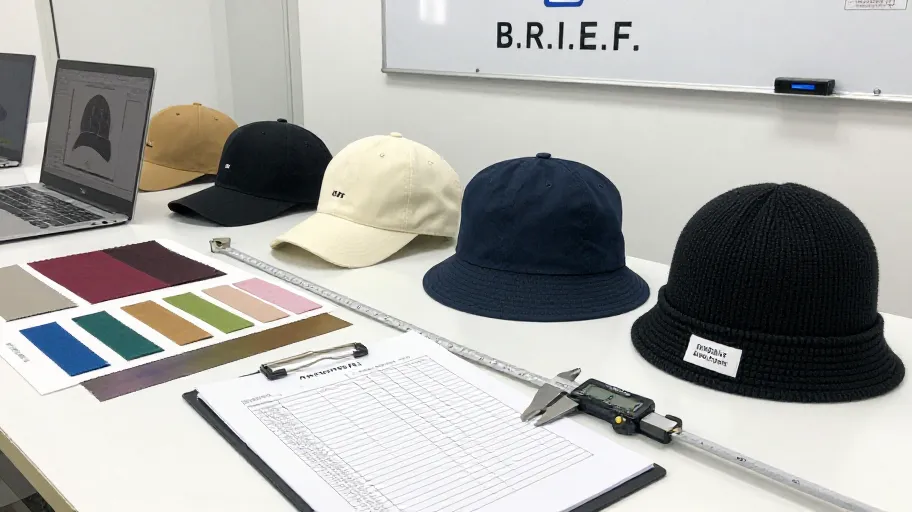
Sourcing custom hats from China becomes far more predictable when you prepare a structured design brief and a written approval checklist before requesting quotes. This article walks you through the B.R.I.E.F. Framework — Build the spec, Reference materials, Itemise approvals, Fix the timeline, Frame the risk questions — so every supplier quotes against the same document.
Why preparation matters more than price comparison
When overseas buyers search for custom hats china, the first instinct is to collect quotations and compare them side by side. The problem is that quotes are only comparable when the specification behind them is identical. A quote for a "6-panel cap" can describe very different constructions depending on the fabric weight, closure type, embroidery method and finishing details the supplier assumes.
The buyers who avoid costly revisions are not the ones who negotiate hardest. They are the ones who document their requirements, secure written approvals at defined stages, and treat every unknown as a question rather than an assumption. The framework below turns that discipline into five repeatable steps.
The B.R.I.E.F. Framework
B — Build the spec
Start with the product definition, not the decoration. For headwear, this means deciding and writing down:
- Silhouette and construction: structured or unstructured; 5-panel or 6-panel; fitted, snapback, strapback or flexfit-style closure.
- Crown and brim profile: height, curvature and stiffness described in words and reference images.
- Fabric: main body material, sweatband, undervisor and any trim. Describe the weight and hand-feel you expect, and ask the supplier to confirm which of their available materials matches your description.
- Decoration methods: embroidery, woven patch, print, leather patch or a combination, including placement and size on each panel.
- Accessories: eyelets, buttons, labels, hangtags and packaging.
Every one of these fields should appear in your brief. Anything left blank will be filled in by someone else — and that someone else is not on your team.
R — Reference materials
A written spec alone is fragile. Add:
- A physical sample you own, if you have one, or photographed reference products.
- A mood board or digital mock-up showing colour, placement and logo scale.
- Pantone references for every colour, including thread colours for embroidery.
State clearly in the brief which reference is the master: if the photo, the mock-up and the text disagree, which one governs? Suppliers will otherwise resolve conflicts for you, and their resolution may not match your intent.
I — Itemise approvals
Define, in writing, the approval stages you require before bulk production. A typical sequence for a buyer preparing to source custom headwear looks like this — but you must confirm with each supplier which stages they offer and what each one includes:
- Development sample: confirms silhouette, fabric and construction.
- Decoration sample or proof: confirms embroidery digitising, patch detail or print reproduction.
- Pre-production sample: confirms the full product, including labels and packaging, exactly as it will ship.
Ask the supplier to state, for each stage, what it covers, what it costs, how long it takes and what happens if you request changes. Do not assume any stage is free, paid, expedited or waived — the current policy must be confirmed directly in writing for your specific project.
F — Fix the timeline
You do not need the supplier's numbers in your brief; you need your own checkpoints. Map out when you need the brief issued, when each approval must be complete, and when bulk production must finish to meet your market date. Then ask the supplier to confirm in writing whether their current schedule can meet your checkpoints, and what could move it. This reframes lead time from a marketing claim into a documented commitment you can verify against.
F — Frame the risk questions
Before committing, put your remaining unknowns to the supplier as direct questions and file their written answers with the brief. The section below gives you the exact list.
Choosing the right hat type to specify
Use this decision table to narrow what belongs in your brief before you approach suppliers. Each row raises a sourcing question you should answer internally first, then confirm externally.
| Product direction | Typical use case to define | Spec details to lock down | Questions to put to the supplier |
|---|---|---|---|
| Structured 6-panel cap | Brand merchandising, retail programmes | Closure type, front panel structure, embroidery placement | Which construction methods do you offer? What decoration sizes can you support? |
| Unstructured / dad cap | Lifestyle brands, promotional giveaways | Washed fabrics, curved brim, low profile | Which fabric washes and finishes are available? How is consistency across units controlled? |
| Trucker cap | Event merchandise, streetwear lines | Mesh back panels, patch front | Which mesh and patch materials do you offer? What patch attachment methods do you support? |
| Beanie | Winter collections, corporate gifting | Knit gauge, cuff style, label type | Which knit constructions do you produce? How is logo decoration applied on knits? |
| Bucket hat / wide-brim | Outdoor and resort programmes | Reversible vs single-side, brim stiffness, print coverage | Which print methods cover full panels? How is colour matching verified on printed fabric? |
| Performance / sports cap | Teams, activewear brands | Moisture-management fabric claims, reflective trim | What materials do you offer, and what documentation accompanies them? |
Note that the table asks what the supplier offers and documents — it deliberately does not state what any supplier provides, because that must be confirmed per project.
The approval checklist
Copy this into your project file. Do not proceed to bulk production until every line carries a written approval and a date.
Specification
- Final tech pack issued, version-numbered, sent to supplier
- Master reference identified (photo vs mock-up vs text) in case of conflict
- Pantone codes confirmed for fabric, thread and trim
- Decoration methods, sizes and placements approved
Samples
- Development sample received and approved against spec
- Decoration sample or digital proof approved
- Pre-production sample approved, including labels, hangtags and packaging
- Approved sample retained as the golden sample for inspection
Commercial terms
- Quantity, unit pricing basis and any tooling or setup items stated in writing
- Sample terms, shipping responsibility and stage costs confirmed directly with the supplier
- Production schedule and delivery terms confirmed against your market date
- Inspection method, acceptance criteria and defect-handling process agreed before deposit
Communication
- Single named contact on both sides confirmed
- Change-request process defined: all changes in writing, no verbal approvals
- File formats for artwork (vector, digitised embroidery) agreed and delivered
A checklist this simple prevents the two most expensive failures in custom headwear sourcing: approving a sample that was never the full specification, and requesting changes after bulk production has started.
Questions to ask every supplier before you commit
Beyond the spec, put these questions in writing:
- Which of these specification lines can you meet exactly, and where would you propose an alternative?
- What does your sample process include at each stage, and what are the current terms and costs for this project?
- What is your current production schedule for this spec and quantity, and what would change it?
- How do you handle a discrepancy between the golden sample and bulk production?
- What documentation can you provide for the materials used in this project?
Record the answers. If a supplier cannot or will not answer a question in writing, treat that as information too.
FAQ
How detailed does my design brief need to be before contacting a supplier? Detailed enough that two different suppliers would quote the same product. At minimum: silhouette, closure, fabric description, decoration methods with placements, colour references and your required approval stages. You can refine the brief with supplier input, but issue the first version yourself.
Should I send a physical reference sample or only digital mock-ups? Both, if you can. A physical reference anchors hand-feel and construction in a way images cannot, while mock-ups and Pantone references anchor colour and placement. State in the brief which one governs if they conflict.
What is the difference between a development sample and a pre-production sample? For this article's purposes: a development sample tests the concept and construction; a pre-production sample represents the finished product with labels and packaging exactly as it will ship. Confirm with your supplier what each stage they offer actually includes — the scope must be verified per project, not assumed.
What should I do if the bulk production does not match the approved sample? This is exactly why the approval checklist asks you to define inspection criteria and a discrepancy process before production starts. Raise the issue against the written standard you both signed off, referencing the golden sample and the agreed acceptance criteria. A documented trail is your strongest position; an undocumented expectation is your weakest.
How do I compare quotes from different Chinese cap manufacturers fairly? Issue the same version-numbered brief to each, require quotes broken down by the same line items (product, decoration, labels, packaging, tooling if any), and ask each to flag any line they cannot meet. A cheaper quote on an unspecified product is not a comparison — it is a different product.
Get your project brief
If you are preparing to source custom hats from China and want a structured brief to work from, 获取项目 Brief — send us your product direction and we will help you turn it into a specification you can put in front of any supplier with confidence.
Prefer to start on your own? Copy the approval checklist above into your project file today. It costs nothing, requires no commitment, and immediately improves the quality of every supplier conversation you have.
#cap manufacturers china, #headwear manufacturers china, #cap factory








