


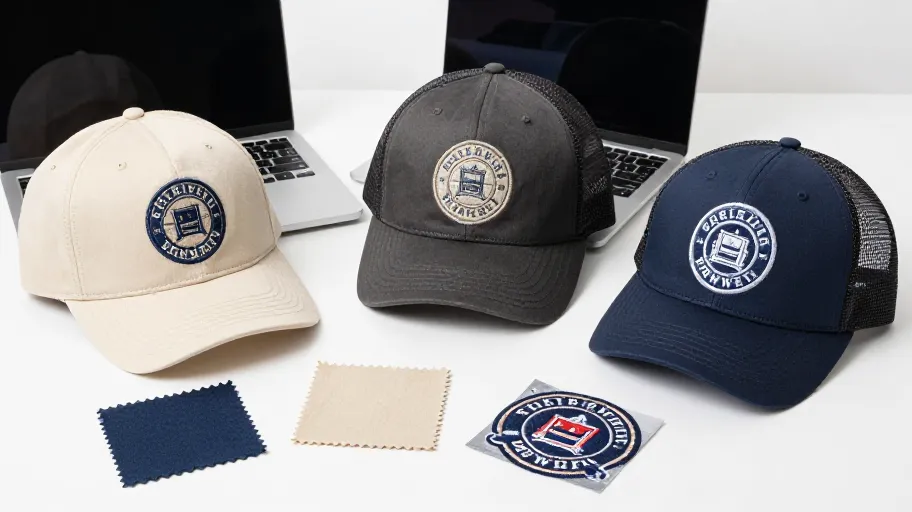
Custom hats for breweries succeed or fail long before production begins: they succeed at the file, the style choice and the sample check. We call this the Logo-to-Shelf Framework — File, Style, Sample, Approve. Work through those four gates in order, document every decision in writing, and you turn a vague merch idea into a repeatable order you can approve with confidence rather than hope.
Why brewery merch is its own sourcing scenario
That split is why a sourcing adviser will push you to define the purpose of each hat before quoting anything. A six-panel structured cap built for the merch wall and an unstructured dad hat handed out at a festival are different products with different decoration realities. If you arrive at a manufacturer with that purpose defined, your quotes come back comparable and your samples come back relevant. If you don't, you'll compare quotes for products that were never the same thing.
Gate one: Logo files
Most merch disappointment traces back to artwork supplied in a format the decoration process can't use cleanly. Before you request quotes, prepare — and ask your supplier to confirm — the following:
- Vector source file (AI, EPS or PDF). Ask the manufacturer directly whether your file version works for their digitising and printing setup; don't assume.
- Layered PNG with transparent background for print-based decoration, at the highest resolution you have.
- Pantone references for each colour in the logo. Screen colours are not production colours; agree the reference standard before sampling.
- Size variants. A detailed crest that works large on a cap front may need a simplified version for a side, rear or beanie placement. Ask whether a simplified mark is recommended at small sizes.
- Placement map. Front, side, rear, closure and bill positions all have physical limits. Ask the supplier to confirm the placement dimensions that apply to your chosen style for your specific order, rather than relying on generic charts.
Approval questions to put in writing at this stage:
- Which file format do you need from us, and is our current artwork production-ready or does it need redrawing?
- How will you confirm the embroidered or printed colours against our Pantone references?
- Can you show us how the logo will look at actual production size before sampling?
- Do you recommend a simplified logo variant for any of our planned placements?
If you can't answer question one confidently, that's precisely the moment to send the file over rather than guessing.
Gate two: Style selection
Style choice should follow from the merchandising role of the hat, not from whatever looks good on a supplier's homepage. Use this decision table to narrow your shortlist before you brief the factory:
| Programme goal | Style direction | Decoration considerations | Ask the supplier |
|---|---|---|---|
| Premium taproom merch wall | Structured six-panel cap with a defined silhouette | Front logo needs crisp edges; complex crests need testing at size | How does this style handle fine detail at our logo size? |
| Casual everyday wear / dad-hat audience | Unstructured, low-profile cap | Soft fronts suit simpler marks and woven patches | Does a patch or flat embroidery suit this construction? |
| Festival and event distribution | Lighter-weight cap or trucker style | Large printable areas suit bold, simple graphics | Which decoration method suits our graphic style here? |
| Cold-season retail or beer-club boxes | Beanies and winter headwear | Fold placement and weave affect logo legibility | What placement and method do you suggest for this knit? |
| Staff and uniform use | Consistent style across a staff team | Durability of daily wear matters; confirm construction details in writing | What construction details should we specify for daily wear? |
Two further decisions belong at this gate, both of which must be confirmed per project rather than assumed:
- Decoration method. Embroidery, woven patches, printing and labels each behave differently on different constructions. Ask the manufacturer to recommend a method for your specific logo, fabric and style combination — and to show you why.
- Closure and trim details. Closure type, labelling and any woven tags affect both cost and perceived quality. List the trim details you care about in the brief so samples reflect them.
Gate three: Sample checks
A sample is not a gift to admire; it is the specification document for your production run. Before you approve anything, work through this checklist and record the result of every line:
Pre-production sample checklist
- Logo matches the approved artwork in shape, proportion and stitch/print quality.
- Colours match the agreed Pantone references under neutral daylight, not just indoor lighting.
- Placement, size and position on the cap match the agreed placement map.
- Fabric, weight and construction match what was quoted and discussed.
- Closure, labels and any trim details match the written specification.
- Fit and finish: seams, bill shape and symmetry inspected on an actual head, not a shelf.
- Any deviation from the sample discussion is documented in writing before approval.
- The approved sample is retained and referenced as the production standard in the order documents.
Approval questions to settle before bulk:
- Is this sample the binding standard for the production run, and how are deviations handled if they occur?
- What documentation accompanies bulk production to show it matches the approved sample?
- Who confirms production against the sample, and at which stage?
Gate four: Approve — and document
Approval is a paper exercise as much as a physical one. Your written spec should reference: the logo file version, the Pantone references, the placement map, the decoration method, the construction details, and the retained approved sample as the production standard. When all of that exists in one document, your production run has a definition to be measured against — and any future re-order becomes a re-run of an approved programme instead of a fresh negotiation.
FAQ
How detailed can a brewery logo be on a cap? It depends on the decoration method, the placement size and the construction — a detailed crest may excel as a woven patch and struggle as small direct embroidery. Don't accept a generic answer; ask the manufacturer to assess your actual artwork at production size for the specific style you're considering. Sending the file for a project-specific review is the reliable way to find out.
Which cap style should a new merch programme start with? Let the merchandising goal decide. A structured cap suits a premium retail wall; an unstructured dad hat suits a casual everyday audience; beanies suit cold-season and gift-box programmes. Use the decision table above to shortlist, then ask the supplier to confirm which construction details apply to each style for your order.
What should we check on a sample before approving bulk production? Everything in the checklist above, under daylight, against the written spec. The two checks buyers skip most are colour verification against the agreed Pantone references and inspecting the hat worn, not displayed. Both take minutes and prevent the most common approvals you'll regret.
Can we run several hat styles under one logo? Frequently the answer is yes, but each style may need its own placement map and possibly a variant of the mark. Confirm with the manufacturer how your logo adapts across the styles in your shortlist, and ask whether each style needs its own sample approval before bulk.
What information should a cap brief contain? At minimum: your logo files and Pantone references, the styles and placements you're considering, the merchandising purpose of each hat, your target market, and any trim or labelling requirements. A complete brief is what allows a manufacturer to respond with terms and samples relevant to your actual project rather than a generic catalogue answer.
Ready to pressure-test your logo and style shortlist?
If you have a brewery merch programme in motion — or just a logo and an idea — send it across before you commit to any quote.
[Submit your cap brief, reference image or logo for a project-specific review →]
Prefer to prepare first? Work through the Logo-to-Shelf Framework: gather your vector files and Pantone references, shortlist styles using the decision table, and list the approval questions you want answered in writing. Then send the brief — a complete brief gets a far more useful review.
#cap manufacturers china, #headwear manufacturers china, #cap factory








