


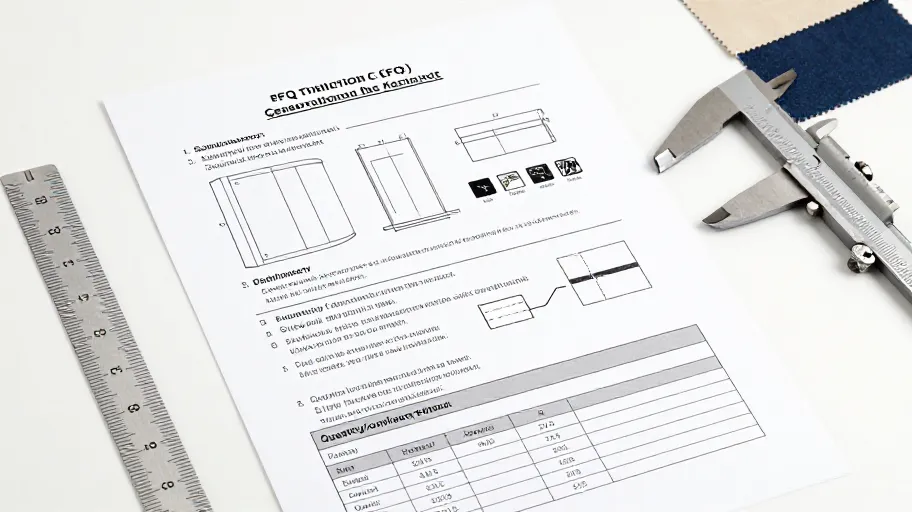
Before you send an RFQ for generation caps, settle five specification areas: structure and sizing, panel and profile, embellishment method, construction details, and quantity with compliance scope. Buyers who quote against documented specifications receive comparable quotes, fewer surprises, and a written record that protects both sides through sampling and production.
Why an RFQ sent too early costs you leverage
An RFQ is not a discovery tool. It is a request for a priced commitment against a defined scope. When specifications are vague, every responding factory fills the gaps with its own assumptions — its default panel profile, its default closure, its default stitching weight — and the quotes that come back are priced against different products. Comparing them is close to meaningless.
The buyer who attaches a clear spec sheet changes the conversation. Factories can price accurately, flag genuine constraints early, and respond with questions that reveal how they think through production. The quoting process itself becomes a supplier evaluation tool.
None of this requires engineering knowledge. It requires deciding, in advance, what you are asking for — and putting the decisions in writing.
The SPEC-5 Gate: five areas to close before quoting
Use this framework as a gate. If any of the five areas is undecided, the RFQ is not ready.
S — Structure and sizing. The cap type (structured five-panel, six-panel, unstructured, trucker, snapback, dad cap, bucket), the sizing system (fitted, adjustable, one-size), and the fit range you expect the cap to cover. Structure affects materials, lining and shaping method, so it belongs at the top of the sheet.
P — Panel and profile. Panel count, crown profile (low, mid, high — decide visually, with references, not by terminology alone), seam style, and whether the crown has a button, eyelets, or reinforced panels. Two caps described identically in words can look entirely different in profile; attach reference images.
E — Embellishment. Embroidery (stitch count expectations, placement, 2D/3D), printing (screen, heat transfer, sublimation), woven or leather patches, appliqué, or a combination. Each method has different artwork requirements, colour-matching behaviour and setup implications. Specify the artwork format you can supply and ask what the factory needs.
C — Construction. Closure type, sweatband material, brim shape and stitching pattern, lining, ventilation, and the thread and stitching approach. This is also where tolerances belong: rather than citing numbers yourself, ask the supplier to state the dimensional tolerances it works to and document the answer.
-5 — Quantity and compliance. Target quantity (and whether it is fixed or tiered), destination market, labelling requirements, and any compliance documentation you need the supplier to evidence. Do not assume any certification exists — ask what the supplier currently holds and can document for your specific product and market.
Decision table: what each specification locks in
| SPEC-5 area | You decide | What it locks in | If left undecided |
|---|---|---|---|
| Structure & sizing | Cap type, sizing system, fit range | Material family, lining, shaping approach | Factory substitutes its default structure |
| Panel & profile | Panel count, profile, seam style | Silhouette and visual identity | Sample looks unlike your reference |
| Embellishment | Method, placement, artwork format | Setup work, colour matching, artwork exchange | Logo rendered in a method you didn't choose |
| Construction | Closure, sweatband, brim, stitching | Wear quality and re-order consistency | Second production run drifts from the first |
| Quantity & compliance | Volume, destination, documentation scope | Whether the supplier can serve the market at all | Compliance gaps discovered after ordering |
The questions to approve in writing
Before the RFQ leaves your desk, be able to answer yes to this pre-flight checklist:
- Cap type, sizing system and target fit range are stated with reference images
- Panel count and crown profile are shown, not just described
- Embellishment method and placement are specified per logo element
- Artwork is available in the format the supplier requires (confirm format directly)
- Closure, sweatband and brim preferences are listed
- Target quantity and any volume tiers are defined
- Destination market and labelling requirements are documented
- Compliance documentation needs are stated as questions, not assumptions
- Supplier's stated dimensional tolerances are captured in writing
- Sampling, tooling and approval stages are named as agenda items in the RFQ
Policy unknowns belong in the RFQ, not after it
Sampling policy, tooling or setup terms, payment structure, lead times, capacity, and compliance evidence are all project-specific and can change. Nothing in this article states them for a reason: they must be confirmed directly with the supplier, in writing, for your specific project. Treat any figure you see online — including anything implied by a catalogue or sample photo — as a question, not an answer.
At New Generation, a Shenzhen-based OEM/ODM manufacturer of custom caps and headwear, the sourcing conversation starts from your specification. The questions above are the ones worth bringing to it.
FAQ
Do I need a full tech pack before requesting a quote for generation caps? A full tech pack helps, but a structured spec sheet covering the SPEC-5 areas is enough to start. The essential point is that every area is decided and documented, so the quote is priced against your scope rather than the factory's assumptions.
How detailed should artwork be at the RFQ stage? Detailed enough to identify the embellishment method, placement and colours. Confirm directly with the supplier which file formats it works with and what it needs for colour matching — don't assume format requirements carry over between projects or factories.
What should I ask about samples before committing? Ask the supplier to explain its current sampling process in writing: what stages exist, what each sample approves, and the terms attached to each stage. Sampling terms are project-specific; confirm them rather than relying on prior experience or general expectations.
How do I keep re-orders consistent with the first production run? Document everything at approval: spec sheet, approved sample references, artwork files, embellishment parameters and the supplier's stated tolerances. A re-order placed against a written record is a far safer basis than a verbal "same as last time."
Which compliance questions matter most for caps? That depends entirely on your destination market and channel. State the market in the RFQ and ask the supplier to evidence, in writing, what documentation it can currently provide for your specific product. Do not treat any certification as existing until it is documented for your order.
Before you send the RFQ
Turn the SPEC-5 Gate into a one-page record. Download the pre-RFQ checklist and work through each gate item before your next sourcing enquiry — then attach it to the RFQ itself.
[下载核对清单]
Prefer to test the framework against a real specification conversation first? Request the checklist version with supplier-facing question prompts and use it directly in your next enquiry.
#cap manufacturers china, #headwear manufacturers china, #cap factory








