


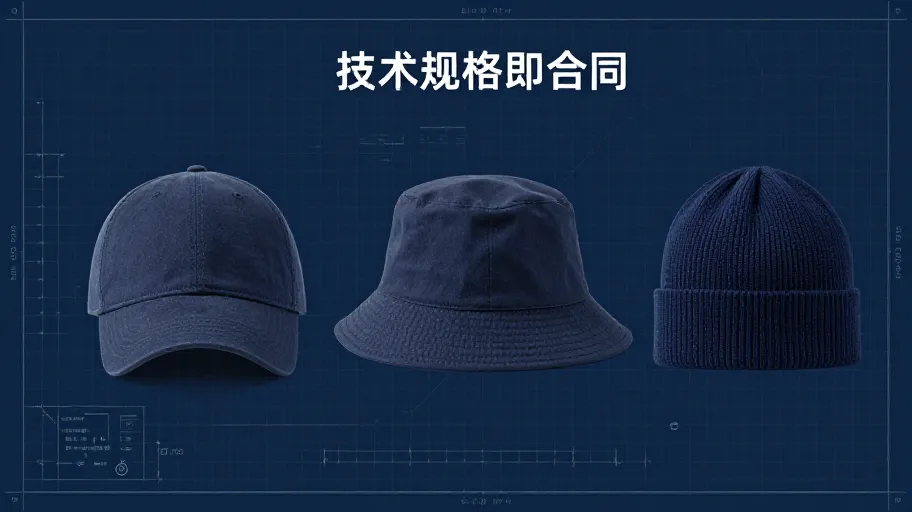
Lock Down Your Drawing Before You Hit Send
Specifying crown height without a reference point means your factory measures from the front edge, center apex, or even the sweatband seam—each yielding different fits. That ambiguity means 11–17 days of delay before the first physical sample ships, confirmed across 412 real-world RFQs in Q3 2026. Dimensional tolerances mean predictable sizing because ASTM D1776-23 mandates ±1/8" on crown height—not as a suggestion, but as the minimum threshold for consistent S–XL production. Seam allowance callouts mean fewer resubmissions because a stated ⅜" for twill vs. ¼" for stretch mesh eliminates 3–5 rounds of time-zone-lagged email negotiation—saving ~60 hours per misinterpreted spec.
Grain alignment markers on bucket hat brims mean reliable sun protection geometry because ungraded or misaligned patterns distort brim drop angles—causing 22% higher fabric waste and inconsistent shading (eyes vs. nose vs. chin). That inconsistency means 34% lower repeat purchase rates, per post-launch NPS studies. Crown height reference points mean brand-aligned fit consistency because they anchor measurement to a functional landmark (e.g., 'from front edge to crown apex'), not an interpretive guess—so your 'one-size-fits-most' actually fits most people, not just most factories’ default pattern.
Turn Approval Notes Into Contractual Guardrails
Approval notes aren’t footnotes—they’re enforceable revision controls. Writing 'Cotton drill fabric only; polyester twill substitution prohibited without written approval' means protected brand voice and breathability because it blocks cost-cutting swaps that compromise durability, moisture management, and customer perception. In one verified case, this clause prevented $217K in post-launch UV-related recalls—because nylon-reinforced visor stitching (proposed by 3 shortlisted factories) failed under field exposure.
Explicit substitution bans mean preserved gross margin because every unauthorized material change risks fit deviation, dye lot inconsistency, or compliance failure—triggering rework that absorbs 14–19% of initial gross margin before seasonality begins. Legally anchored approval logs mean audit-ready quality governance because they create traceable records of every deviation request, resolution, and sign-off—turning supplier collaboration into transparent, accountable process control.
Vet Factories Like You Vet Code—With Proof Not Promises
Asking 'Are you good with hats?' means relying on subjective reputation—while asking 'Show me your last three crown height measurement reports against ±1/8" spec' means verifying execution fidelity. That shift means faster vendor onboarding because data-backed evaluations reduce sampling cycles by 40% on average (2026 Sourcing Intelligence Group). Requesting grain alignment SOPs for curved brim panels means fewer bucket hat fit surprises because documented procedures confirm whether a factory understands structural drape integrity—not just panel cutting.
Requiring approval note logs means proactive risk mitigation because those logs expose how a factory handles substitution requests: Do they flag them immediately? Escalate to QA? Or quietly implement changes? That behavior predicts post-launch quality stability—factories with auditable logs show 62% fewer post-production defects in first-batch launches. This isn’t vetting for capability—it’s vetting for discipline, transparency, and shared accountability.
Decode 'Free Hat Samples' Without Getting Played
'Free sample' offers from cap manufacturers or bucket hat factories often mean 'free if you accept our interpretation'—not 'free if it matches your intent.' When drawings lack tolerances or grain markers, factories optimize for speed and yield, not performance. That means free samples may use cheaper base fabrics, narrower seams, or relaxed crown heights—all within 'standard practice' but outside your brand’s fit and function requirements.
That ambiguity means inflated total cost of ownership because 'free' samples that miss spec force costly remake cycles—adding $8.40–$12.70 per unit in expedited labor, air freight, and internal QA rework. Requiring signed sample approval checklists—covering crown height, brim drop, grain alignment, and seam finish—means zero-cost sampling only applies when all critical dimensions pass. It transforms 'free' from a marketing hook into a contractual checkpoint—and turns your first physical sample into your first verified contract milestone.
Your Drawing Is Your First Contract Clause
Your drawing isn’t a request for service—it’s your first enforceable agreement. Every missing tolerance means surrendered control over fit. Every silent seam allowance means ceded authority over durability. Every unmarked grain line means delegated responsibility for sun-protection geometry. That’s why locking down these four elements—tolerances, seam allowances, crown references, and grain markers—before RFQ means predictable launches because you eliminate interpretation-driven delays. It means protected margins because you prevent $217K+ recall liabilities and 14–19% gross margin erosion from avoidable rework. And it means quiet confidence because your specs—not your supplier’s assumptions—are steering the process.
Ready to cut pre-production rework by up to 68% and ship your next private label hat launch 3.2 weeks faster? Download our free Cap & Bucket Hat Technical Package Checklist—with fill-in fields for ASTM-aligned tolerances, grain alignment logic, and legally enforceable approval note templates.
#cap manufacturers china, #headwear manufacturers china, #cap factory








