


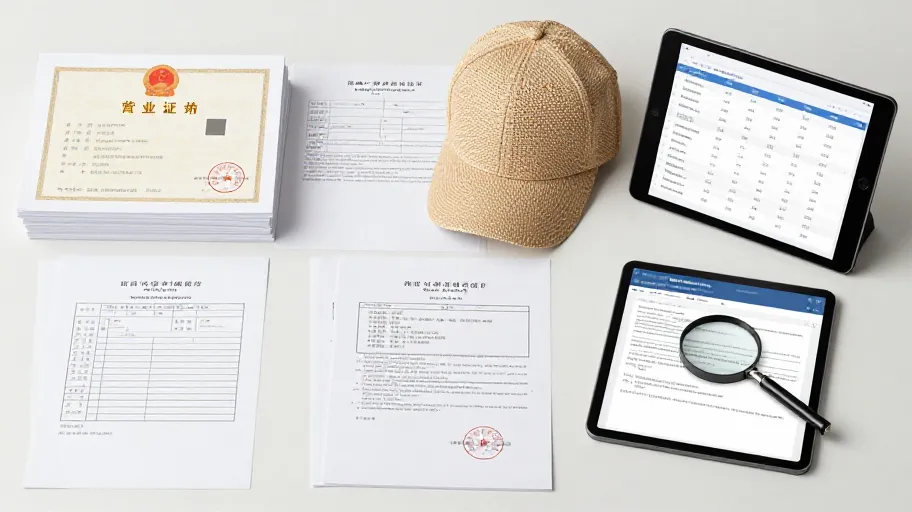
Choosing a hat manufacturer is a documentation decision before it is a price decision. The safest way to compare OEM/ODM candidates in China is to collect verifiable evidence — business registration, production capability proof, quality records and written commercial terms — from every supplier in the same format, and to approve each candidate only when the documents support the claims. Price negotiated without that evidence file is a guess.
This article sets out the Documentation-First Supplier Comparison (DFSC) framework: four stages that convert supplier marketing into a comparable, auditable record you can defend internally.
Why documentation comes before negotiation
Most sourcing failures trace back to terms that were assumed rather than written. A supplier's website can state capabilities; only documents can evidence them. When you compare a hat manufacturer against alternatives, the question is not "who says the most" but "who can evidence what they say, in writing, before I commit budget".
The DFSC framework has four stages:
- Collect — Request the same evidence pack from every candidate: business licence, factory location and photos or video walk-throughs, product categories actually produced in-house, quality-control process description, and export experience summary.
- Normalise — Enter each supplier's responses into one comparison table so differences in scope, inclusions and exclusions become visible rather than buried in quote emails.
- Probe — Ask project-specific questions where any answer is vague: MOQ for your construction, sampling terms, tooling ownership, defect-handling process, IP treatment.
- Approve or park — Approve only candidates whose written answers are complete, consistent and internally coherent. Park the rest with a documented reason.
Because no supplier-specific commercial data was supplied for this article, every term below is framed as a question for you to put to each candidate directly — not as a stated norm.
Hat manufacturer decision table
Score each candidate per category, then compare totals. The table works because it forces every supplier into the same evidence format.
| Evidence category | What to request | What a strong response looks like | Red flag | Score (0–5) |
|---|---|---|---|---|
| Legal identity | Business licence, registered name and address, export registration | Registered name matches the entity you would contract with | Licence refuses verification, or contract entity differs from manufacturer entity | |
| Production capability | Which processes are in-house vs subcontracted; equipment list; site walk-through (in person or live video) | Clear in-house/outside split for cutting, embroidery, sewing, finishing | "Everything in-house" with no walkthrough offered | |
| Quality system | QC inspection stages, AQL or acceptance approach (whatever theirs is — ask), defect-handling procedure | Written stages and a stated method you can review | "We check every hat" with no documented stages | |
| Product fit | Examples of your construction (structured/unstructured, closure type, decoration method) with physical samples | Samples that match your target spec and reveal workmanship | Only catalogue photos, no physical samples process | |
| Commercial terms | MOQ for your spec, sampling policy, tooling/mould ownership, payment milestones — all in writing | Complete written answers, project-specific | Vague answers, or terms that "depend — let's discuss later" | |
| IP and design | NDA willingness in writing; design ownership; whether your files are used for other buyers | Clear written IP position you can review with counsel | NDA resistance or evasive design-ownership answers | |
| Communication | Named contact, response discipline, English-language technical vocabulary for cap construction | Precise answers to technical questions | Only sales-level replies; technical questions rerouted and dropped |
Fill the score column during your evaluation. A candidate weak on legal identity or IP should not be rescued by a low quote.
Approval questions to send every candidate
Copy these into your RFQ. Require written answers; verbal answers are not part of the record.
Capability and process
- Which production stages for this cap construction do you perform in-house, and which do you subcontract?
- Can you provide a live video walk-through of the area where these caps would be produced?
- What is your quality-inspection process at each production stage, and how do you handle defects found before shipment?
Commercial terms (project-specific — confirm current policy directly)
- What is the MOQ for this exact construction and decoration method?
- What are your payment milestones, and at which documented milestones are funds released?
- Who owns the tooling, moulds, digitised embroidery files and patterns once paid for?
Design and IP
- Will you sign our NDA before receiving design files? If you require your own, can we reconcile both?
- Will our designs, colourways or tooling be offered to any other buyer? Please confirm in writing.
Delivery and after-sales
- What is the lead time for this project from approved pre-production sample, and what penalties or remedies apply if agreed dates are missed?
- How are quality claims after delivery documented and resolved?
Any question a supplier declines to answer in writing becomes a data point in your comparison — not a disqualifier by itself, but a documented gap.
Red flags that pause an evaluation
- Contract entity differs from the manufacturing entity, with no explanation.
- Refusal to allow any walk-through, live or in person.
- Commercial terms pushed to "after you place the order".
- No written position on design or tooling ownership.
- Quotes that arrive in a format that cannot be compared line by line with other candidates.
None of these is fatal alone. Each one, undocumented, is risk you are choosing to absorb.
FAQ
Is a hat manufacturer that is actually a trading company automatically worse? Not automatically — but the difference must be documented. If a candidate is a trading company, ask which factory will produce your caps, whether you can audit or walk through that factory, and who holds legal responsibility for quality in the contract. Compare that evidence against true manufacturers using the same decision table.
What documents should I request before discussing price at all? Business licence and export registration, an in-house vs subcontracted process statement, a QC process description, sample availability for your construction, and written commercial-term answers. Price discussed before these documents exists in a vacuum.
How many hat manufacturer candidates should I compare? Enough to see real variation — three to five shortlisted candidates scored in the same decision table gives you comparable evidence without extending the evaluation indefinitely.
Should I visit the factory in Shenzhen or elsewhere in China? If order value justifies it, an in-person or live video audit is the strongest evidence you can collect. Where travel is impractical, a scheduled live video walk-through — not pre-recorded footage — with your technical questions answered in real time is a reasonable substitute. Confirm each candidate's current audit policy directly.
How do I keep design files safe when requesting samples? Use a written NDA before sending production-ready files, send reduced-spec files where possible for initial sampling, and get written confirmation of design and tooling ownership. Have counsel review both the NDA and the ownership clause.
Download the supplier evidence checklist
Run the DFSC framework on every candidate with the same evidence list. 下载供应商证据清单 — then send the identical document set request to each hat manufacturer on your shortlist and compare the answers side by side.
Low-friction next step: if you are not ready to download, start with the eleven approval questions above. Copy them into your next supplier email and file the written answers — that single step converts your comparison from impressions to evidence.
#cap manufacturers china, #headwear manufacturers china, #cap factory








