
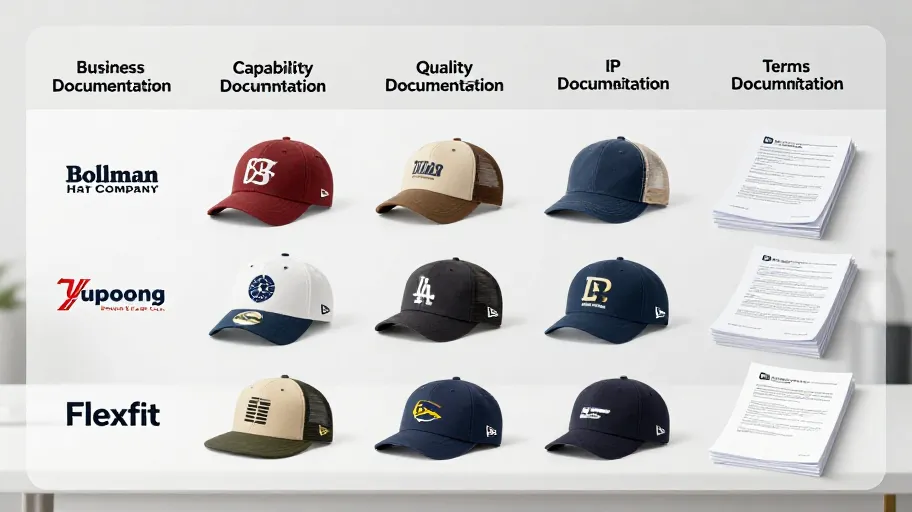
Comparing headwear manufacturers is less about who quotes the lowest number and more about whose claims you can verify in writing. A documentation-first comparison scores every candidate OEM/ODM supplier on the completeness of their business, capability, quality, IP and terms documentation before you weigh price or speed. This article gives you the framework, a decision table and the exact approval questions to send.
The five-layer documentation stack
When we advise buyers evaluating custom cap and headwear suppliers in China, we recommend separating the comparison into five documentation layers. A supplier who answers all five in writing is comparable; a supplier who answers three is not, no matter how attractive the quotation looks.
Layer 1 — Legal and commercial identity. Business licence, export registration, banking details matching the contracting entity, and the named legal entity that will sign your purchase agreement. This layer answers: who am I actually contracting with?
Layer 2 — Capability evidence. What the manufacturer can and cannot produce for your specific product: construction types, decoration methods (embroidery, printing, patch, mixed), materials, closures, and finishing. Ask for it in writing against your own specification, not as a general brochure.
Layer 3 — Quality and inspection documentation. The inspection stages the supplier proposes, what is checked at each stage, how defects are categorised and recorded, and what inspection rights you or your third-party inspector hold during production.
Layer 4 — IP and tooling ownership. Written statements on design ownership, tooling and digitising-file ownership, re-order rights, and confidentiality terms. For private-label buyers this layer can outweigh every other consideration.
Layer 5 — Commercial terms, fully itemised. MOQ per variant, unit pricing basis, sampling terms, payment structure, and delivery terms — each stated as a written, current policy rather than an informal estimate.
No supplier — including New Generation — should be scored on assumptions. Every line above must be confirmed directly with the supplier as a current, written policy before you shortlist.
Decision table: scoring candidate headwear manufacturers
Apply this table identically to each candidate. Score each layer 0 (no answer), 1 (verbal or partial answer), 2 (written, current, complete answer). The supplier with the highest total documentation score earns the sampling conversation — before price is discussed in depth.
| Layer | What to request | Score 0 | Score 1 | Score 2 |
|---|---|---|---|---|
| Legal and commercial identity | Licence, export registration, contracting entity details | Refused or vague | Partial documents | Complete, current, consistent set |
| Capability evidence | Written response to your product specification | Generic brochure only | Partially matches spec | Point-by-point written match/mismatch |
| Quality and inspection | Inspection stages, defect handling, inspection access | No documented process | Described verbally | Documented stages with access rights |
| IP and tooling | Ownership and re-order terms in writing | Not addressed | Template only | Explicit written terms per your project |
| Commercial terms | MOQ, pricing basis, sampling, payment, delivery terms | Numeric claims with no document | Some terms in writing | Fully itemised written quotation |
Interpretation guidance:
- Total 8–10: documentation-complete; proceed to sampling due diligence.
- Total 5–7: conditional; request the missing documents and re-score.
- Total 0–4: not comparable on evidence; deprioritise regardless of quotation.
Approval questions to send every candidate
Paste these into your first RFQ email. Score the answers using the table above.
- Which legal entity signs our agreement, and can you provide current business and export registration documents for that entity?
- Against our attached specification, confirm in writing which construction, decoration methods, materials and closures you can produce — and which you cannot.
- What inspection stages do you propose for our order, what is checked at each stage, and what access would our appointed third-party inspector have during production?
- Who owns the design files, digitising files and any tooling created for our project, and what are the re-order terms attached to them?
- What is your current written policy on MOQ per variant, sampling, payment structure and delivery terms for a project of this scope?
- What is your current sampling policy, including any fees and shipping arrangements, stated in writing?
- If a batch fails an agreed inspection criterion, what is your documented remediation process?
Questions 5 and 6 matter because these terms vary by project and change over time. Never rely on a figure quoted in a forum, a catalogue or a previous order; require a current written confirmation for your own project.
How New Generation approaches this process
New Generation is a Shenzhen-based OEM/ODM manufacturer of custom caps and headwear serving overseas brands, importers, wholesalers and corporate buyers. Our position in a documentation-first comparison is simple: we expect to be scored the same way you score every other candidate. Send us the seven questions above with your specification and we will respond in writing, item by item, including the current policies we can evidence and the limits we cannot — because a comparison only works when every manufacturer is answering the same questions with the same standard of proof.
We do not ask you to accept capability, compliance or commercial claims on trust. Confirm them against documents, and approve only what you can verify.
FAQ
Why compare headwear manufacturers on documentation before price? Because price without documentation is not comparable. Two quotations can differ in tooling inclusion, packaging, inspection scope and MOQ basis. Documentation is the only common denominator that lets you compare offers on equal footing — and it predicts how a supplier will behave when a dispute arises.
What documents should a custom cap manufacturer provide before sampling? At minimum: business and export registration for the contracting entity, a written capability response against your specification, a described inspection process with access rights, IP and tooling ownership terms, and an itemised written quotation. Anything the supplier cannot document, treat as unconfirmed.
How do I verify a headwear manufacturer's quality claims? Convert claims into documented inspection stages and criteria, secure written third-party inspection access, and confirm the remediation process for failed batches. Verify during the order, not after shipment.
Who owns my cap designs and embroidery files? Only your written agreement decides this. Ask for explicit ownership and re-order terms before tooling or digitising begins, and confirm the answer applies to your project, not a template policy.
What if a supplier won't answer these questions in writing? Score them accordingly and deprioritise. A manufacturer unable or unwilling to document identity, capability, quality, IP and terms cannot be reliably compared — and unverifiable claims should carry no weight in your shortlist.
Download the supplier evidence checklist
Turn this framework into a working audit tool. 下载供应商证据清单 to get the full evidence checklist: every document to request, every approval question, and the scoring grid — so your next supplier comparison runs on proof, not promises.
Prefer to start smaller? Use the seven approval questions above as your first-pass checklist for any candidate manufacturer, and download the full evidence version when you're ready to shortlist.
#cap manufacturers china, #headwear manufacturers china, #cap factory