


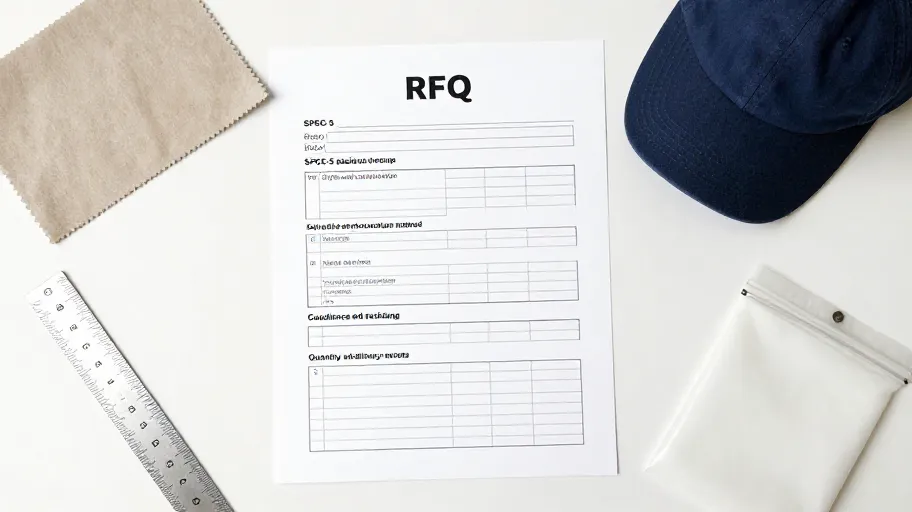
Before issuing an RFQ for custom headwear, settle five specification groups in writing: style and construction, embellishment method, materials, compliance and packaging, and quantity and delivery terms. The SPEC-5 Framework turns each group into a fixed input plus an approval question. Doing this before first contact makes quotations comparable and reduces costly clarification loops.
Why incomplete specifications distort quotations
When a custom headwear RFQ is vague, suppliers fill the gaps with assumptions. One may quote on a lighter fabric, another on a different embellishment method, a third on export packaging you never asked for. The quotations arrive at different prices and different scopes, and comparing them becomes guesswork. Worse, assumptions made at quotation stage can silently carry into sampling and bulk production, surfacing as disputes after goods ship.
The remedy is not to write a longer RFQ. It is to fix a small number of decisions early, document them, and require the supplier to confirm each one in its response.
The SPEC-5 Framework
Work through five groups before contacting any manufacturer:
- Style — crown shape, closure type, brim or visor style, and the reference images or physical references you will allow the supplier to work from.
- Panel and construction — panel count, seam type, lining, sweatband material, structural interlining, stitching density and thread specification.
- Embellishment method — embroidery, printing, woven labels, patches, or a combination; placement, colour count and artwork format.
- Compliance and packaging — requested test or certification evidence, labelling requirements for your destination market, and packing configuration.
- Quantities and delivery terms — order quantity, size or colourway breakdown, Incoterms, and how you will review and approve samples at each stage.
Each element is either a decision you make now, or a documented question the supplier must answer in its quotation.
Decision table: fixing specifications before the RFQ
| SPEC-5 area | What to settle before the RFQ | Approval question for the supplier |
|---|---|---|
| Style | Crown shape, closure, brim style, reference images | Which reference will govern if drawings and images conflict? |
| Panel and construction | Panel count, seams, lining, sweatband, interlining | What construction details can you document in a confirmed spec sheet? |
| Embellishment | Method, placement, colour count, artwork files | What file formats and stitch or print references do you require for approval? |
| Materials | Fabric composition and weight, thread, trims | Which material options can you present with swatches for our selection? |
| Compliance and packaging | Required test or certification evidence, labels, packing | What documentation can you provide against our stated requirements for our destination market? |
| Quantities and delivery | Quantity, breakdown by colourway/size, Incoterms, approval stages | What are your current MOQ, lead time, sample policy and payment terms for this specification? |
The final row contains commercial terms. These are project-specific: confirm current MOQ, pricing, sampling arrangements, lead times and terms directly with each supplier, in writing, and attach the answers to the specification sheet.
Approval questions to embed in every RFQ
Beyond the table, put these questions in the RFQ document itself:
- Who owns the technical package once specifications are confirmed, and how are changes requested and versioned?
- What sample stages does the supplier propose, and what does each stage require us to approve before production proceeds?
- How will the supplier document material substitutions, if any, and require our sign-off before use?
- What inspection points and documentation can the supplier support before shipment?
- What is the current policy on samples, fees and shipping for samples — confirmed directly and in writing?
Do not rely on verbal assurances. Ask for each answer in a reply that references the RFQ version number, so the record travels with the project.
Evaluating supplier responses
A useful quotation does three things. It restates your specification in the supplier's own words, exposing misunderstandings early. It answers every approval question explicitly, including the commercial terms you asked to confirm. And it flags where the supplier cannot meet a requirement rather than remaining silent.
Compare responses line by line against your SPEC-5 sheet. Where a supplier answers "we will confirm later", treat the item as unresolved and push for a written answer before shortlisting. Where two suppliers quote different constructions for the same item, the specification was not tight enough — fix it and re-quote rather than negotiating the difference.
Pre-RFQ checklist
Use this checklist before sending the RFQ to any headwear manufacturer:
- Style references selected, with one governing reference designated
- Panel count and construction details written down
- Fabric composition and weight specified, or swatch selection process defined
- Embellishment method, placement and artwork files finalised
- Labelling and packaging requirements for the destination market documented
- Test or certification evidence requested in the RFQ itself
- Quantity breakdown by colourway and size confirmed internally
- Incoterms and approval stages agreed internally
- Commercial questions (MOQ, lead time, sampling, payment) listed for written answers
- RFQ version number assigned for traceability
FAQs
Which specification causes the most disputes in custom headwear sourcing? No single item can be named as a rule, but disputes cluster where specifications were never written down — material substitutions, embellishment placement and packaging are frequent areas. Documenting each in the RFQ closes that gap.
Should I send the RFQ to one manufacturer or several? Several quotations are easier to compare when the SPEC-5 sheet is fixed. Vague RFQs make multiple quotes incomparable, which is the problem this framework prevents.
How detailed should artwork files be? Detailed enough that the supplier can confirm placement, size and colour count in writing, and that both parties can check the sample against the same file. Ask the supplier which formats it requires for approval.
What commercial terms must I confirm directly with a supplier? Current MOQ, pricing, sampling arrangements, lead times, payment terms and shipping arrangements. None of these should be assumed from any article, catalogue or prior project — confirm each in writing for this specific order.
How do I handle specification changes after the RFQ? Version the document, record the change, and require written confirmation from the supplier before it affects sampling or production. This keeps the approval trail intact.
Get the full checklist
下载核对清单 — download the complete pre-RFQ specification checklist and attach it to your next headwear enquiry, so every supplier answers the same questions in writing.
Short on time? Start with the pre-RFQ checklist above and download the expanded version when your project is ready.
#cap manufacturers china, #headwear manufacturers china, #cap factory








