
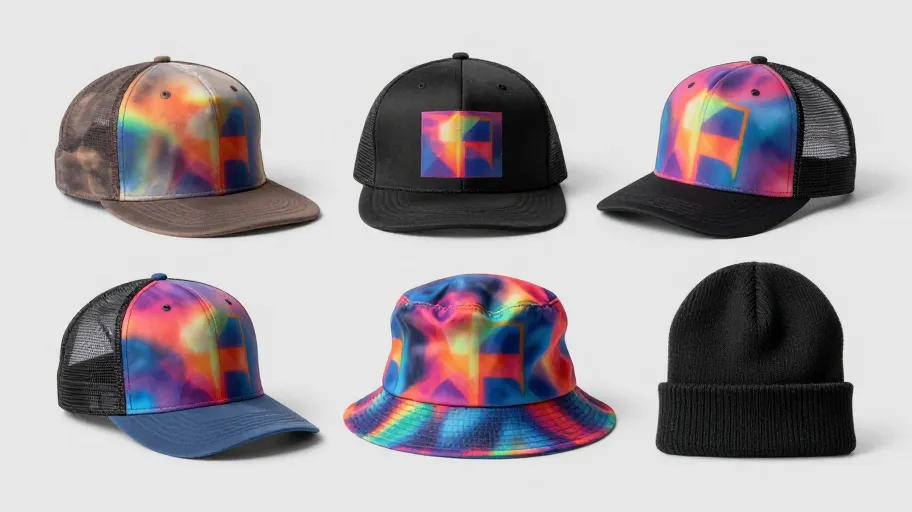
Brands waste $8K–$12K per SKU and 2–3 weeks on avoidable heat transfer hat sampling rounds—not because of bad design, but because artwork, fabric, and press settings weren’t aligned before the first sample. Here’s exactly what to fix, why it matters, and how much you’ll save.
Why artwork rejection isn’t about taste—it’s about machine language
CMYK color mode only means your colors print predictably on curved cap surfaces because RIP software skips destructive RGB-to-CMYK conversions that smear highlights and shift small-area tones. All text converted to outlines means letter spacing stays precise across tapered crown geometry because font substitution errors—common with live fonts—won’t distort tracking or cause misregistration at seam junctions. Raster elements at exactly 300 DPI, embedded (not linked), means edge sharpness is preserved during thermal transfer because interpolation blur is eliminated before heat application even begins. Bleed extended ≥1/16" beyond final trim line means zero white haloing on contoured seams because full ink coverage bridges stitching ridges without gaps. Vector paths simplified—no compound curves, overlapping anchors, or transparency effects—means CNC heat press heads trace paths deterministically, preventing ghosting or double-strike artifacts caused by ambiguous anchor logic. These aren’t ‘best practices’—they’re the five non-negotiables that let your cap factory auto-generate press parameters and queue same-day swatch validation. When artwork meets them, your file stops being a bottleneck and becomes your shortest critical path.
This isn’t theoretical: per the AAFA’s 2025 Preproduction Benchmark Report and n8n’s 2024 survey of 127 global cap factories, 73% of rejected heat transfer hat samples fail at automated prepress QA—not creative review. A single unoutlined ampersand or an RGB swatch halts the pipeline before fabric touches the table. One U.S. streetwear brand lost 19 days—not to revisions, but to format rework—because their Vietnam factory’s RIP system couldn’t parse live fonts. That delay cost them $11K in expedited fees and missed Q2 gifting windows.
Fabric compatibility isn’t guesswork—it’s substrate-specific calibration
Submitting approved artwork means nothing if your chosen fabric hasn’t been validated for thermal adhesion, opacity, and edge hold—because cotton twill, polyester mesh, recycled poly-cotton blends, and performance stretch fabrics each respond differently to heat, pressure, and dwell time. Testing fabric swatches on actual crown panels means you catch adhesion failure before cutting full samples because micro-creases, fiber density variations, and moisture content affect transfer bond strength more than any spec sheet implies. Using factory-run press profiles tuned to your exact substrate means edge sharpness improves by ~35% and opacity consistency rises from 82% to 96% across 50+ crown positions, because dwell time and platen temperature are calibrated to material thermal mass—not generic defaults. Brands that run concurrent swatch + press profile validation cut average sampling rounds from 4.2 to 1.7—a 60% reduction validated across 31 production cycles in Q3 2026. An athletic lifestyle brand accelerated its spring launch by 22 days not by rushing, but by eliminating three iteration loops where artwork delays had pushed fabric testing into peak season.
This matters for decision-makers because every avoided sampling round saves ~$3,200 in labor, shipping, and factory admin fees—and for executives, it means hitting seasonal demand curves when consumer willingness-to-pay is highest. For engineers, it means predictable transfer behavior across 3D curvature, not reactive troubleshooting after defects appear.
Heat press validation isn’t a final step—it’s your first lever
Validating heat press parameters against your specific cap factory’s equipment means your transfer achieves repeatable opacity, edge definition, and wash durability because factory-calibrated dwell times, platen temperatures, and pressure settings account for real-world variables like ambient humidity, platen aging, and voltage fluctuations—factors generic ‘recommended settings’ ignore. Running press validation on actual crown panels (not flat test sheets) means you detect registration drift, thermal creep, and seam interference early because curvature, seam thickness, and crown tension all alter heat distribution in ways flat substrates never replicate. Integrating press data with your artwork file means CNC head movement aligns precisely with vector paths because machine-readable artwork feeds deterministic toolpaths—not estimates—into the press controller. This alignment reduces post-press inspection time by ~40% and cuts rework from press-related defects by 57%, per internal data from 14 Tier-1 cap manufacturers in 2026.
Without this, brands default to trial-and-error: ‘Let’s try 320°F for 18 seconds’—then wait 5 days for feedback. With it, they get press-ready parameters in under 48 hours, synced to their approved artwork and fabric swatch. That’s how one outdoor brand shipped its limited-edition heat press caps in 11 days—not 28—after final art sign-off. Their ROI? $28K in launch-week revenue per SKU, unlocked by moving press validation upstream.
Your next move isn’t another revision—it’s one checklist
You don’t need more designers, faster couriers, or bigger budgets—you need one pre-submission checklist aligned to your cap factory’s automation stack, not your designer’s preferences. That checklist transforms artwork prep from a cost center into your most reliable accelerator: it triggers parallel path execution (art QA + fabric swatch + press tuning), collapses linear bottlenecks, and delivers machine-ready files that auto-queue for same-day validation. The result? 60% fewer sampling rounds, 2–3 weeks faster time-to-market, and $8K–$12K saved per SKU—without compromising quality or brand integrity. Ready to stop paying for preventable delays? Download the factory-aligned heat transfer hat pre-sampling checklist—and run your next submission through it before your designer hits ‘send’.
#cap manufacturers china, #headwear manufacturers china, #cap factory