


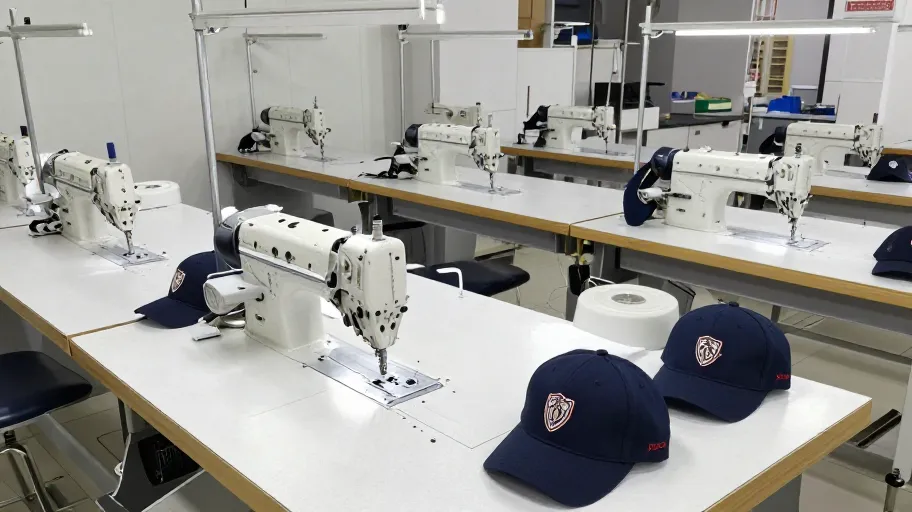
Search results for the “best cap manufacturers China” can only show you who markets well. To find the right partner for a private-label headwear programme, use the Verify–Compare–Document (VCD) framework: verify each factory’s capability with evidence, compare candidates against your own weighted criteria, and document every agreed term before the first purchase order. That process, not a ranking, defines “best” for your project.
Why “best” is a verification problem, not a ranking problem
A manufacturer that suits one brand’s six-panel cotton cap programme may be wrong for another brand’s structured, embroidered, multi-colour line. Sizing, panel construction, closure types, decoration methods and packaging all change what “capability” means. Instead of asking which factory is best, ask which factory can prove it can execute your specific spec, on your terms, with your documentation requirements.
The VCD framework keeps the comparison honest:
- Verify — test every capability claim against physical and documentary evidence: samples, line conditions, export history, communication quality.
- Compare — score candidates on the same weighted dimensions, in writing, so decisions survive team changes and re-order cycles.
- Document — convert verbal assurances into signed specifications, approval gates and contractual terms before money moves.
Decision table: how to score candidate cap manufacturers
Use this table as your comparison backbone. Weight each row according to your programme, then score every candidate on the same scale.
| Dimension | What to ask for | Evidence to demand | Red flag |
|---|---|---|---|
| Product capability for your spec | Confirmation they can produce your exact construction, materials and decoration method | Counter-sample made to your tech pack, not a catalogue sample | Vague “we can do everything” answers with no sample |
| Sample process | Current sample policy, cost, revisions and timing — confirm directly, in writing | A documented sample procedure you can reference in the PO | Refusal to put sample terms in writing |
| Quality control | Inspection stages from incoming fabric to finished caps | Written QC flow; agreed AQL or acceptance criteria you define together | No inspection checkpoints between materials and cartons |
| Approval gates | Who signs off the golden sample and pre-shipment inspection | Named approval steps in the production agreement | Shipping without your final approval right |
| IP protection | NDA terms, artwork file handling, tooling ownership | Signed NDA before sending designs; clarity on moulds and digitised embroidery files | Pressure to send full artwork before any agreement |
| Export experience | Track record with your destination market’s documentation needs | Ability to answer labelling, packing and customs documentation questions for your market | Guesswork on export paperwork |
| Communication | One accountable contact window; response discipline | A named merchandiser or project owner | Anonymous “sales team” replies with no ownership |
| Commercial terms | MOQ, pricing structure, payment split, Incoterms, lead time — all confirmed directly | A written quotation valid for a stated period | Verbal quotes that shift after sampling |
No row in this table can be filled from a website. Each one is a question to put to the supplier and record in your comparison sheet — which is exactly what the scorecard below is for.
下载 Supplier Scorecard and run every candidate through the same weighted evaluation before you commit.
Approval questions to send every candidate factory
Send this set before quoting, not after. The quality of the answers tells you as much as the answers themselves.
- Can you produce a counter-sample from our tech pack, and what is your current sample policy regarding cost, revisions and timing? (Confirm the current policy directly; do not assume.)
- Which parts of our specification — crown construction, closure, brim, materials, decoration — would be made in-house versus subcontracted?
- What inspection checkpoints exist between incoming materials and packed cartons, and can we set our own acceptance criteria in writing?
- Will you hold a golden sample after our approval, and can pre-shipment inspection compare bulk against it with our right of final approval?
- What are your NDA terms for artwork, embroidery files and any tooling, and who owns that tooling after payment?
- What are your current MOQ, lead time, payment structure and Incoterms for a first order — and can you issue them as a written quotation?
- Which export documentation can you provide for our destination market, and can you walk us through it on a call?
- Who is the single named contact accountable for our project from sampling through shipment?
A factory that answers with specifics and documentation is demonstrating how it will behave during production. One that answers with reassurances is demonstrating the opposite.
Locking quality from sample to bulk
Most private-label disputes trace back to a gap between the approved sample and the delivered cartons. Close that gap with written approval gates:
- Gate 1 — Materials approval: approve swatches or trims against the tech pack before cutting.
- Gate 2 — Counter-sample approval: one physical sample, signed and held by both sides as the golden sample.
- Gate 3 — Pre-shipment inspection: bulk checked against the golden sample under acceptance criteria you agreed in the PO, with your approval required before dispatch.
Whether inspection is performed by your own staff, a third-party inspector or the buyer’s agent is a project decision — but the gates themselves, and your right of approval at each one, belong in the production agreement. Confirm the current inspection policy and any associated arrangements directly with the supplier in writing.
IP, terms and risk: document before the first payment
For brands, the cap design, logo treatment and embroidery files are assets. Before sending any artwork:
- Require a signed NDA covering design files, patterns, digitised embroidery data and any custom tooling.
- Agree in writing who owns tooling, moulds and digitised files, and what happens to them if you move production.
- Put the payment structure, Incoterms, quotation validity and any deposit terms in a written document — confirm each directly rather than relying on chat history.
- Keep every approval in one project file so re-orders reference the same standard.
FAQs
How many cap manufacturers should I compare for a private-label project? Three to five candidates is a workable range: enough to see real differences in capability, communication and documentation, few enough to complete counter-sampling and factory verification for each. Score them all on the same weighted table.
Should I visit the factory in Shenzhen or elsewhere in China? A visit is the strongest verification step available, and many buyers combine visits to several suppliers in one trip. If a visit is not practical, ask for a live video walk-through during working hours and an independent third-party audit. Either way, verify capability with evidence rather than assurances.
What documents should be in place before the first purchase order? At minimum: a signed NDA, a written specification or tech pack, an approved golden sample held by both parties, a written quotation covering MOQ, lead time, payment structure and Incoterms, and a production agreement describing your inspection gates and right of final approval.
How do I compare a trading company and a factory making caps? Ask directly which processes are in-house and which are subcontracted, and request evidence for each. Either model can serve a private-label programme well; what matters is that you know who controls each step and who is accountable when something drifts.
What makes a supplier “the best” choice for my brand? The supplier that can prove — through counter-samples, documented QC gates, clean export answers and signed terms — that it can execute your specific cap programme at your quality level. That proof, gathered through the VCD framework, is the only ranking that matters.
Ready to compare suppliers properly? 下载 Supplier Scorecard — a weighted evaluation template covering capability, sampling, QC gates, IP terms and commercial conditions, built for private-label headwear projects.
Not ready to score yet? Start with the free pre-order checklist above: send the eight approval questions, collect written answers, and keep every response in one project file. That alone will separate credible manufacturers from confident marketing.
#cap manufacturers china, #headwear manufacturers china, #cap factory








