


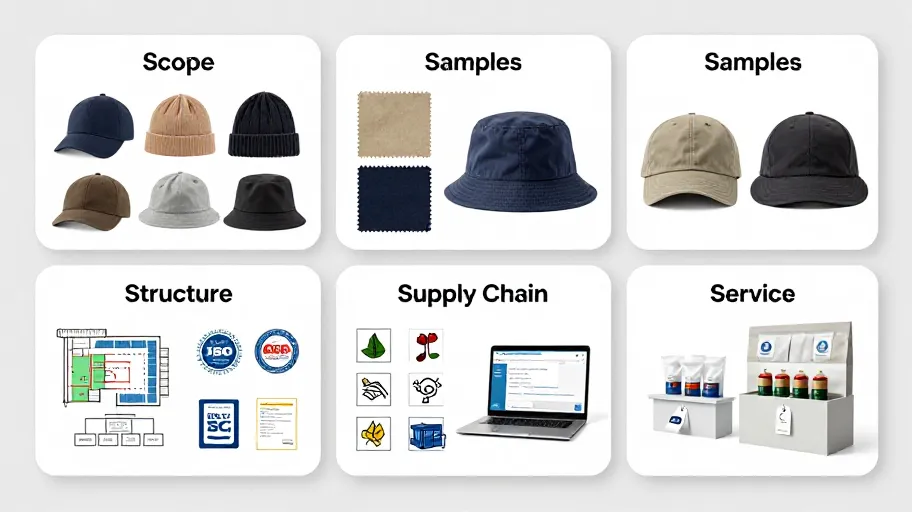
Searching for the best hat manufacturers china produces long lists of suppliers making similar promises — but a private-label headwear project is won or lost at the comparison stage. The buyers who succeed apply a repeatable screen — the 6S Supplier Screen: Scope, Samples, Structure, Standards, Supply chain, and Service — before any deposit is discussed.
Why a screen matters more than a shortlist
When you evaluate custom cap and headwear manufacturers as an overseas brand, importer, or corporate buyer, every factory profile you see will look convincing. Catalogues are polished, response times at the enquiry stage are quick, and product photos are well-lit. None of that tells you whether the supplier can execute your specification — a structured 6-panel cap with your embroidery, labelling, and packaging requirements — at a consistent standard across an order.
A screen gives you three things a shortlist cannot:
- Comparability. The same questions, asked the same way, to every candidate.
- Evidence discipline. Claims you can document rather than impressions you can't.
- A paper trail. Written answers you can reference when a specification or term is later disputed.
The 6S Supplier Screen below is designed for exactly this. Use it to structure first-round enquiries, then score each candidate on the Supplier Scorecard before narrowing to sampling.
The 6S Supplier Screen
1. Scope. Does the manufacturer actually produce the type of headwear you need — for example, structured baseball caps, unstructured dad caps, beanies, or bucket hats — as a core product rather than an occasional line? Ask which construction methods they handle in-house versus subcontract, and which processes (embroidery, printing, woven labels, custom metal buckles) they do themselves.
3. Structure. Who exactly will handle your project? Ask for the name and role of your main contact, whether there is a dedicated merchandiser for your account, and who is responsible for interpreting your tech pack. Communication gaps, not production problems, cause most private-label disappointments.
4. Standards. Ask how the supplier defines an acceptable product: what their internal quality-check points are, at which production stages inspection happens, and how defects found in-line are handled. Request documentation of their quality-management approach rather than a certification logo alone — then verify any certificate they present directly with the issuing body.
5. Supply chain. For materials and trims — fabric, buckles, sweatbands, labels — ask where they are sourced, whether alternative material options exist if one becomes unavailable, and how substitutions are approved. Substitution without consent is one of the quietest ways a private-label product drifts from what you approved.
6. Service. Ask about revision handling on samples, how changes after sample approval are documented, what communication cadence they propose during production, and what reporting you receive before shipment. Then confirm lead times, order quantities, payment terms, and shipping arrangements for your specific project — these are project-specific and must be quoted directly, not assumed.
Supplier comparison decision table
Use a table like this to score each candidate. Score from 1 (unverified claim only) to 5 (documented and verified).
| Criterion | What good evidence looks like | What to reject | Score (1–5) |
|---|---|---|---|
| Scope match | In-house capability for your cap type and decoration, stated in writing | "We can make anything" with no construction detail | |
| Sample process | Written sample policy including fees, shipping responsibility, and timeline | Verbal assurances only | |
| Account structure | Named contact and escalation path | Generic mailbox, changing contacts | |
| Quality standards | Documented inspection points and defect-handling procedure | Certification logos with no process explanation | |
| Supply chain | Named material sources and a written substitution-approval step | "Materials vary by availability" with no approval process | |
| Service | Agreed reporting cadence and change-control in writing | "We'll keep you updated" with no format |
A candidate worth sampling scores well on at least Scope, Samples, and Standards — with the rest verified before you commit to a production order.
Approval questions to ask before you sign anything
Bring these to your first serious conversation with each shortlisted factory:
- "Which parts of my cap — crown construction, visor, closure, decoration — do you produce in-house, and which involve subcontractors?"
- "What is your current sample policy for this project, including any fees and shipping responsibility?" (Confirm in writing; do not rely on assumptions or what another supplier told you.)
- "What is your minimum order quantity for my specified construction and decoration?" — this varies by product and process, so get the figure for your exact spec.
- "What inspection checkpoints exist during production, and what report do I receive before shipment?"
- "If a material or trim I approved becomes unavailable, what is the approval process before substitution?"
- "What payment terms and production lead time apply to an order of my quantity and specification?"
The value of these questions is not only the answers — it is whether the supplier answers precisely and in writing. Vagueness at the enquiry stage becomes ambiguity at the production stage.
Verification checklist before you shortlist
- Same question set sent to every candidate; answers filed in writing.
- Sample policy, including any fees and shipping responsibility, confirmed in writing for each supplier.
- Named contact and role confirmed for each supplier.
- Quality-check process documented, not just claimed.
- Any presented certificate verified independently with the issuing body.
- MOQ, price, lead time, and payment terms quoted for your specific specification.
- Substitution and change-approval procedures agreed in writing.
- Reference checks or third-party inspection arranged for final candidates.
Red flags worth pausing on
No single warning sign proves a problem, but patterns deserve attention: reluctance to put terms in writing; a price quoted instantly without understanding your specification; pressure to skip the pre-production sample; certificates offered without documentation; and a contact who changes repeatedly during enquiry. In each case, the remedy is the same — ask for the detail in writing, and compare how each supplier responds.
FAQ
How do I compare hat manufacturers in China fairly when each has a different quoting style? Normalize the comparison: send an identical enquiry — same specification, same quantities, same questions — to each candidate, and score the written responses against the same criteria. Then normalize commercial terms: ask each for MOQ, unit pricing at your quantities, lead time, and payment terms for the same spec, and confirm every figure directly with that supplier for that project.
What documents should I request before sampling? Ask for a written sample policy, a description of their quality-inspection process, the name and role of your contact, and — for any certification they cite — the certificate number so you can verify it with the issuing body. Confirm what a pre-production sample will include for your project and who bears which costs.
Should I work with a manufacturer or a trading company? Both can work; what matters is transparency and accountability. Ask directly whether the party you're speaking with manufactures in-house or sources from partner factories, which parts of production are in-house, and who is contractually responsible for quality and delivery. Judge candidates on how clearly and verifiably they answer, not on the label.
How can I verify quality before committing to a full order? Use the sample stages: confirm what each sample round includes and what it is meant to verify, approve the pre-production sample as your reference standard in writing, and arrange inspection — your own, a third party's, or the supplier's documented process with reporting — before shipment. Confirm inspection arrangements with your supplier for your specific order.
What should be in writing before production starts? At minimum: the approved specification and sample reference, MOQ, unit price, production lead time, payment terms, substitution and change-approval procedures, inspection arrangements, and packaging and labelling requirements. If a term isn't written, it isn't agreed.
Your next step
Download the Supplier Scorecard — the 6S scoring sheet used above, with the full question set and comparison table ready to fill in for each candidate factory. Use it to turn your best hat manufacturers china shortlist into a documented, comparable evaluation before you commit.
Prefer to start smaller? Copy the verification checklist above into your enquiry email and send the same questions to every supplier on your list today. Consistency is the fastest way to separate real capability from a good profile page.
#cap manufacturers china, #headwear manufacturers china, #cap factory








