


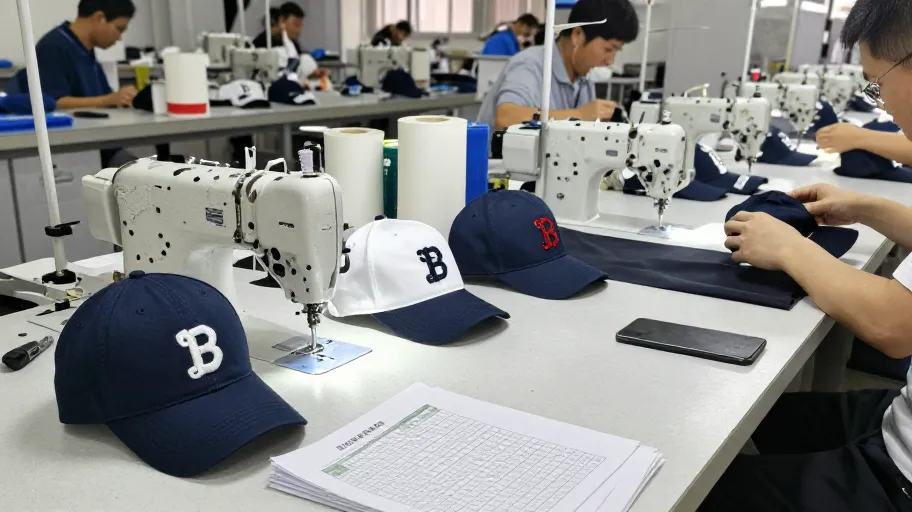
Comparing custom baseball cap manufacturers in China comes down to seven verifiable factors: capability, accountability, process control, reliability evidence, economics, yield management and documentation. Instead of trusting sales claims, score each factory against the same weighted checklist, request written confirmations for every policy, and approve a pre-production sample before any deposit. This article gives you the framework and the questions to do exactly that.
The CAP-READY framework for evaluating custom baseball cap manufacturers in China
When importers lose money on a private-label headwear project, the cause is rarely one bad factory. It is an unstructured selection process in which claims were compared instead of evidence. The CAP-READY framework forces every candidate through the same seven checks:
- C — Capability. Can the factory actually build your construction? Six-panel structured caps, five-panel, unstructured dad caps, trucker mesh, snapback and fitted constructions each demand different machinery and pattern expertise. Ask which constructions they produce in-house versus subcontract, and how they document that distinction.
- A — Accountability. Who answers for defects? Request the written procedure for raising, documenting and resolving a quality claim, including who signs off on disposition of rejected goods.
- P — Process control. Ask how specifications move from your tech pack to the cutting table: pattern digitisation, embroidery or printing file handling, colour matching method, and in-line inspection points. A factory that cannot narrate its own workflow is a risk regardless of its quotations.
- R — Reliability evidence. Ask for verifiable evidence of repeat production, export experience and communication discipline — for example, reference procedures, audit availability and response-time commitments in writing. Do not accept verbal assurances; confirm what can be documented today.
- E — Economics. Request every fee category in writing: sampling, tooling or digitising, revision rounds, packaging customisation and any charges connected to changes after approval. Confirm the current policy for each item directly — never assume any charge is waived or credited.
- Y — Yield management. Discuss how over/under shipment quantities are agreed, how defects are counted, and what inspection standard (such as an agreed AQL discussion) will govern acceptance. Every number here is project-specific and must be negotiated, not assumed.
- D — Documentation. Confirm which compliance documents, material declarations and traceability records the factory can provide for your target markets, and verify current validity rather than accepting file copies at face value.
Decision table: scoring candidate factories
Score each supplier from 1 (weak) to 5 (strong) on every criterion. Weights reflect what drives private-label outcomes; adjust them to your own priorities.
| Criterion | Weight | What to verify | Strong evidence looks like | Weak evidence looks like |
|---|---|---|---|---|
| Construction capability | 20% | In-house production vs subcontracting for your exact cap type | Written construction list with machinery detail | Vague "we make all caps" claims |
| Tech-pack handling | 15% | How specifications are confirmed before sampling | Structured spec review with a countersigned confirmation sheet | Sampling starts before spec agreement |
| Golden-sample discipline | 15% | Whether an approved sample governs mass production | Signed, dated, retained reference sample with both parties | Sample approved verbally or by photo only |
| Quality-control process | 15% | In-line and final inspection points, defect counting method | Named inspection stages with recorded results | "We check quality" with no method |
| Fee transparency | 10% | Written schedule of sampling, tooling, revision and change fees | Complete written fee schedule per category | Fees appear only after decisions are made |
| Communication discipline | 10% | Response reliability and single point of accountability | Named merchandiser with documented escalation path | Rotating contacts, unanswered questions |
| Documentation & compliance | 15% | Export documents, material declarations, audit availability | Current documents offered for your market | "No problem" without documents |
A factory scoring below 3 on capability, golden-sample discipline or quality control should not advance to sampling, whatever its other scores.
Approval questions to put in writing
Send this list to every candidate and compare the written answers side by side. Any refusal to answer in writing is itself data.
- Which cap constructions do you produce in-house, and which do you subcontract? To whom?
- Walk us through your pre-production process from approved tech pack to first sample: who checks what, and at which stage do we confirm?
- What is your current sample policy — cost, timeline, and what happens to charges if we proceed to production? (Confirm the current policy directly; do not rely on past arrangements.)
- Which fees apply to tooling, digitising, revision rounds and packaging changes, and when are they triggered?
- How are production defects counted, and what inspection standard do you propose we agree for acceptance?
- What procedure governs a quality claim after delivery, and who has authority to resolve it?
- Which documents can you provide for our destination market, and how do you evidence they are current?
- Can we arrange a factory audit or video walkthrough of the production floor for our construction type?
- How do you handle agreed over/under quantities and reject disposition?
- Who is our named contact, and what is the escalation path if responses stall?
Red flags that justify pausing a project
- Sampling begins before the tech pack is countersigned
- Fees surface incrementally after each approval
- Inspection methods cannot be described, only promised
- Documents offered as screenshots rather than verifiable originals
- The factory cannot say which processes happen on its own floor
None of these alone proves a bad partner — but each one removes your ability to hold the partner accountable later. Verify, document and approve before you commit.
FAQ
Is OEM or ODM the right model for a private-label cap project? OEM means you supply the full design and specification; ODM means you adapt an existing factory design. OEM suits brands with a defined identity and a finished tech pack; ODM suits buyers who need a faster route to a sellable product with limited design input. Ask each manufacturer which model they support for your construction and how much design support is included.
How do I compare quality between two custom baseball cap manufacturers in China? Use identical inputs: the same tech pack, the same evaluation criteria, the same written question list. Score both samples against the golden-sample discipline and process-control criteria above. Comparing quotations without comparing evidence is the single most reliable way to choose the wrong supplier.
What documents should I request before placing a deposit? A countersigned tech pack or spec sheet, a written fee schedule, a signed pre-production sample approval record, the agreed inspection and acceptance method, and whatever compliance documentation your destination market requires. Confirm each document's current validity directly with the supplier.
Should I audit the factory before ordering? An audit — on-site or by structured video walkthrough — is the strongest way to confirm that the processes described to you exist. Whether it is mandatory depends on your order value, risk tolerance and regulatory exposure. Frame it as one of the CAP-READY reliability checks rather than a courtesy request.
How do I keep specifications from drifting between sampling and mass production? Anchor everything to a signed golden sample held by both parties, and require written confirmation at every change point. Any revision to materials, colours or decoration should trigger a new approval round before production continues.
Run the comparison yourself
Download the Supplier Scorecard — the same seven-pillar CAP-READY scoring sheet used above, formatted so you can evaluate multiple custom baseball cap manufacturers in China side by side and attach the written answers as evidence.
Not ready to contact suppliers yet? Start with the ten approval questions above: copy them into an email, send them to your shortlist, and compare which manufacturers answer in writing and which deflect. That single step filters more candidates than any brochure ever will.
#cap manufacturers china, #headwear manufacturers china, #cap factory








