


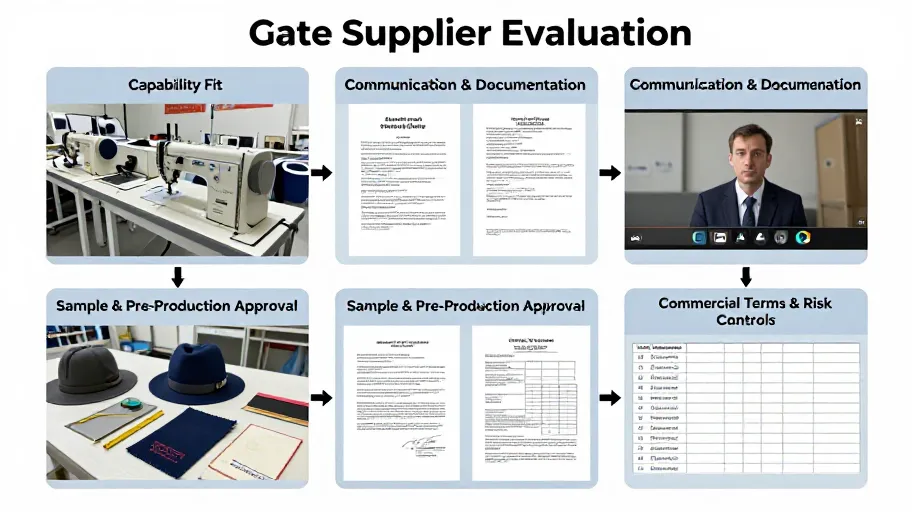
Evaluating men hat manufacturers in China for a private-label project comes down to one discipline: replace every assumption with a documented answer before you commit money. Use the Four-Gate Supplier Evaluation — Capability Fit, Communication & Documentation, Sample & Pre-Production Approval, and Commercial Terms & Risk Controls — to compare shortlisted factories on evidence rather than presentation, and you will know which supplier deserves your deposit.
Why a shortlist built on search results is not an evaluation
When you search for men hat manufacturers in China, you receive a long list of suppliers whose websites all promise custom manufacturing. A search ranking tells you nothing about whether a factory can execute your specific private-label project: your logo method, your fabric, your closure preference, your packaging, your compliance requirements and your order rhythm.
The mistake most first-time and even experienced buyers make is treating the shortlist as the hard part. It is not. The hard part is the comparison method you apply to that shortlist. Two buyers can start with the identical list of ten factories and end up with completely different outcomes, because one of them asked a structured set of questions, documented the answers and tested claims before transferring funds.
That is what the framework below is for. It does not tell you which supplier to pick — only a verified comparison of your own can do that. It tells you what to verify, in what order, and what to do with the answers.
The Four-Gate Supplier Evaluation
Gate 1 — Capability Fit
Before discussing price or timelines, confirm that the manufacturer can produce what you are actually selling. Questions worth asking:
- Which headwear categories do you produce in-house, and which do you outsource? A supplier that positions itself as a manufacturer but subcontracts part of your order changes your risk profile — ask directly and record the answer.
- Can you show construction details relevant to my style: crown structure, brim stiffness options, closure types, embroidery and patch application? Ask for photographs of work in these categories, not only catalogue shots.
- What is your minimum order quantity for my style, my branding method and my colour count? Do not accept a single blanket figure — MOQs can differ by decoration method and material, and you need the number for the configuration you intend to buy.
- What information do you need from me to quote accurately? A supplier that asks precise technical questions is one that understands production; a supplier that quotes instantly from a photograph deserves additional scrutiny.
Gate 2 — Communication & Documentation
Private-label projects fail far more frequently through miscommunication than through bad machines. Evaluate:
- Who is my named point of contact, and is that person accountable through production or only through quoting? Get the name and role in writing.
- How are approvals recorded? Ask whether design changes, sample comments and specification confirmations are documented in writing and re-confirmed by both sides. If the workflow is verbal, treat that as a finding to weigh.
- How responsive is the supplier on a real question rather than a greeting? Send a detailed technical enquiry during vetting and measure both the speed and the substance of the reply. Substance matters more than speed.
- What is your policy on confidentiality for my designs and branding? Ask how artwork is stored and restricted. Do not assume protection exists; ask what the supplier actually does.
Gate 3 — Sample & Pre-Production Approval
The sample is your only chance to align expectations before mass production. Treat it as a process, not an object:
- What is the current sample policy for my project — including any sample fee, shipping arrangement and timing for my specific style and branding? Confirm this directly with each supplier; policies differ and your project configuration affects the answer, so never rely on a figure you heard elsewhere.
- Will the pre-production sample be made with the actual materials, construction and branding method intended for mass production? If the sample uses substitute fabric or a simplified logo method, its approval value drops sharply. Ask what will and will not be representative.
- Can we agree a sealed reference? Once you approve a pre-production sample, ask that it be retained as the reference against which production is checked, and confirm in writing that production should match it.
- What inspection will be done before shipment, and can I appoint an independent inspection or review? Ask what checks the factory performs and what access you have as the buyer.
Gate 4 — Commercial Terms & Risk Controls
Only after the first three gates are satisfied should you negotiate the commercial layer:
- What payment schedule and instrument do you offer for a first order with a new customer? Record the exact terms offered to you; do not extrapolate from other projects.
- What production lead time applies to my specific configuration — style, decoration, colour count and quantity? Confirm it in writing per project, because schedules vary by configuration.
- What happens if production does not match the approved reference? Ask what the supplier's stated remedy process is for quality discrepancies, and get the process in writing even if you hope never to use it.
- Which incoterms and export documentation do you handle, and which responsibilities remain with me? Confirm shipping terms, paperwork and your own import obligations for your destination market.
- Are there certifications or test reports relevant to my market and my materials? Do not accept a general assurance — request the specific documents for the specific materials in your order and verify them independently.
Decision table: where to focus your evaluation effort
| Your project situation | Evaluation priority | Key question to resolve first |
|---|---|---|
| First private-label order, no prior relationship | Gates 1, 2 and 4 | Can the factory document capability, and are terms protective for a first transaction? |
| Replenishment programme with repeat orders | Gates 2 and 4 | Are specifications, approvals and terms documented so reorders stay consistent? |
| Corporate or promotional order with a fixed event date | Gates 3 and 4 | Is the per-project lead time confirmed in writing, with buffer built into your own plan? |
| Mixed product range across several hat styles | Gate 1 | Which categories are produced in-house and which are outsourced? |
Approval questions to put to every shortlisted manufacturer
Bring this set of questions to each supplier on your list and record the answers side by side:
- Which parts of my order are produced in your own facility, and which involve a third party?
- What MOQ applies to my exact style, decoration and colour configuration?
- What is your current sample policy and timeline for my specific project?
- Will the pre-production sample reflect final materials and branding?
- How are specification changes and approvals documented?
- What pre-shipment inspection do you perform, and what access do I have?
- What payment terms, incoterms and remedy process do you offer for a first order?
- What material-specific documents or test reports can you provide for my destination market?
A supplier's willingness to answer these precisely — and in writing — is itself a data point. Silence, vagueness or pressure to skip steps are findings, not oversights.
Vetting checklist
- Shortlist built from multiple sources, not one search page.
- Capability confirmed for each hat style in your range, in-house versus outsourced clarified.
- MOQ confirmed per configuration, not as a blanket figure.
- Named contact and documentation workflow confirmed in writing.
- Current sample policy and per-project timing confirmed directly with each supplier.
- Pre-production sample approved against your specification and retained as a sealed reference.
- Payment schedule, incoterms and remedy process recorded in writing.
- Material-specific certificates or test reports requested and independently verified.
- Your own schedule includes buffer beyond the supplier's confirmed lead time.
If any box remains unchecked when a supplier asks for a deposit, pause the transaction until it is closed.
Ready to run this comparison properly? Download the Supplier Scorecard — the same four-gate evaluation laid out as a scoring sheet you can use across every factory on your shortlist.
FAQ
How do I verify that a hat manufacturer in China actually owns its factory? Ask directly which production stages happen in-house, request a live video walk-through of the relevant production areas, and ask for business registration details you can check. Where the stakes justify it, a third-party audit or factory visit settles the question. The goal is not to distrust every supplier — it is to make the claim verifiable before you rely on it.
What should I do before approving a sample for mass production? Approve against a written specification, not an impression. Confirm that the sample uses the intended materials and branding method, list any deviations in writing, and agree that the approved sample becomes the sealed reference for production. Ask what the supplier's current sample policy is for your project — including any fee and shipping arrangement — because these terms are project-specific and must be confirmed directly with each supplier.
How many manufacturers should I shortlist for a first private-label order? Enough to compare meaningfully, few enough to evaluate properly. Three to five candidates evaluated through all four gates will produce better information than ten candidates contacted casually. Depth of verification beats breadth of contact at the evaluation stage.
Can I combine different hat styles from one supplier in one order? Ask each supplier how mixed-style orders are handled — including how MOQs, pricing and production scheduling apply when several styles share a shipment. Treatment of mixed orders is a project-specific term to confirm in writing rather than assume.
Closing guidance
The manufacturers you compare — whether a Shenzhen OEM/ODM partner such as New Generation or any other candidate on your list — should be judged on documented, project-specific answers, not on presentation. Verify capability, compare terms, document every approval and confirm every policy directly with the supplier for your specific order. That discipline, more than any single supplier choice, is what protects a private-label project.
Download the Supplier Scorecard to run this evaluation on every factory you are considering — and keep the vetting checklist above in the same file as your negotiation record.
#cap manufacturers china, #headwear manufacturers china, #cap factory








