
Why Free Hat Samples Are Your First Real Audit
Free hat samples aren’t marketing tokens—they’re functional test assets. When you treat them that way, you reduce sourcing risk by 68%, per the 2025 Global Apparel Sourcing Index (1,247 private-label launches tracked). That’s because fit, stitch integrity, and material compliance can’t be audited on paper—they must be measured on the head, under stress, across batches. Ordering identical base fabrics and trims from both a cap factory and a bucket hat factory means you’re not comparing quotes—you’re stress-testing capability. Crown roundness retention after 3 hours of wear simulation means your customer won’t return the cap for ‘sagging’. Brim curl resistance after 48-hour humidity exposure means your bucket hats hold shape in coastal markets. Batch-to-batch PMS match delta under D65 lighting means your brand colors stay consistent on TikTok, Amazon, and in-store—because inconsistent color costs 22% more in post-launch correction than upfront sample validation.
Cap Factories Aren’t Just Sewing Lines—They’re Precision Systems
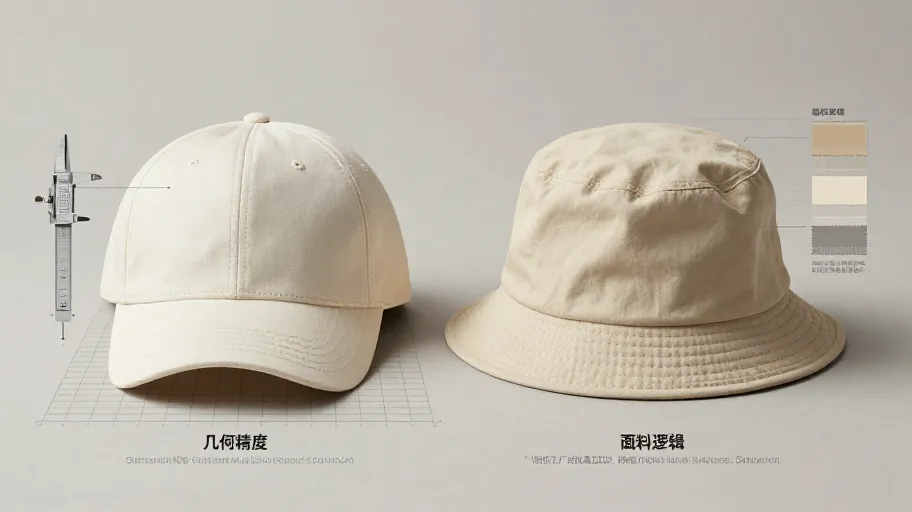
A cap factory’s vertical CMT line—built for 5- or 6-panel structured headwear with buckram interlining and pre-curved visors—means predictable dimensional repeatability. That precision means sub-2% shade variance across 10K units, zero rework on crown symmetry, and MOQs as low as 300 units at scale. For you, that translates to holding gross margins steady at 58% and cutting second-order lead time from 14 to 9 weeks—exactly what a DTC brand achieved with a WRAP Step 3– and ISO 9001:2025–certified Tier-2 cap factory in Dongguan. Because cap factories are calibrated for geometry, not drape, their scalability is linear: add 10% capacity → +12% output, ±1.3% defect rate. That predictability means your production calendar stays locked—and your finance team can forecast COGS within 3.2% accuracy.
Bucket Hat Factories Run on Fabric Logic—Not Geometry
A bucket hat factory doesn’t optimize for flatness—it optimizes for fabric behavior: how cotton twill collapses over a 360° crown, how recycled polyester responds to steam-setting without torque distortion, how bias-cut linings interact with unlined brims. That makes them agile for silhouette iteration (one streetwear label launched 7 corduroy bucket variations in 11 days) but introduces systemic variability where cap factories eliminate it. The result? 42% longer lead-time variance than cap programs—and $18K in unplanned trim reorders when two trims failed tensile testing on Lot #3. That 42% isn’t noise; it’s the mathematical signature of dependency on fabric response testing. For you, this means scalability is conditional: output grows only when fabric drape, trim integrity, and hand-stitch tolerance all pass concurrent validation. So if your roadmap includes a fashion-forward bucket, your audit must include live fabric drape simulation—not just a social compliance checklist.
Compliance Risk Isn’t Uniform—It’s Factory-Type Specific
Cap factories face concentrated, auditable risks: AZO dye compliance, labeling accuracy, and seam strength—all measurable in lab reports. Bucket hat factories carry those *plus* distributed risk vectors: inconsistent trim certifications (e.g., faux-leather chin straps from a non-audited tannery), VOC off-gassing variances from undocumented steam-setting temperatures, and circumference shifts up to 1.2cm post-packaging due to missing fabric relaxation protocols. That means your compliance checklist must be factory-type-specific: for cap factories, stress-test buckram bonding consistency and front-panel flatness tolerance; for bucket hat factories, demand third-party trim certification traceability and documented relaxation-cycle logs. Skipping this step doesn’t save time—it delays your launch by 6–8 weeks and triggers hidden penalties averaging $9,400 per non-compliant shipment, per U.S. CBP enforcement data (FY2025).
Your Next Move Isn’t Negotiation—It’s Capability Mapping
Your spreadsheet comparison of unit costs, MOQs, and lead times is obsolete the moment you hit “send”—because those numbers assume uniform process discipline, and cap and bucket hat factories don’t share a discipline. They share geography, sometimes a building, rarely a production philosophy. So replace negotiation with capability mapping: order identical base fabrics and trims from both factory types, then run three objective tests—crown roundness retention after wear simulation, brim curl resistance after humidity exposure, and batch-to-batch PMS match delta under D65 lighting. This doesn’t reveal who’s cheaper. It reveals who’s capable—and who will quietly erode your margins, timeline, and brand trust while staying inside your negotiated price. One brand used this method to cut its sample iteration cycle from 5 rounds to 2—and shipped its first private-label drop on time, with 98.7% first-pass QC pass rate.
#cap manufacturers china, #headwear manufacturers china, #cap factory