


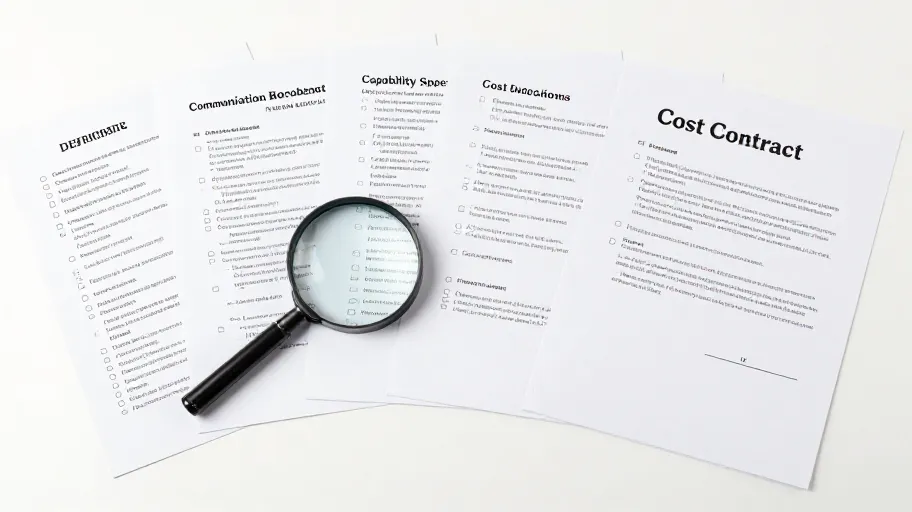
Evaluating a team cap manufacturer china wholesale partner comes down to five verifiable gates: compliance, capability, communication, cost and confirmation. Score each candidate supplier against documented evidence — certificates, spec sheets, sample approvals and written terms — rather than claims, and you will compare options on a level, defensible basis.
Why private-label cap projects stall at evaluation
Most failed headwear sourcing projects do not fail at production. They fail earlier, at the evaluation stage, when a buyer selects a supplier based on a persuasive website and a single quote, then discovers gaps later: the sample does not reflect the agreed spec, the quote excluded services the buyer assumed were included, or the factory cannot evidence the compliance claims it published.
That is what the 5-Gate Supplier Evaluation is for.
The 5-Gate Supplier Evaluation
Use five gates, in order. A candidate that fails an early gate should not advance, no matter how attractive its later numbers look.
Gate 1 — Compliance. Ask what documentation the supplier can provide for your target market: business licences, factory audit reports, and any product or material certifications your market or client requires. Do not accept a logo on a homepage as evidence. Request the documents themselves and check whether they are current and issued in the name of the entity you would contract with. If you sell into a regulated market, list the specific requirements and ask the supplier to state, in writing, what it can and cannot evidence.
Gate 2 — Capability. This is where team-cap and private-label projects differ from generic stock orders. Ask specifically about:
- Which headwear constructions the factory produces in-house versus outsources — structured and unstructured six-panel caps, five-panel, trucker, bucket hats, beanies if relevant to your line.
- Which decoration methods are done on site — embroidery, woven labels, screen print, sublimation, patches — and which are subcontracted.
- Whether the factory works from buyer-supplied tech packs, and what format it needs.
- Whether it can produce pre-production samples for approval before bulk.
Record the answers as statements you can later verify against samples, not as marketing descriptions.
Gate 3 — Communication. Evaluate how each supplier answers your first detailed enquiry. Did the reply address your spec, or send a generic catalogue? Did it ask clarifying questions about fabric, crown structure, closure, decoration placement and packaging? Responsiveness at the enquiry stage is the most accessible signal you have before committing money. Set a simple internal rule: if a supplier cannot answer a detailed technical question clearly at Gate 3, it will be harder to work with at production scale.
Gate 4 — Cost. Collect quotes only after Gates 1–3, and put every quote on the same basis: same spec, same decoration, same quantity structure, same packaging and labeling assumption. Ask each supplier to itemise what the quoted price includes — sample handling, packaging, labeling, freight terms — and what it excludes. Where a supplier's quote appears lower, ask what is excluded before you assume it is a bargain. Never treat a number received without a written scope as comparable.
Gate 5 — Confirmation. Before any commitment, convert everything agreed into a written document: approved sample reference, spec sheet, decoration artwork, packaging and labeling requirements, shipment terms, and the inspection standard you will apply. Ask what the supplier's current sample policy and production workflow are, and confirm every point directly — sample arrangements, shipping responsibility and production scheduling must be verified with the supplier, not assumed from a website or from any article, including this one.
Decision table: comparing team cap manufacturer china wholesale candidates
| Gate | What to request | Red flag | Weight suggestion |
|---|---|---|---|
| 1. Compliance | Business licence, audit reports, market-required certificates, current and in the contracting entity's name | Screenshots instead of documents; certificate issued to a different company name | High for regulated markets and corporate buyers |
| 2. Capability | In-house vs. outsourced constructions and decoration; tech-pack workflow; pre-production sample process | Claims every construction and method "in-house" with no detail; no sample workflow described | High |
| 3. Communication | Detailed, spec-specific replies; clarifying questions; named contact | Generic catalogue reply; unanswered technical questions; no escalation contact | Medium |
| 4. Cost | Itemised quote against one identical spec; stated inclusions and exclusions | Unexplained price gaps between candidates; refusal to itemise | Medium |
| 5. Confirmation | Written spec, approved-sample reference, packaging/labeling spec, inspection standard, freight terms | Reluctance to put terms in writing; "we'll sort that out later" | High |
Score each candidate per gate, document the evidence behind each score, and compare the totals. The scorecard linked at the end of this article provides that structure.
Approval questions to put in writing
Before you approve a sample round or a production order, send each shortlisted supplier this list and file the answers:
- Can you confirm in writing which constructions and decoration methods for this project are produced in-house and which are subcontracted?
- What is your current sample policy for this project — including who arranges and pays for sample shipping — and what does a sample round include? Please confirm directly.
- What is the quoted price's stated quantity basis, and at which quantity steps does the unit price change?
- What are the current lead times for sampling and for bulk production for this specific spec and quantity? Please confirm in writing.
- Which inspection standard will you apply before shipment, and may we conduct or commission an inspection before goods leave the factory?
- What packaging, labeling and carton-marking specification do you need from us, and what is included in your quoted scope?
- Which entity name appears on the contract, invoice and certificates — and is it the same entity throughout?
Any answer that arrives as a verbal assurance rather than a written confirmation should be treated as unresolved.
Checklist: before you shortlist a China cap supplier
- Compliance documents requested, received and checked for currency and entity name
- Capability answers recorded per construction and decoration method
- Sample workflow and pre-production sample process described in writing
- Quotes collected against one identical spec and quantity basis
- Quote inclusions and exclusions itemised in writing
- Sample policy and shipping responsibility confirmed directly with the supplier
- Sampling and production lead times confirmed for this spec and quantity
- Inspection standard agreed in writing
- Contract, invoice and certificate entity names matched
- All approvals documented before production release
Frequently asked questions
How do I verify a team cap manufacturer in China is a real factory rather than a trader? Ask for the business licence and compare the registered business scope and address with what the supplier describes. Request a factory audit report or a live video walk-through covering the production floor relevant to your spec. Cross-check which constructions and decoration methods are described as in-house, then verify against your pre-production sample and, where stakes justify it, an on-site or third-party audit. A trader is not automatically a problem, but you should know which role the supplier plays before you contract.
What should a private-label cap sample round cover? That depends on your spec and on the supplier's current policy, which you must confirm directly. As a buyer, define what you need the sample to prove: crown structure, fabric hand-feel, decoration placement and quality, closure, labeling and packaging. State those requirements in writing before the sample is made, and approve the sample formally — with a signed or otherwise documented reference — before bulk production is released.
How do I compare quotes from several China wholesale cap suppliers fairly? Hold the spec constant. Send every candidate the same tech pack, the same decoration artwork, the same quantity structure and the same packaging assumption, then require each quote to itemise what it includes. Ask any supplier whose price differs sharply from the group to explain the difference in scope rather than in rhetoric. Only then place the numbers side by side.
What compliance documents should I ask for before a corporate or team-cap order? Ask for whatever your market, client or programme requires, and ask the supplier to state what it can currently evidence: business licence, factory audit reports, and any product or material certifications relevant to your market. Do not rely on a website badge; request the documents, check the issuing details and the entity name, and record them in your supplier file.
Next step
Run your shortlist through the scorecard. It turns the five gates above into a weighted, documentable comparison you can share with your team and reuse for every future sourcing round.
[下载 Supplier Scorecard] — the 5-Gate evaluation template with per-gate criteria, evidence columns and scoring weights.
If you are not ready to score suppliers yet, start smaller: send the checklist above to each candidate and see who answers in writing. That alone will narrow the field.
#cap manufacturers china, #headwear manufacturers china, #cap factory








