


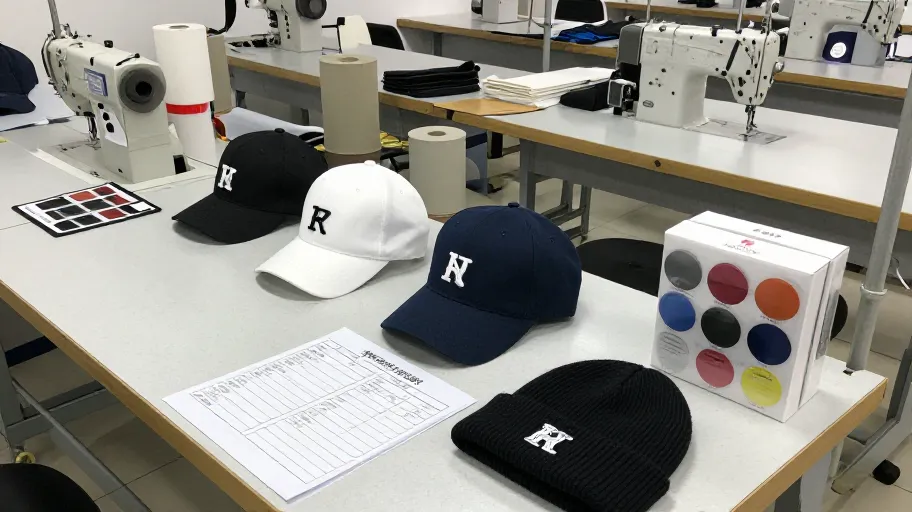
The honest answer to "who are the best hat manufacturers in China?" is that "best" is project-specific: the right factory is the one whose capabilities, communication and documentation match your private-label programme — not the one with the loudest website. Evaluate candidates with a structured frame, verify claims with evidence, and document every confirmed term before approval. This article gives you that frame.
The SCORE Frame for comparing hat manufacturers
When you compare factories from overseas, the biggest risk is comparing marketing instead of capability. The SCORE Frame keeps every candidate on the same evidence-based path:
- S — Scope. Does the factory's product range genuinely cover your categories — structured caps, unstructured caps, bucket hats, beanies, visors, or specialty constructions? Ask which categories they build in-house and which they subcontract.
- C — Capability. Ask about embroidery, printing, patch application, washing and finishing techniques relevant to your design. Request examples of comparable complexity, not just their showcase pieces.
- O — Ownership. Verify who actually owns production. A manufacturer in Shenzhen controls its lines; a trading company coordinates them. Both can be valid partners, but you should know which you are contracting, because it changes who answers for quality and scheduling.
- R — Reliability. Test responsiveness before you commit. How precisely does the supplier answer technical questions? Do they ask for a tech pack, or accept a vague sketch? A factory that requests your spec sheet is showing you how it will behave during production.
- E — Evidence. Every claim should map to something you can inspect: samples you approve in writing, photos of the relevant process, third-party inspection reports you commission, and site visits or video walkthroughs where possible.
Decision table: scoring your shortlist
Score each candidate from 1 (weak) to 5 (strong) on the rows below. Weight the rows according to your programme — a corporate uniform buyer will weight Scope differently from a fashion brand launching a seasonal capsule.
| Evaluation dimension | What to verify | Evidence to request | Score (1–5) |
|---|---|---|---|
| Product scope fit | Categories and constructions match your line | Product range list with construction details | ___ |
| Decoration capability | Techniques your design requires are in-house | Physical or photographed examples of comparable work | ___ |
| Manufacturing status | Direct manufacturer vs intermediary | Business licence, factory address, video walkthrough | ___ |
| Technical communication | Precise answers to spec questions | Written replies to your tech-pack questions | ___ |
| Quality control process | Defined checkpoints you can inspect | QC workflow description; inspection reports you commission | ___ |
| Documentation discipline | Terms confirmed in writing | Draft agreement covering every point below | ___ |
| Traceability | Named contacts for each production stage | Organisational chart or key-contact list | ___ |
A candidate that scores well on communication but cannot evidence its process is a risk; a factory with strong capability but weak documentation is a different risk. The scorecard makes both visible.
Approval questions to send before you sign
Send these to every shortlisted supplier and compare the written answers side by side:
- Which parts of my design will you produce in-house, and which will you subcontract — and who handles each?
- What information do you need from me to build a complete tech pack for this style?
- What inspection checkpoints exist between sampling and bulk production, and can I or my appointed inspector attend or receive reports at each?
- What happens if a bulk batch does not match the approved sample — what is your correction process?
- Which certifications, test reports or compliance documents can you currently provide, and which would need to be arranged for my market?
- What are your current terms for minimum order quantity, sampling, payment, production scheduling and shipping? Confirm the current policy directly.
Never rely on a verbal answer to question 6. Ask for everything in writing and attach it to your purchase agreement.
Separating manufacturers from trading companies
Ask three direct questions:
- Can we hold a live video walkthrough of the production floor where my style will run?
- Will the business licence you provide match the entity that signs my contract?
- Who signs off on the final quality inspection — your factory team or a third party?
A genuine manufacturer can answer these concretely. If answers stay vague, you are evaluating an intermediary. That may still work for your programme, but price the accountability gap into your decision and document who is responsible for each obligation.
Red flags worth pausing on
- A supplier that quotes a full programme from a photo alone, without requesting a tech pack.
- Reluctance to put commercial terms in writing. Confirm the current policy directly — and record the answer.
- A sample that arrives without documentation of its specifications, so you cannot anchor the bulk order to it.
- No named person accountable for quality decisions.
None of these means a supplier is dishonest. They mean the burden of verification falls on you, and the scorecard is where you record what was and was not confirmed.
Worked scenario: three candidates, one frame
Imagine a brand shortlisting three Chinese suppliers for a private-label cap launch. Supplier A replies within a day with detailed questions about panel construction and embroidery density. Supplier B sends a price list but no technical engagement. Supplier C offers a video walkthrough and a written QC workflow, and answers every commercial question in writing.
Under the SCORE Frame, Supplier C scores highest on Evidence and Documentation discipline even before any order is placed — because the comparison is based on what each supplier has actually documented, not on impressions. That is the entire point of the frame: it converts a vague search for "the best" into a recorded, repeatable comparison.
Frequently asked questions
How many hat manufacturers should I shortlist before deciding?
Three to five candidates is enough to make the SCORE comparison meaningful without slowing your programme to a crawl. Score all candidates on the same table so the comparison stays honest.
Should I visit the factory in China before ordering?
A visit is one of the strongest evidence sources available, but it is not the only one. A live video walkthrough, third-party inspection and documented terms can carry a decision when travel is not practical. Choose your evidence level to match your order's importance.
What documents should I insist on before approving production?
At minimum: an approved sample with its written specification, a tech pack both parties signed, a written statement of commercial terms, and a defined inspection and correction process. Confirm the current policy directly on any term a supplier resists documenting.
Is a Shenzhen manufacturer better than one in another region?
Region alone does not determine fit. What matters is whether the specific factory's scope, capability and documentation match your programme. Shenzhen's manufacturing ecosystem offers genuine advantages for some buyers, but verify the individual supplier rather than the postcode.
How do I compare suppliers when everyone promises good quality?
Stop comparing promises and start comparing evidence: written technical answers, samples with documented specifications, verifiable manufacturing status, and terms provided in writing. The supplier that documents the most is demonstrating behaviour, not making claims.
Get the evaluation tool: 下载 Supplier Scorecard and run every candidate through the same five-part SCORE comparison before you commit.
Low-friction next step: Not ready to score suppliers yet? Download the free 12-question supplier diligence checklist and start with just the first three questions at your next supplier call.
#cap manufacturers china, #headwear manufacturers china, #cap factory








