


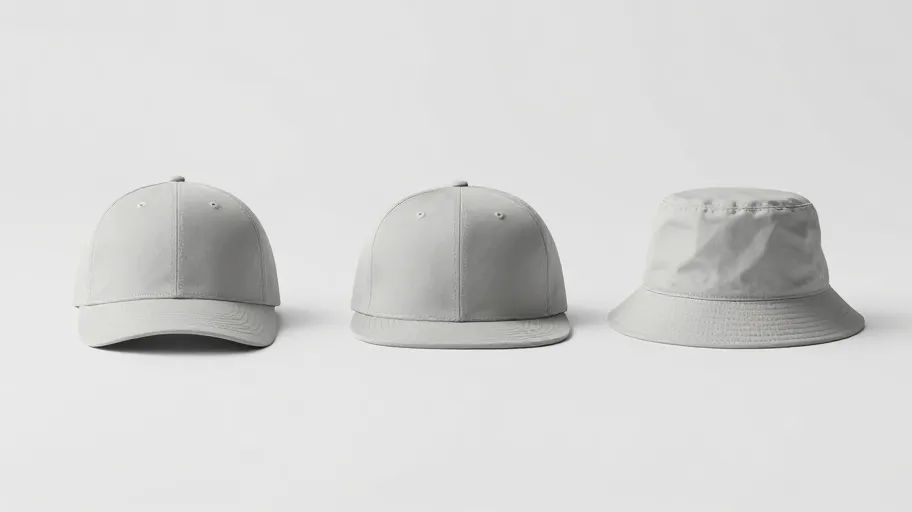
Why Your Spec Sheet Is a Translation Problem, Not a Checklist
Cap manufacturers don’t interpret your spec sheet as instructions—they reverse-engineer it using internal pattern libraries, fabric behavior databases, and machine-specific stitching tolerances. That means 'crown height' measured from the front seam vs. the crown apex isn’t a detail—it’s a 5–7mm fit deviation waiting to happen. This misalignment means your spec sheet is a translation problem, not a checklist, because inconsistent language triggers costly rework: one U.S. DTC brand spent $14,200 and lost 36 days across three full sample rounds due to ambiguous brim stiffness and stretch recovery definitions.
Standardizing specs means replacing subjective terms like 'soft roll' or 'good recovery' with testable engineering inputs: 'brim curvature radius of 18mm ±1.5mm, verified via digital contour gauge' means your bucket hat factory and cap factory evaluate against the same benchmark—not their own defaults. That shift cuts pre-production rework by 68% (2024 Sourcing Intelligence Group), shortens evaluation time by 40%, and turns subjective feedback into objective pass/fail verification.
Pre-Sample Validation Is Your Real First Gatekeeper
Even with a bulletproof spec sheet, assumptions survive into pattern grading, trim sourcing, and seam placement—especially where human anatomy meets garment geometry. Pre-sample validation means interrogating the digital pattern *before* cutting fabric: Does the graded crown volume match your target head size distribution (e.g., 95th percentile male head circumference + 12mm ease)? Is the sweatband seam positioned to avoid pressure at the occipital ridge—not just centered visually? Will the snapback mechanism clear the folded brim during repeated folding tests?
This protocol means you catch dimensional errors before they become physical waste: an outdoor apparel brand avoided $8,900 in wasted yardage and two weeks’ delay by catching a 5mm crown height miscalculation digitally. Another DTC label cut its average sample iterations from 4.7 to 1.3 per SKU—freeing up $21,000/year in sample logistics alone. Because when specs are engineered—not described—the sample becomes confirmation, not negotiation.
Free Hat Samples Are Strategic Leverage, Not Just Courtesy
Free hat samples aren’t a perk—they’re your lowest-cost, highest-fidelity stress test of a supplier’s technical discipline. A factory that ships a sample meeting your tolerance-bound criteria (e.g., 'crown height ±3mm at all four cardinal points') demonstrates material fluency, process control, and alignment with your fit intent. One that ships three rounds of 'close enough' reveals gaps in measurement rigor, lab capability, or cross-functional communication.
This means free hat samples transform from cost centers into ROI signals: each approved sample validates a supplier’s ability to execute against engineered benchmarks—not just follow instructions. And in seasonal headwear, where relevance decays at 3.2% per week post-launch, that precision protects margin and market share. Brands using tolerance-driven sample review launch 11–14 days earlier on average—capturing Q2 shelf space competitors miss.
How to Start Tomorrow: Your 3-Step Launch Checklist
You don’t need perfect specs to start—you need disciplined sequencing. Here’s what works for brands scaling from 500 to 50,000 units/year:
- Step 1 — Lock functional geometry first: Define crown height (front seam to apex, ±3mm), brim radius (18mm ±1.5mm), and stretch recovery (% retained after 50 cycles at 150% strain) before selecting trims or fabrics.
- Step 2 — Require pre-sample sign-off: Ask your cap factory or bucket hat factory to submit digital pattern files, seam placement diagrams, and trim clearance reports—and approve them *in writing* before cutting.
- Step 3 — Treat free hat samples as test reports: Reject any sample missing tolerance documentation—even if it ‘looks right.’ That discipline builds supplier accountability faster than any audit.
That’s how you move from hoping your first cap fits—to knowing it will.
#cap manufacturers china, #headwear manufacturers china, #cap factory








