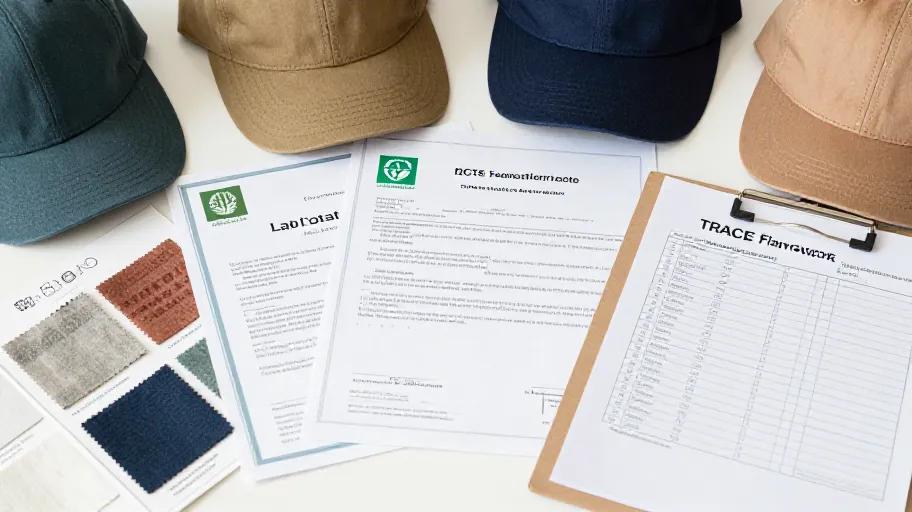
Verifying sustainability claims for sustainable custom caps means matching each claim to a named document — a test report, a scope certificate, a transaction certificate, an audit record — and confirming that document covers the exact material, colourway and production lot you are ordering. A supplier's brochure statement is a starting point, not evidence. Use a structured framework such as TRACE (Test reports, References, Audits, Chain of custody, Evidence of change) to compare suppliers on documentation quality rather than on promises.
Why claims need document-level verification
When a European brand sources custom headwear from China, the sustainability claim travels through several hands: the brand's marketing team, the procurement team, the supplier, the fabric mill, and the recycler or farm upstream. A claim that reads "made with recycled polyester" on a tech pack has no standing until it is tied to paperwork that names the material, the certification holder and the transaction.
This matters for three practical reasons. First, your brand carries the claim downstream — to customers, retailers and, in many European markets, regulators who increasingly expect substantiated environmental statements. Second, certificates can expire, change scope, or belong to a mill rather than to the cap factory you are contracting with. Third, without consistent evidence standards, comparing two suppliers becomes a comparison of sales writing rather than of facts.
The goal is not to distrust suppliers. It is to convert a sustainability conversation into a documentation conversation, which is something both sides can act on.
The TRACE framework
T — Test reports. Ask for test reports that name the specific material in your cap — for example, the fabric composition, the dye or the trims. A report on a similar material is not the same as a report on your material. Check the report date, the testing body and whether the tested article matches the article number in your specification sheet. Confirm with the supplier which reports exist for the exact fabric and colourway you are ordering.
R — References. References here mean traceable claims: where did the fibre come from, who holds the certificate, and can that holder be independently checked in the certification body's public database? Many certification schemes let you look up a certificate number or holder name yourself. Verify rather than accept.
A — Audits. Ask whether the production site has been audited, by whom, against what standard, and whether you can see the scope and date of the most recent audit. If your company runs its own supplier audits or uses a third-party programme, state that early so the supplier can prepare. Whether any audit applies to a given facility at a given time must be confirmed directly.
C — Chain of custody. For recycled or organic content, the key question is whether the supplier can produce a transaction certificate or equivalent chain-of-custody document for the specific order — not only a scope certificate held by a mill. Chain-of-custody documents connect the certified input to your purchase order. Ask whether the supplier's chain-of-custody coverage extends to their own facility or stops at their upstream mill, and how they document the link.
E — Evidence of change over time. One clean document set proves one point in time. Ask how the supplier renews certificates, how they notify customers of scope changes, and how they handle a material substitution mid-programme. A supplier with a documented change-notification process gives you something to rely on when you re-order next season.
Decision table: comparing suppliers on evidence quality
Score each supplier on the evidence they can actually produce for your order. Any row that cannot be evidenced becomes a follow-up question or a risk to note in your file.
| Evidence item | Weak (marketing only) | Acceptable (document exists) | Strong (document matches your order) |
|---|---|---|---|
| Fabric content claim | "Eco-friendly fabric" on a brochure | Composition sheet with material names | Test report naming your article number and composition |
| Recycled content | Percentage stated verbally | Scope certificate from a mill | Transaction certificate tied to your purchase order |
| Organic claim | Logo image in a catalogue | Certificate naming the fibre type | Chain-of-custody documentation from fibre to finished cap |
| Chemical safety | "Non-toxic dyes" claim | A test report for a fabric family | Report for the dye class and colourway you specified |
| Facility practices | Sustainability mission statement | Audit report available on request | Audit scope, date and corrective actions shared proactively |
| Continuity | No answer | Certificate renewal mentioned | Documented renewal and change-notification process |
This table works as a side-by-side comparison tool when you shortlist two or more headwear suppliers for the same programme.
Concrete approval questions to send a supplier
Copy these into your next supplier email. Each is answerable with a document or a clear policy statement, which is what makes them useful.
- Which certificates or test reports currently cover the exact fabric, trim and dye you propose for our caps? Please share document numbers and validity dates.
- Does the certificate holder named in each document match your facility, your mill, or a third party? Please clarify for each document.
- Can you issue a transaction certificate or equivalent chain-of-custody document for our specific order? If not, please explain what documentation you can provide.
- What is your process if a certified material becomes unavailable mid-production — how would you notify us and what documentation would accompany a substitute?
- Which audits, if any, apply to the facility that will produce our order, and can we see the scope and date?
- How do you handle material testing for a custom colourway, and what documentation will we receive with the shipment?
- What evidence can you provide at the shipment stage — for example, per-lot documentation — so our receiving team can verify the claim on arrival?
None of these questions presumes an answer. Each invites the supplier to state their current, verifiable position.
Matching documents to your actual order
A document is only useful if it matches what you are buying. Before approving a supplier's evidence pack, check four points of match:
- Material match: does the document name the same fibre, blend or recycled content stated in your tech pack?
- Colourway match: does any chemical or dyestuff testing cover the colour you specified, or a closely documented equivalent?
- Facility match: does the audit or certificate name the facility that will actually sew and finish your caps?
- Order match: for chain-of-custody schemes, is there a transaction-level document connected to your purchase order rather than a generic scope document?
Where any match is missing, ask the question in writing and keep the response in your project file. The written exchange becomes part of your audit trail.
Building the audit trail for internal review
European procurement teams are asked to substantiate claims internally as much as externally. Create a simple project file per programme: the claim as worded, the documents received, the match checks completed, the questions asked, and the supplier's written answers. This file protects you in three moments — when marketing writes the product page, when a retailer asks for evidence, and when a re-order comes due and documents may have expired.
Re-verify at every re-order. Certificates lapse, mills change, and material substitutions happen. A claim verified for season one is not automatically verified for season two.
FAQ
How do I know if a "recycled" cap claim is genuine? Ask for chain-of-custody documentation — ideally a transaction certificate tied to your order — and check the certificate holder in the certification body's public database. A scope certificate from an upstream mill alone does not confirm that your specific caps used certified inputs.
Which documents should I request before approving a supplier? Test reports for the exact fabric and colourway, any scope certificates with validity dates, transaction or chain-of-custody documents for your order, and audit records with scope and date. Anything the supplier cannot provide becomes a documented open question rather than an assumption.
Should I audit the factory for sustainability claims? If your programme volume or brand commitments justify it, yes — or use a third-party audit programme. State your audit expectations early. Whether a given audit applies to a given facility at a given time is something to confirm directly with the supplier.
How do I compare sustainability evidence between two cap suppliers? Use the decision table above and score each supplier on document-to-order match, not on marketing language. The supplier who answers your questions in writing, with document numbers, is giving you comparable evidence.
What if the supplier says documents are confidential? Ask what they can share under NDA, or whether the certification body's public database can confirm the certificate's existence, holder and scope. Confidentiality is workable; absence of any verifiable reference point is a risk to record.
Download the documentation verification checklist and run it against every supplier shortlisted for your next sustainable custom caps programme — it converts each claim into a named document to request, check and file.
Short on time? Start with the seven approval questions above — send them today, and you will have a written, comparable answer set from each supplier before your next sourcing call.
#cap manufacturers china, #headwear manufacturers china, #cap factory