
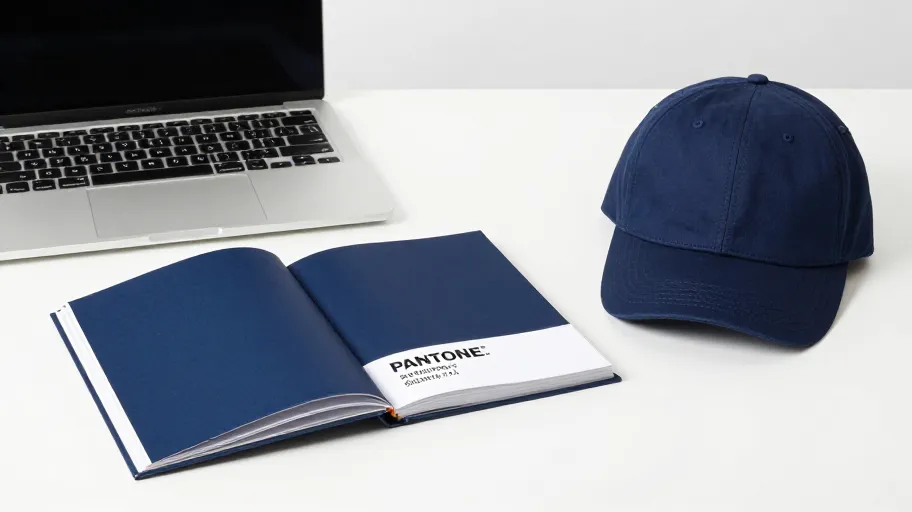
When sourcing pantone color matching hats from a Chinese OEM/ODM manufacturer, the single most valuable thing you can do before sampling is put a solid Pantone fabric-colour reference in writing alongside your vector logo files. Verbal colour descriptions ("navy-ish blue") invite interpretation; a documented reference chain invites approval. This article shows you how to build that chain.
Why colour belongs in the tech pack, not the email thread
Colour is one of the few specification items where a small ambiguity at the start compounds into a large disagreement at the end. A shade discussed informally can drift between a buyer's screen, a dye lot, a photographed sample and a production run. A colour written into a tech pack as a named reference gives every party — buyer, merchandiser, dye house and QC — the same target.
This is why a structured tech pack matters more than a detailed email. New Generation's tech-pack page, for example, asks buyers to specify the cap style, panel construction, fabric, a solid Pantone fabric-colour reference, and the logo's size, position and embellishment type. Notice what that list implies: colour is requested as a solid Pantone reference, not as a photo, a hex code or a description. Each of those alternatives has a place in early conversations, but the formal request is the reference itself.
The same document also asks for original Illustrator vector logo files. That detail matters for colour too: a vector logo carries defined colour values for the embellishment, while a raster screenshot of a website banner does not. If your logo file and your fabric reference disagree — say the artwork was designed against a slightly different palette — that discrepancy should surface at the tech-pack stage, not after the first sample arrives.
The Reference-to-Approval framework
Use this four-step chain to organise your colour specification before any sample is made:
| Stage | What you provide | What you should receive | What to document |
|---|---|---|---|
| 1. Reference | A solid Pantone fabric-colour reference for the cap body; vector logo files for the embellishment | Confirmation that the reference is understood and workable for the chosen fabric | The exact reference code, in writing, in the tech pack |
| 2. Tech pack | Cap style, panel construction, fabric, colour reference, logo size, position and embellishment type | A complete specification reflecting your inputs | Version number and date of the tech pack |
| 3. Sample | Approval of the sample scope and any conditions you want checked | A physical sample against the documented reference | Written notes on what matches and what does not |
| 4. Sign-off | A clear accept, reject or revise decision | An agreed standard for what production should match | The approved sample retained as the sealed reference |
The framework's value is not that it guarantees a perfect match — no reference system can promise that, and the practical tolerance between a swatch and dyed fabric is a question you should raise directly with your supplier. Its value is that every later conversation has a documented anchor. When you say "the sample is slightly off," you are comparing against a code and a sealed sample, not a memory.
Choosing the right colour reference: a decision table
Different projects justify different levels of specification effort. Compare your situation:
| Your situation | Recommended reference approach | Why |
|---|---|---|
| Single-colour corporate cap with a simple embroidered logo | One solid Pantone fabric-colour reference plus vector logo files | One fabric colour, one embellishment; keep the spec minimal but written |
| Multi-panel cap with contrasting panels | A separate solid Pantone reference per fabric colour used | Panel construction can combine fabrics, so each colour needs its own named reference |
| Brand palette that must match existing merchandise | Your existing approved reference plus a physical swatch if you hold one | Continuity across your range matters more than any single new decision |
| Logo with multiple colours and an embellishment type you have not chosen yet | Vector logo files now; confirm embellishment type and its colour handling with the supplier | The tech pack requests embellishment type alongside logo size and position, so these decisions belong together |
| Uncertain whether a shade is achievable on the fabric you want | Ask the supplier directly before sampling | Fabric and colour interact; the supplier can tell you what is workable for your specific combination |
If your project sits across several rows, that is a signal to resolve the open items before requesting a sample rather than after.
What the tech-pack process requests — and what it does not
Based on New Generation's published tech-pack requirements, prepare the following before submitting a brief:
- Cap style — the silhouette you want (the brand's cap style pages can help you choose).
- Panel construction — how many panels and how they are built.
- Fabric — the material for the cap body.
- Solid Pantone fabric-colour reference — the formal colour specification for the fabric.
- Logo size, position and embellishment type — where the branding sits, how large, and how it is applied.
- Original Illustrator vector logo files — not screenshots, exports or flattened images.
What the published requirements do not establish is equally worth knowing. They do not state a matching tolerance between reference and production, order terms, sample policy, pricing or lead times. Any of those may be relevant to your project, but none of them should be assumed from this article — confirm them directly with the supplier as part of your brief.
Approval questions to ask — and answer in writing
Before sampling:
- Which exact Pantone reference is going into the tech pack, and is it written there verbatim?
- Does my vector logo file carry the colour definitions you need, or do you need additional artwork?
- For a multi-panel build, is there a separate reference recorded for each fabric colour?
- Does the embellishment type I have chosen handle my logo colours the way my artwork assumes?
When the sample arrives:
- Compared against my documented reference, does the fabric colour read as acceptable under the lighting I will use to judge it?
- Does the embellishment colour sit where my logo file specifies?
- Is logo size and position consistent with the tech pack measurements?
- Which sample — and which version of the tech pack — will serve as the approved standard going forward?
Answering these in writing, and keeping the approved sample, is what turns a one-off approval into a repeatable standard. This matters doubly if you intend to reorder: a sealed sample plus a versioned tech pack is how a second order can be specified without re-litigating the first.
Frequently asked questions
Do I need Pantone references for both the fabric and the logo? The published tech-pack request covers a solid Pantone fabric-colour reference and original vector logo files. The vector file is the colour source for your logo; the reference covers the fabric. Treat them as two separate specification items and check that they agree with each other before submitting.
Can I just send a photo or a hex code instead? Photos and hex codes are useful for discussion, but the formal request is a solid Pantone fabric-colour reference. If you only have a photo or a screen colour, say so in your brief and let the supplier advise on how to convert it — that is a project-specific question worth raising early.
What if I have not chosen my embellishment type yet? The tech pack asks for logo size, position and embellishment type together. If the embellishment is undecided, flag it in your brief. Colour behaviour can differ between embellishment types, so resolving the type before finalising colour approvals keeps the sequence clean.
Does a Pantone reference guarantee the production run will match the sample? No reference system guarantees anything by itself. What it does is give you a documented target and a physical approved sample to compare against. Questions about matching tolerances between reference, sample and production are legitimate and should be asked directly of the supplier before you approve anything.
What files should I bring to the first conversation? At minimum: your cap style choice, fabric preference, solid Pantone fabric-colour reference, logo size and position notes, embellishment type if chosen, and original Illustrator vector logo files. A reference image of a cap you like the look of is also welcome and helps frame the project.
Submit your brief for project-specific review
If you are preparing a custom cap or headwear order and want your colour specification reviewed against a working tech pack, submit a cap brief, reference image or logo for project-specific review. Include your solid Pantone fabric-colour reference and original Illustrator vector files where you have them, and note openly anything still undecided — an honest brief gets a more useful response than a polished but incomplete one.
Before you submit, confirm you have:
- Chosen a cap style and panel construction
- Named your fabric
- Written down your solid Pantone fabric-colour reference
- Specified logo size, position and embellishment type
- Prepared original Illustrator vector logo files
- Noted any open questions (matching tolerance, order terms, sample policy) to raise directly with the supplier
Tick what you can, flag what you cannot, and send it across — partial briefs with clear open questions are a perfectly good starting point.
#cap manufacturers china, #headwear manufacturers china, #cap factory