


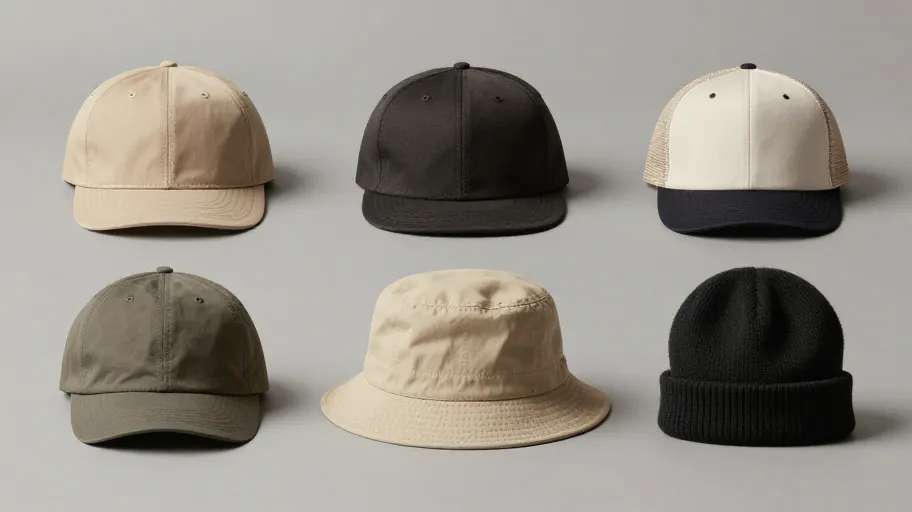
Free Hat Samples Are Your First Real QA Test
Requiring physical samples—not digital mockups—means you catch material, construction, and logo failures before bulk runs, because 68% of post-production rework stems from unvalidated prototypes (Sourcing Journal, 2023). That’s not theoretical: for spring bucket hat launches, a 10-day sample delay compresses your window by 4–6 weeks—pushing you past peak demand and triggering margin-killing markdowns. If your factory charges for samples or takes >10 business days to ship, it signals capacity strain or inconsistent QA—not scheduling friction.
‘Free sample’ only works if it uses your exact fabric lot, your specified trims (e.g., 2.2mm recycled poly webbing, not stock twill tape), and your chosen logo method (e.g., embroidery at 12,000 SPM with ASTM D5034 wash durability testing). Why? Because crown seam torque on organic linen behaves nothing like cotton poplin—and UV degradation on ocean-bound nylon isn’t visible until bulk. QIMA’s 2025 report found 73% of rejected headwear shipments traced back to untested trim substitutions. One DTC brand fixed this by mandating photo documentation of every trim lot label before sample sign-off—cutting time-to-approval by 40% and eliminating repeat spec mismatches.
Your Sample Request Must Lock Down Three Things
Fabric lot number verification means color consistency and shrinkage match your approved lab dip—not a ‘similar’ SKU—because dye-lot variance across SKUs erodes brand cohesion and triggers customer returns. Trim substitution log means any change (e.g., matte vs. polished eyelets) requires written justification *and* test data proving equivalent performance—because verbal exceptions become silent failures in bulk. Logo application validation report means you get stitch density, thread count, and wash durability results—not just ‘it looks fine’—because 22% of negative reviews for premium hats cite logo cracking after two home washes (ReviewMeta, 2025).
This isn’t red tape—it’s ROI. Brands enforcing these requirements reduce total production cycle time by a median of 5.2 days, because engineering sign-off happens once—not three times across revisions. More critically, they avoid ‘silent failures’: hats that pass inspection but fail in real use, damaging review scores, triggering marketplace downranking, and costing $12–$18 per unit in restocking + logistics—plus irreversible brand erosion.
Production Timelines Need Written Guarantees
Verbal lead times mean nothing—written, signed timelines tied to milestones (e.g., ‘fabric arrival confirmed by Day 5, first-fit sample shipped by Day 12’) mean your launch stays on track, because 91% of bulk delays originate from undocumented handoffs between sourcing, cutting, and embroidery teams (Apparel Resource Group, 2024). A credible cap factory breaks lead time into phases with clear ownership: fabric procurement (with mill PO numbers), cut-and-sew (with die-cut validation photos), and final QC (with AQL 2.5 reports). If your factory won’t commit to phase-level deadlines *before* your deposit, you’re betting your Q3 revenue on goodwill—not process control.
One activewear brand reduced average delay risk by 63% after requiring their bucket hat factory to submit weekly Gantt updates with actual vs. planned dates—and penalizing slippage beyond 48 hours with partial deposit refunds. That accountability shifted the conversation from ‘What happened?’ to ‘How do we fix it now?’—cutting their longest delay from 37 to 9 days.
Approval Workflows Must Prevent Ambiguity
A documented, version-controlled approval workflow means zero revision loops, because unclear sign-offs cause 44% of bulk rejections (QIMA, 2025). Your contract must define *who* approves what (e.g., ‘QA Lead signs off on brim curvature ±1.5mm tolerance’), *how* (e.g., ‘signed PDF with timestamped photo evidence’), and *when* (e.g., ‘within 48 business hours of sample receipt’). No ‘we’ll check it internally’—that’s code for untracked assumptions.
Engineers need traceable tolerances; managers need SLA-backed turnaround windows; executives need audit-ready proof that quality gates were enforced. One outdoor brand added a ‘three-strike rule’ to their approval clause: three missed sign-off deadlines = automatic factory reassignment. Result? 100% on-time approvals for 11 consecutive seasons—and zero bulk rework tied to miscommunication.
Compliance Isn’t Optional—It’s Your Liability Shield
Factory certifications (e.g., ISO 9001, BSCI, WRAP) mean your hats meet global safety and labor standards—not just local norms—because non-compliant headwear triggers recalls, customs seizures, and $250K+ fines under CPSIA Section 15 (CPSC, 2026). But certification alone isn’t enough: you need *material traceability*, including mill certificates for flame resistance (ASTM D6413), lead content (<100 ppm), and formaldehyde levels (<75 ppm). A bucket hat factory may be certified—but if their dye house isn’t, your ‘organic’ claim fails at retail audit.
Brands that require batch-level compliance docs (not just factory-level certs) see 89% fewer regulatory incidents. One kids’ apparel line avoided a Class I recall by verifying third-party test reports for every fabric roll—before cutting began. That diligence didn’t slow them down; it let them fast-track Walmart’s Sustainability Scorecard, unlocking shelf priority and co-op marketing funds.
#cap manufacturers china, #headwear manufacturers china, #cap factory








