


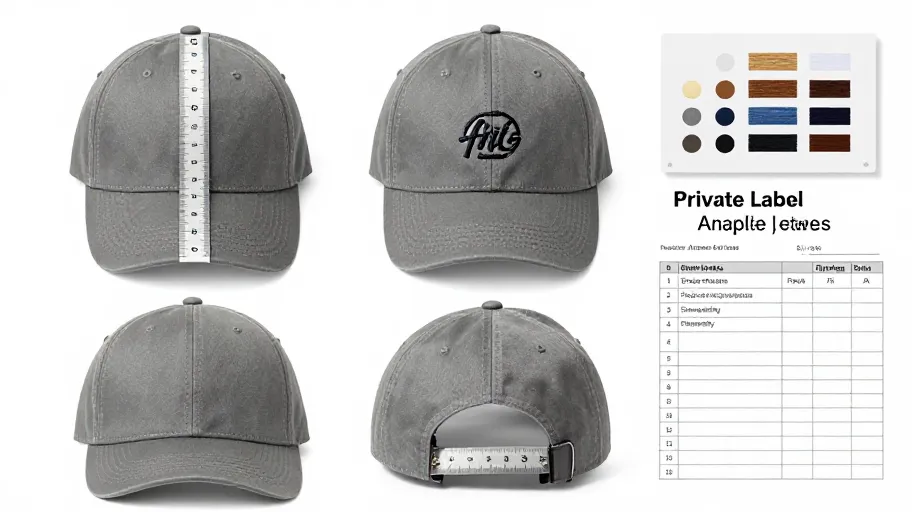
Most first samples fail for reasons that were never written down: an unstated curve on the crown, a placement measured by eye, a thread colour chosen from memory. Before you compare any private label hats manufacturer on price or responsiveness, turn the first sample into a structured review using the Four-Signature Sample Review — structure, finish, branding fidelity, repeatability — and document what passes before anyone talks about bulk.
Why the first sample is a decision document
Private label brands tend to treat the first sample as a preview. That underuses it. The sample is the only moment when changes are cheap and expectations can still be set in writing. Once bulk production begins, every ambiguity in your specification becomes a negotiation.
The right mindset: you are not asking "do I like this hat?" You are asking "does this hat match a specification precise enough that a production run can be held to it?" If your answer depends on feel alone, the specification is not ready — and neither is your decision.
This matters doubly when comparing several suppliers. If each sample is judged against different informal criteria, your comparison is noise. A single documented framework makes supplier differences visible and defensible.
The Four-Signature Sample Review
Signature 1: Structure. Judge the hat's architecture before its decoration. Put it on. Put it on a form if you have one. Check the crown holds its shape without collapsing, the brim curve is consistent left to right, the panels meet symmetrically at the apex, and the sweatband sits flat against the forehead line. Distortions here are specification problems, not bad luck — they can be corrected, but only if you name them.
Signature 2: Finish. Work around the hat once, slowly. Stitch density and tension, seam cleanliness inside and out, eyelet consistency, closure attachment, any lining or taping. Note anything inconsistent between the left and right sides. Finish flaws that appear on a carefully made sample tend to appear in amplified form under production pressure — but do not assume that; make it a question the supplier must answer about their bulk controls.
Signature 3: Branding fidelity. Lay your artwork next to the sample under good light. Compare logo dimensions, placement relative to seams and crown height, thread or print colour, stitch or print method, and edge quality on patches or embroidery. Colour is the most frequent mismatch: screens, pantone references and thread charts all drift. Confirm exactly which colour reference the supplier worked from and which reference bulk will be matched to.
Signature 4: Repeatability. This is the signature most buyers skip. A sample proves the factory can make one hat well. You need evidence the factory can make your hat consistently. Ask how the sample's parameters will be carried into bulk: which measurements are controlled, how materials are matched across a run, what in-process checks apply, and what the buyer's approval points are before and during production. The answers — not the sample alone — are your repeatability evidence.
Decision table: what to do with each finding
| Finding type | Example | Action | Documentation to require |
|---|---|---|---|
| Structural defect | Crown asymmetry, brim curve inconsistent | Correct and re-sample | Corrected measurement spec agreed in writing |
| Finish inconsistency | Uneven stitch tension between panels | Supplier explains cause and bulk control; correct if needed | Bulk QC points named and confirmed |
| Branding mismatch | Logo offset from seam, colour drift vs artwork | Correct placement/colour reference before any further step | Signed-off artwork placement sheet and colour reference |
| Parameter gap | Supplier cannot state how sample settings carry to bulk | Clarify before approval | Written description of bulk control and buyer approval points |
| Capability mismatch | Construction method you want is not achievable as sampled | Re-scope or decline this option | Revised construction spec or documented decline |
Approval questions to put in writing
Ask these of every candidate supplier and compare the answers side by side:
- Which exact artwork file, colour reference and placement dimensions was this sample made against, and will bulk match the same references?
- What will change between this sample and bulk production — materials, construction, decoration method, or nothing?
- Which measurements and quality points are controlled during bulk, and at which stages can I review or approve?
- What happens if bulk output does not match the approved sample, and how is that resolved?
- What is the current sampling policy for my project — including any sample or courier costs, timelines and revision rounds? Confirm this directly; policies vary by project and must be stated by the supplier, not assumed.
Question five deliberately avoids assumptions. Sample fees, courier arrangements and revision terms differ by supplier and by project scope, so treat every statement about them as something to verify in writing with the specific supplier, for your specific brief.
Pre-approval checklist
Run this before you approve any first sample:
- Crown shape, brim curve and symmetry checked worn and on a form
- Interior and exterior finish inspected once, slowly, both sides
- Logo dimensions, placement, method and colour compared against the artwork under good light
- The exact colour reference for bulk confirmed in writing
- Sample-to-bulk parameter handover explained by the supplier in writing
- Bulk control points and buyer approval stages confirmed
- Non-conformance resolution process stated before approval
- Current sampling terms for your project confirmed directly with the supplier
- All corrections listed as measurable requirements, not adjectives ("larger", "higher", "2 mm closer to seam" — with the actual figure agreed between you and the supplier for your design)
FAQ
How many sample rounds should I expect? There is no fixed number. It depends on how complete your specification is and how many corrections the first review surfaces. Suppliers state their own revision arrangements, so confirm the rounds available for your project before approving, rather than assuming a norm.
Can I approve a sample based on photos? Photos are useful for discussion but weak for structure, finish and colour. If the sample will anchor your bulk approval standard, review the physical unit — or define in writing which photo-verified elements are sufficient and which require physical confirmation.
What if the sample is good but I am unsure about the factory?
Should I sample multiple suppliers at once? If you are comparing private label hats manufacturers, parallel sampling judged against the same documented framework gives you a genuine comparison. Sample different suppliers against different informal standards and you learn little.
Who owns the sample and the approved specification? Ownership of tooling, digitised files and physical samples should be stated in writing before production. Confirm the supplier's policy for your project directly — do not assume files or samples automatically transfer to you.
Next step
Request the development brief. Send us your design intent, branding elements and target market, and we will respond with the specification points and approval questions your project should settle before sampling — so your first sample review starts documented, not improvised.
Prefer to prepare first? Download the one-page sample review checklist above, run it against any sample you already hold, and bring the gaps to your next supplier conversation.
#cap manufacturers china, #headwear manufacturers china, #cap factory








