


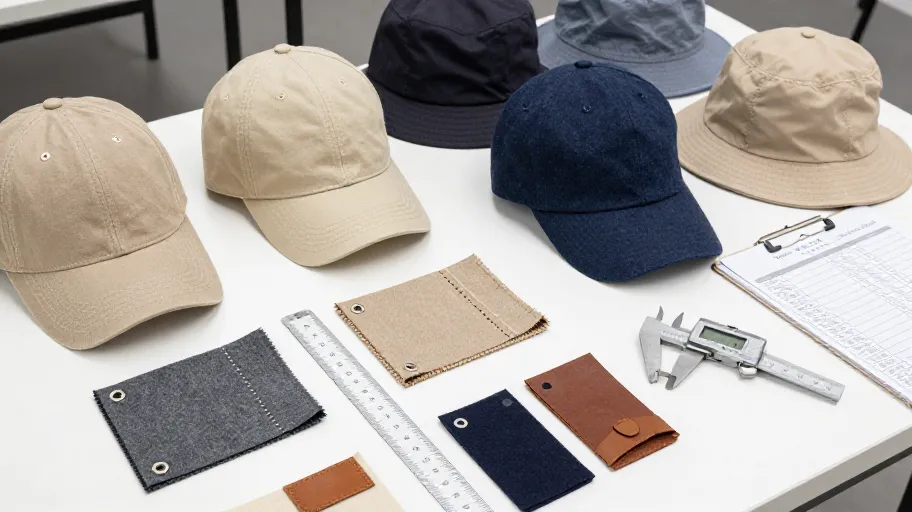
Comparing private label hat samples by photo is a guessing game. Fabric weight, stitch density, lining attachment, sweatband finish and colour consistency cannot be judged through a lens. Evaluate physical samples in hand using the F.A.C.T.S. framework — Fabric, Assembly, Consistency, Trims, Specification — score each sample in writing, and approve production only against a documented specification both parties have confirmed.
Why photographs cannot carry a sourcing decision
A photograph flattens exactly the variables that separate a sellable private label product from a returns problem. It compresses texture, hides seam allowance, disguises loose threads, masks embroidery thread count differences and renders colours through a screen you do not calibrate. None of this means the manufacturer is deceiving you — it means the tool is inadequate. Photographs belong in the process for tracking progress between revisions, not for approving a production run.
A shortlist of candidate manufacturers produces samples. The question this article answers is: how do you compare those samples methodically, and what do you confirm in writing before you commit?
The F.A.C.T.S. framework for sample comparison
Use the same five lenses on every sample from every candidate private label hats manufacturer, and record a short written note for each. Identical evaluation conditions produce comparable results.
F — Fabric
- Feel the shell fabric and note the hand, weight impression and recovery after light creasing.
- Check the crown inside and out: lining attachment, visible substrate, and whether the inner surface matches the outer in colour and finish.
- Ask the manufacturer to state the fabric composition and construction in writing, and whether the bulk-run material will be the same lot as the sample.
A — Assembly
- Inspect seams: are they straight, flat, and consistently tensioned across the crown and brim?
- Look at the visor edge, button attachment and grommets under bright light.
- Check the sweatband join point — is it tidy where it meets itself?
C — Consistency
- If you received more than one sample of the same spec, compare them against each other. Differences between samples from the same maker tell you more than any single sample.
- Compare logo placement, embroidery density and colour across the set.
T — Trims and decoration
- Evaluate embroidery edge definition, appliqué stitching, print adhesion and any hardware finish.
- Test closures and adjusters by repeated operation; note any looseness or slippage.
S — Specification
- Request a written specification sheet covering materials, decoration method, sizing and labelling.
- Confirm whether the sample represents the final intended specification or an earlier draft.
Side-by-side sample decision table
Score each candidate sample against each criterion and record what you actually observed, not impressions. The table below is the working document.
| Criterion | What to inspect physically | Questions to document | Score A (1–5) | Score B (1–5) |
|---|---|---|---|---|
| Fabric hand and recovery | Crease lightly, feel both faces | Has composition been stated in writing? | ||
| Lining and inner finish | Turn inside out, check attachment | Does the spec sheet cover lining? | ||
| Seam quality | Crown, visor edge, grommet areas | Any visible irregularity under bright light? | ||
| Decoration (embroidery/print) | Edge definition, thread density, registration | Same method and file for bulk? | ||
| Trims and closures | Repeated operation, finish of hardware | Closure type and adjuster confirmed? | ||
| Sample-to-sample consistency | Compare multiple units of same spec | How many samples did you compare? | ||
| Specification documentation | Spec sheet exists and matches sample | Is the sheet signed or version-controlled? | ||
| Communication quality | Responsiveness on technical questions | Were answers specific or evasive? |
The last two rows matter as much as the first six. A technically good sample from a supplier who cannot document it creates exactly the photo-dependency risk you are trying to remove.
Approval questions to send before production
Send these in writing and keep the replies attached to your purchase record.
- Will the bulk production use the same fabric lot and decoration method as the approved sample?
- Can you confirm the approved sample will be retained as the reference standard for the production run?
- What is your process for handling discrepancies between the approved sample and bulk output?
- Who inspects the goods before shipment, and against which reference?
- How are revisions to the sample handled — and what do I need to confirm in writing before each revision round?
Sample policy questions you must confirm directly
Sample terms, costs, freight responsibility, timelines, revision limits and whether any fees are credited against orders vary by manufacturer and by project. Do not assume terms from any previous supplier or from what other buyers describe. Confirm the current policy in writing with your candidate manufacturer before budgeting your sampling phase. Ask specifically:
- What is your current sample policy, including any charges and what they cover?
- Who bears sample delivery cost to my address, and through which courier arrangement?
- What is the current sampling lead time for my specification?
- How many revision rounds are included before further charges apply, under the current policy?
Hands-on sample inspection checklist
Use this checklist each time a physical sample arrives. Tick, note and file.
- Photographed on arrival against neutral background for the record (photo as documentation, not as evaluation)
- Fabric face and reverse inspected under daylight and bright light
- All seams and the visor edge examined
- Sweatband and lining attachment checked
- Decoration compared against artwork file
- Closures operated repeatedly
- Written spec sheet on file and matched to sample
- Differences from previous sample version listed
- Questions sent to manufacturer in writing
- Approval or revision decision recorded with date
FAQ
How many samples should I compare before choosing a private label hats manufacturer? There is no fixed number that fits every project. Compare at least two candidate suppliers so you have a reference point, and request more than one unit per specification where possible so you can check sample-to-sample consistency within the same maker.
Can I judge embroidery quality from photos? No. Thread density, underlay structure, edge definition and raised effect cannot be assessed accurately on screen. Inspect embroidery physically and compare it against the digital artwork file, then record differences.
What if two samples score closely on the decision table? Weight the criteria that drive your brand risk most — decoration quality and documentation — and compare the written responsiveness of each manufacturer. A supplier who answers technical questions precisely reduces downstream production risk even when samples are close.
Should I visit the factory before approving? A visit can strengthen a decision, but many private label buyers approve remotely with documented specifications, retained reference samples and written inspection terms. Confirm with your manufacturer what verification options they support.
How do I handle colour approval across suppliers? Request physical colour references rather than relying on screen images, and confirm in writing which reference the bulk run will be matched against. Colour perception varies between screens; physical references do not.
Request the development brief
The fastest way to get a first sample worth evaluating is to brief it precisely. 获取开发 Brief — request our development brief, built for private label buyers, and start your sample comparison with a specification that both sides have confirmed in writing.
Low-friction next step: if you are not ready to request a brief, start with the hands-on inspection checklist above. Apply it to whatever samples you already hold, and you will immediately see which questions to put to your candidate suppliers.
#cap manufacturers china, #headwear manufacturers china, #cap factory








