
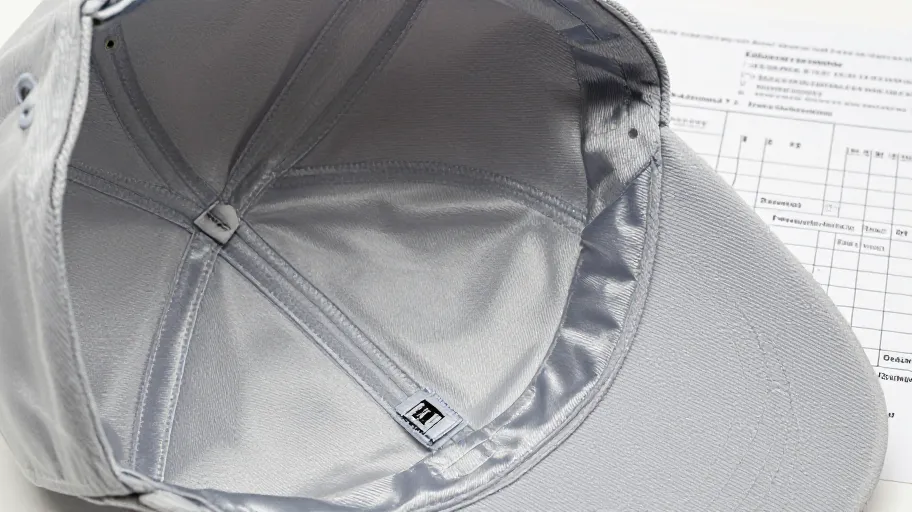
Satin lined caps are specified successfully when the buyer treats the lining as a construction decision, not a catalogue tick-box. Before sampling, define where the satin sits, its composition, how it attaches to the shell, and how colour and branding must match — then put every point in writing for the supplier to confirm against your design.
Why satin lining is a construction question, not a catalogue question
New Generation, a Shenzhen-based OEM/ODM manufacturer of custom caps and headwear, lists Satin in its fabric customization catalogue. That listing is a genuine starting point — it tells you satin is a fabric the factory works with in customization projects. What a catalogue listing does not tell you is how satin behaves in your cap: whether it is used as a full lining, a headband, a partial sweatband insert, or as trim; what the actual fibre composition is for your price point; how it is sewn into the crown; and whether your chosen shell fabric and structure are compatible with it.
This distinction matters for buyers comparing suppliers. Two quotations can both say "satin lined" and describe materially different products. One may mean a full sewn-in lining; another may mean a satin-tape sweatband. Neither is wrong — but if you do not define the term in your brief, you will be comparing offers that are not comparable. The fix is simple: write the definition yourself before you ask for samples, and ask each supplier to confirm it.
The Lining Confirmation Framework
Use this four-step framework on every satin lined cap project. It keeps the conversation factual and gives you a written record to approve against.
- Define. Decide in your own brief where the satin goes (full lining, headband, sweatband, or trim), the target wearing context, and the visual outcome you expect. You do not need technical vocabulary — a reference image and a sentence describing the intent is enough to start.
- Verify construction. Ask the supplier to describe, in writing, how the satin would be incorporated into the crown and band for your specific design. Different cap constructions — structured, unstructured, panel counts, closure types — affect how a lining is cut and attached, so the answer must be project-specific, not generic.
- Confirm composition. Ask what the satin fabric's composition is, what weights or finishes are available for your project, and how the colour will be matched to your shell fabric or Pantone reference. Composition and colour behaviour are project-level facts to confirm, not assumptions to carry forward.
- Approve a physical sample. Treat the sample as an approval document. Check it against the written definition from step one, and record any deviation before production is discussed. An approved sample becomes the reference both parties work from.
What to define before sampling: decision table
| Decision point | Why it matters | Question to put to the supplier |
|---|---|---|
| Lining coverage | "Satin lined" can mean full lining, headband or trim — each is a different product. | Where exactly will satin appear in this cap — full lining, headband, sweatband or trim only? |
| Composition and finish | Look, drape and cost all follow from the fabric itself. | What is the satin composition available for this project, and what finish or weight options can you offer? |
| Colour matching | The lining is visible when worn, so mismatch is noticeable. | How will the satin colour be matched to my shell fabric or Pantone reference, and will I see a match on the sample? |
| Construction compatibility | Lining attachment depends on crown structure and closure. | Is my cap construction compatible with the lining I've described, and are there adjustments you'd recommend? |
| Branding interaction | Logos, labels and interior prints may sit against or on the lining. | Can interior branding, labels or prints be applied alongside the lining, and how will they be positioned? |
| Documentation | Verbal agreements cannot be approved against. | Will the lining specification be written into the sample approval sheet? |
Approval questions to ask before samples are made
Copy these into your enquiry or RFQ. They convert an open-ended "can you do satin lined caps?" into a reviewable specification:
- Where will the satin be used in the cap, in your proposed construction?
- What satin composition and finish options apply to this project?
- How will the lining colour be matched, and at what stage can I verify the match?
- How is the lining attached — stitching method and coverage — and can that be shown on the sample?
- Are there interactions between the lining and my chosen shell fabric, closure or embroidery that I should know about before sampling?
- What documentation will accompany the sample so I can approve against a written spec?
Every answer should come back as a project-specific confirmation. If a supplier cannot describe how the lining will be built into your design, that itself is useful information for your comparison.
How to evaluate satin lined cap samples
When the sample arrives, judge it against your written definition — not against memory. Work through this checklist and keep it with your project file:
- Lining coverage matches the agreed definition (full / headband / sweatband / trim).
- Satin colour matches the shell fabric or Pantone reference under daylight, not just indoor light.
- Attachment points and stitching are consistent around the crown.
- Interior branding, labels or prints sit correctly relative to the lining.
- The lining sits smoothly with the crown shape — no pulling or distortion visible when the cap is worn.
- Any deviation from the written spec is noted and agreed in writing before production is discussed.
If a check fails, document it with a photo and reference the original definition. A structured note-back is faster and less ambiguous than a general "the lining doesn't look right".
FAQ
Can satin be used in any cap style? New Generation lists Satin among its fabric customization options for custom headwear, which means satin is part of the catalogue the factory works from. Whether satin suits a particular cap construction — structured crowns, unstructured six-panels, trucker styles, closures — is a project-level question. Send your design or reference image and ask the supplier to confirm compatibility for that specific build.
What is the satin fabric made of? That depends on the option selected for your project, and it should be confirmed in writing before sampling rather than assumed from a catalogue listing. Ask the supplier which compositions are available for your design and price expectations, and request that the composition be stated on the sample documentation.
Is satin lining suitable for promotional or corporate giveaway caps? Satin is listed as a customization fabric option, so it is available to consider for corporate programmes as well as retail lines. Suitability depends on your design intent, budget expectations and the cap construction you have in mind — all points to raise in a project brief so the supplier can advise against your actual specification.
How do I compare satin lined cap quotes from different suppliers? Use the same written lining definition with every supplier: coverage, composition, colour-matching method and attachment described identically. Then compare the written confirmations and the physical samples against that single definition. Quotes built on an undefined "satin lined" description cannot be compared fairly; quotes built on your definition can.
What should I send to start a satin lined cap project? A short brief is enough: the cap style, where you want the satin to appear, a reference image if you have one, and your logo or branding files. The supplier can then respond with a project-specific confirmation rather than a generic answer.
Start your project review
If you are evaluating satin lined caps for a brand, wholesale programme or corporate order, send your cap brief, a reference image or your logo for project-specific review. You will receive a response against your actual design — including where satin can be used, what needs confirmation for your construction, and what to define before sampling — rather than a catalogue answer.
Low-friction next step: not ready for a full brief? Copy the approval questions and sample checklist above into your own enquiry document and use them with any supplier you are comparing. When you want those questions answered against a specific design, submit the brief for review.
#cap manufacturers china, #headwear manufacturers china, #cap factory