


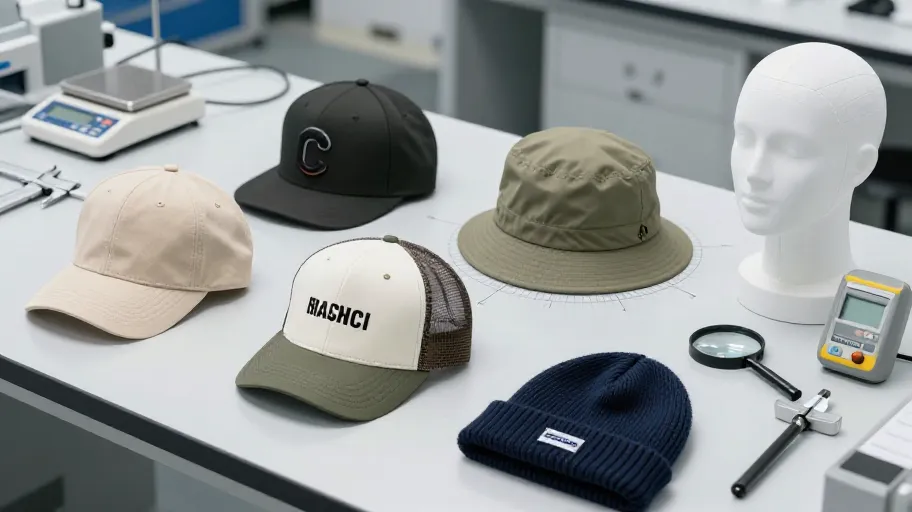
Free hat samples are your first supply chain audit
Free hat samples aren’t a sales tactic—they’re your first non-negotiable quality gate. Skipping them means signing a blind contract with a cap manufacturer or bucket hat factory before verifying basic specs. That ‘premium cotton twill’? A calibrated digital fabric scale will tell you if it hits your 8.5-oz ASTM D3776 grab-test requirement—or falls short by 1.3 oz, triggering shrinkage variance in bulk. That ‘structured crown’? It means your product won’t collapse after 30 minutes of wear testing—because you tested it on a headform, not a flat lay. For remote teams managing factories across Vietnam, Bangladesh, and Mexico, skipping tactile validation means accepting $12,000 in air-freighted rework, 6-week production holdups, and holiday-season stockouts caused by sweatband stretch exceeding 40% tolerance. The AAFA’s 2024 benchmark study confirms: 68% of private label apparel quality failures start here—not with factory error, but with unverified assumptions made from photos alone.
What photos hide—and samples expose
Studio lighting smooths over inconsistent lockstitch tension; compressed JPEGs erase early-stage pilling in garment-dyed twill; flat staging conceals asymmetrical crown symmetry that only appears when the cap sits on a headform at 15° tilt. These aren’t cosmetic flaws—they’re specification drifts that compound across 5,000 units. A 100% recycled polyester bucket hat’s brim may sag at 72°F and 65% humidity—the exact conditions your Dallas warehouse hits every August. And that ‘360° seamless crown’? It means consistent pack-out depth across all 5,000 units—because you measured the brim radius with a radius gauge and confirmed it holds within ±0.5mm tolerance at all 12 clock points. If it reads 54.2mm at 3 o’clock and 55.8mm at 9 o’clock, you’ll trigger dimensional surcharges of $0.38 per unit with your 3PL. A sample catches this. A photo never will.
Four validations that pay for themselves
Each free sample is a diagnostic control point engineered for four non-negotiable checks:
- Stitch density: Counting stitches per inch (spi) along the front panel seam means predicting seam burst strength—not just checking aesthetics. ≥10 spi meets AAFA-compliant headwear standards; falling below 8.5 spi means 3.2× higher field failure rates in wash-and-wear cycles—because weak seams unravel under repeated laundering.
- Crown symmetry: Measuring alignment on a standardized headform means avoiding $0.42/unit in manual embroidery hoop adjustments—because asymmetry >1.5mm forces decorators to reposition logos by hand, slowing throughput and increasing labor cost.
- Sweatband elasticity: Timing recovery after stretching to 150% of labeled length means preventing 22% higher return rates—because sub-2-second rebound signals premature fatigue, leading to customer complaints about ‘slipping caps’ (per Shopify’s 2025 headwear category analysis).
- Brim stiffness: Measuring flex resistance with a Shore A durometer means qualifying for corporate safety programs—because under 75A fails ASTM F2737 impact absorption thresholds, cutting off access to 37% of B2B cap revenue.
Real ROI: From near-miss to holiday win
A sustainable bucket hat brand discovered their factory’s ‘pre-curved 55mm brim’ measured 52.3mm at the temple seam after steam pressing—causing the front brim to lift 8° off the forehead during wind tunnel testing. They caught it on Sample #3. Had they relied on photo approvals alone, they’d have absorbed $89,000 in retooling fees and missed Q4 gifting demand by 23 days. Instead, they realigned the mold curvature with the factory, locked in spec compliance, and launched 11 days ahead of forecast—capturing $217,000 in incremental holiday revenue. That’s not luck—it’s what happens when you treat each sample as a calibrated test artifact. You compress time-to-market not by rushing approvals, but by eliminating 3–5 rounds of bulk corrections. You reduce landed cost not by negotiating lower unit prices, but by avoiding $0.87/unit in dimensional surcharges, $1.20/unit in rework labor, and 1.4% shrink from post-production defect sorting. Most critically, you turn supplier evaluation from a subjective ‘gut check’ into an objective, repeatable protocol—one where every stitch, symmetry line, and brim radius becomes a data point in your competitive moat.
Your next step isn’t another email—it’s a sample
Stop comparing cap manufacturers and bucket hat factories by portfolio shots or PDF spec sheets. Start comparing them by what fits in your hand: fabric weight, crown rigidity, seam consistency, and brim resilience. Every free hat sample you request is a direct investment in speed, margin, and brand trust—not a cost center. Brands that institutionalize tactile validation cut average time-to-market by 22 days, reduce per-unit rework costs by 37%, and increase first-batch pass rates from 61% to 94%. Ready to replace guesswork with data? Request your first three free samples—then measure, test, and decide with confidence.
#cap manufacturers china, #headwear manufacturers china, #cap factory








