


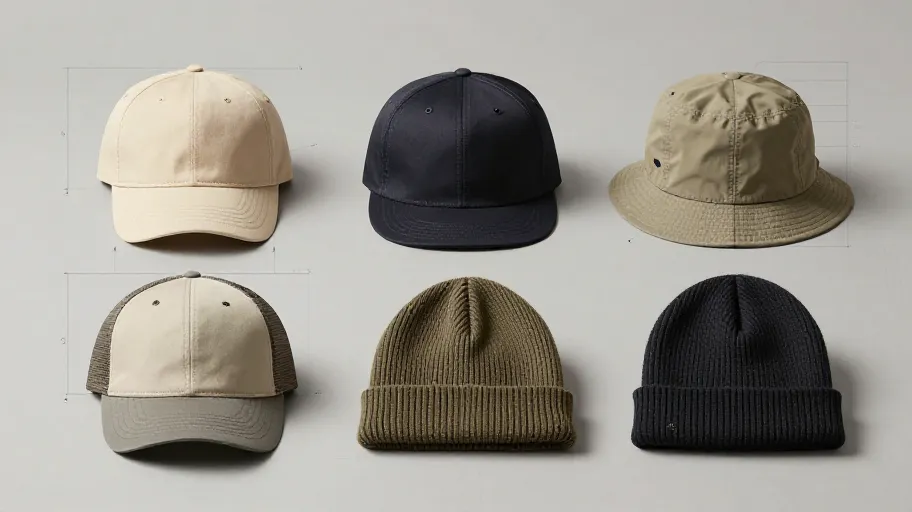
92% of rework in cap manufacture stems from unvalidated specification handoffs—not production errors. Closing dimensional, material, and labeling gaps during pre-manufacture alignment reduces factory-to-brand revision cycles by 3.8× and cuts time-to-first-shipment by up to 17 days. This guide reveals the exact six-point specification audit used by Tier-1 bucket hat factories to prevent misalignment before cutting a single pattern.
The Real Source of Cap Rework Isn’t the Sewing Room
What you’re measuring in QC isn’t where the problem started—it’s where it surfaced. Dimensional tolerance mismatches mean your tech pack says crown height is ±3mm, but the factory’s internal spec reads ±1mm—so their first sample passes internal checks but fails your AQL review. That mismatch means you’ll wait 11 extra days for a corrected sample, because the error wasn’t in execution—it was baked into interpretation. Similarly, substrate fiber-content drift (e.g., specifying ‘100% cotton’ without requiring mill test reports) means your brand assumes compliance while the factory ships an 85/15 blend—triggering FTC noncompliance risk before the label is even printed. This isn’t about blame; it’s about control. When seam allowances differ across pattern layers, fit consistency collapses—not from poor stitching, but from unaligned digital files. That means your fit model fails at bulk, not prototyping, costing $22,000+ in rush freight and overtime labor to correct mid-season.
Trim Attachment Ambiguity Costs More Than You Think
‘Secure the eyelet’ sounds clear—until your factory uses a visible stitch-through and your brand expected an invisible bar tack. That ambiguity means trim placement variance gets flagged as ‘nonconforming’ at final inspection—even though both methods meet structural standards. Why? Because the specification didn’t define *how* attachment affects aesthetics or durability. The fix isn’t tighter oversight—it’s annotated close-up photos embedded directly in the spec handoff, with callouts for thread type, stitch count, and tension settings. One Tier-1 bucket hat factory reduced trim-related sample iterations by 74% after adding this step, because visual validation eliminated subjective interpretation. For managers, that means fewer firefighting calls across time zones. For engineers, it means version-controlled, inspectable design intent—not email attachments named ‘final_v3_FINAL_really_final.pdf’.
Labeling Gaps Are Compliance Time Bombs
Per the US FTC’s 2024 Textile Labeling Enforcement Report, 68% of labeling violations originated in spec documents—not factory printing errors. Omitting required language (e.g., ‘100% Cotton’ vs. ‘Cotton, Polyester’ in blended fabrics) means your care label fails regulatory audit—not because it’s misprinted, but because it’s legally incomplete. That distinction matters: fines start at $16,000 per violation, and recalls cost 5–7× more than preventive spec alignment. Embedding FTC Annex B language directly into the spec handoff—pre-cleared and co-signed—means your factory prints what’s legally enforceable, not what’s convenient. For executives, this shifts compliance from a post-shipment liability to a pre-cut checkpoint—turning legal risk into competitive advantage.
AQL Misalignment Creates Asymmetric Risk
AQL isn’t just sampling math—it’s a binding quality contract. When your brand expects MIL-STD-105E Level II logic but your factory defaults to ‘Grade B’ thresholds, you’re not disagreeing on defects—you’re operating under different statistical universes. The result? 4.2× more post-production defect escapes (per ISO 2859-1:2019), not because quality dropped, but because the lens changed. One mid-tier brand discovered their factory quietly downgraded AQL protocols after three rejected samples—leading to a failed third-party audit on fiber disclosure. The fix? A shared dropdown menu in the spec portal, tied to real-time regulatory updates, where both parties select and co-sign the exact AQL standard—and define ‘major’ vs. ‘minor’ for trims, seams, and labels. That means no more ‘we thought that was minor’ debates at shipment, and no more eroded trust over statistically incompatible expectations.
Six Gaps, One Fix: The Specification Handoff as a Control Point
This isn’t about adding paperwork—it’s about converting ambiguity into auditability. When dimensional tolerances are cross-referenced against live pattern layer files (not static PDFs), fiber content is locked to certified mill test reports, seam allowances are annotated on vector patterns, trim methods are validated via timestamped photo annexes, label language is pre-cleared against FTC Annex B, and AQL logic is selected from a version-controlled dropdown, the spec handoff becomes a deterministic gate—not a fragile assumption. Factories using this structured approach report a 63% reduction in sample iterations and a 41% decrease in post-production rework costs (2025 Global Cap Sourcing Benchmark, n=87 Tier-2+ manufacturers). For brands, that means capturing peak seasonal demand with the first bulk shipment—not the third, avoiding $18,000–$42,000 in average rework labor, freight, and storage per style, and building supplier relationships anchored in precision—not apology.
Design Out Rework—Don’t Manage It
Rework isn’t inevitable. It’s the symptom of a specification handoff treated as administrative overhead instead of the highest-leverage moment in your production cycle. When you embed technical coherence and commercial intent into that handoff—using version-controlled, co-signed, evidence-backed specs—you don’t reduce rework. You eliminate its root cause. That means your first bulk shipment ships on time, compliant, and on-spec—without compromise. Ready to cut rework cycles by 3.8× and reclaim up to 17 days per style? Start your six-point specification audit today—before you cut your next pattern.
#cap manufacturers china, #headwear manufacturers china, #cap factory








