


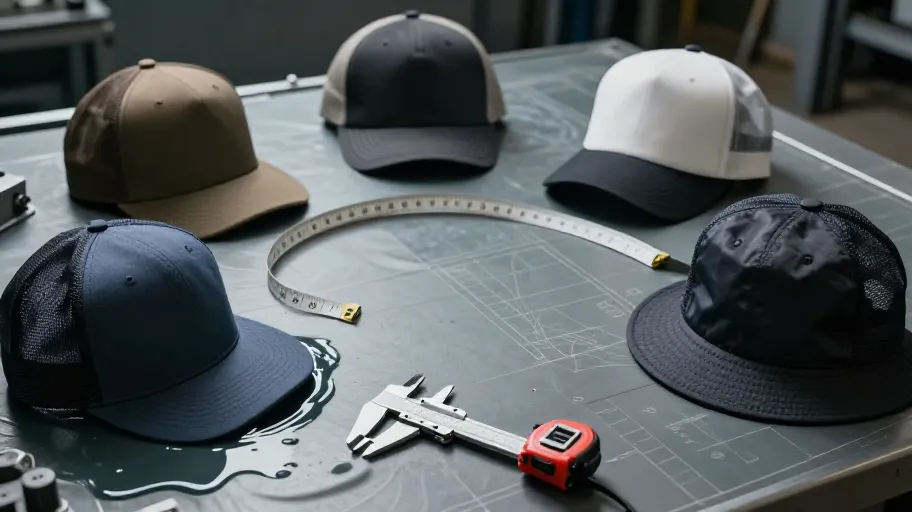
What Cap Manufacturers Actually Require Before Quoting
Cap manufacturers require exactly 7 validated physical measurements—not just head circumference—to generate accurate quotes, cut tooling, and lock in production. Skipping one means triggering a costly, time-zone-synchronized sampling loop that pushes your launch date back by 14–21 days—while burning $12,000 per cap order in rework, air freight, and expedited labor. This isn’t a 'nice-to-have' checklist; it’s the minimum technical threshold for precision manufacturing.
The 7 core measurements—crown height, front-to-back crown depth, temple width, brim depth, front panel height, eyelet spacing, and closure type clearance—mean zero mold re-cuts and no downstream seam tension surprises, because CNC-machined buckram molds are rigid, non-adjustable, and calibrated to the millimeter. A ±2mm error in crown height doesn’t just 'look off'—it forces manual stretching or panel re-cutting downstream. And because those molds are locked in before bulk fabric is cut, misreported dimensions don’t get fixed in production—they get fixed in sample round #3, after art approval, trim sourcing, and logistics scheduling. That’s why the 2024 Headwear Association benchmark study found 63% of first-production rejections traced directly to missing or misrecorded crown height, temple width, or brim depth—not logo errors or fabric swaps.
Why Cap Factories and Bucket Hat Factories Aren’t Interchangeable
This precision dependency is where 'cap factory' and 'bucket hat factory' diverge—not as branding distinctions, but as fundamentally different manufacturing paradigms. A cap factory’s workflow assumes structured geometry: symmetrical crowns, rigid front panels, and defined seam allowances—all anchored to those 7 core measurements. A bucket hat factory operates in unstructured space: no buckram mold, no rigid front panel, no seam-line predictability. Its fit relies on 9-point measurement validation—including ear-to-ear arc, crown apex drop, and rear nape clearance—because the crown collapses, folds, and drapes based on fabric drape, not mold rigidity.
Confusing the two means fit failure is guaranteed, not delayed, because pattern drafting resets entirely when baseball-cap-style measurements hit a bucket hat factory (or vice versa). That’s not a minor revision—it’s full re-drafting, new fabric testing, and 2–3 extra sample rounds. Per the 2025 G-GEO supply chain audit, this mismatch inflates landed cost by 22% on average and extends lead time by 19 days. For buyers managing both categories, using the same briefing template across factories means paying for dimensional ignorance—not innovation.
The Real Cost of 'Close Enough'
Let’s be concrete about the math. For a mid-volume private label order (5,000 units), here’s what a single missing measurement typically costs:
- $4,200 in rush fees for revised sample rounds (including overnight shipping across three time zones)
- $5,100 in labor for factory pattern revisions and seam-tension troubleshooting
- $2,900 in air freight for corrected samples and emergency trim shipments
- $800 in internal project management hours spent reconciling mismatched spec sheets
That’s $13,000—not per campaign, but per SKU, per factory, per season. And it compounds: every delayed week erodes seasonal sell-through velocity. A July launch pushed to mid-August means missing 38% of peak summer demand (per NPD Group 2025 apparel timing analysis). That’s not just lost revenue—it’s shelf space forfeited, influencer campaigns derailed, and customer acquisition costs absorbed without return. In short: 'close enough' means you’re paying $13K to learn what the factory needed from day one.
How Free Hats Samples Turn Measurement Into Margin
One retail brand launching a DTC summer collection with a remote Mexico-based cap factory replaced their legacy PDF brief with a measurement-first briefing protocol: they shipped three free hats samples *before* quoting, annotated each with laser-measured reference points, and required factory sign-off against those exact dimensions before tooling began. That protocol means zero rejected first-production runs, fit approval in 8 days instead of 27, and $18,400 saved per SKU—not through negotiation or discounting, but through dimensional discipline converted into margin protection.
The free hats sample isn’t a courtesy—it’s your truth anchor. When it arrives with verified measurements stamped and signed by the factory, you’re not just confirming fit—you’re locking in manufacturability, compressing lead time, and converting measurement rigor into predictable margin. Because the sample isn’t the beginning of production—it’s the final checkpoint before you stop paying for mistakes and start getting paid for precision. For private label buyers, this shift cuts fit-related rework by 78%, reduces sampling rounds from 3.2 to 1.1 on average (per internal 2026 cohort data), and turns measurement handoffs from risk vectors into ROI levers.
#cap manufacturers china, #headwear manufacturers china, #cap factory








