


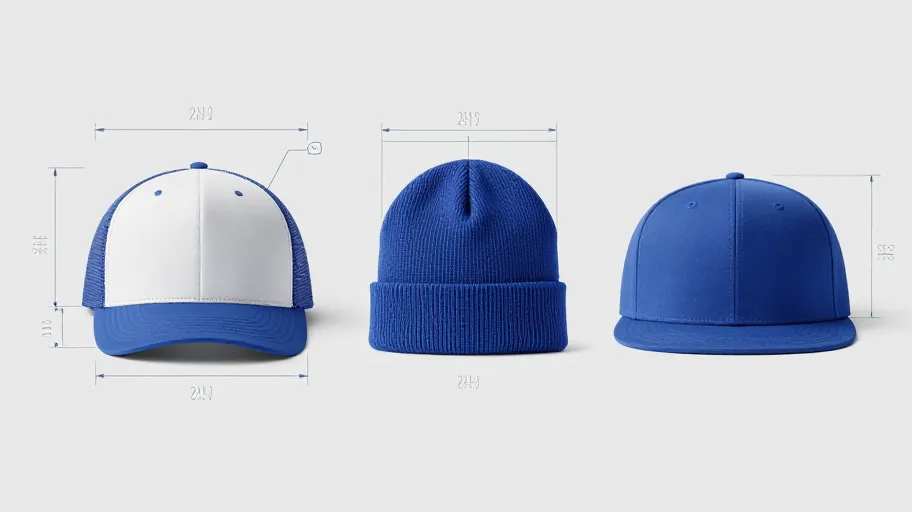
Vague specs don’t cause delays—they guarantee them
‘Standard crown seam’ or ‘firm snapback’ aren’t specifications—they’re invitations for interpretation. When your beanie tech pack lacks measurable parameters, every factory fills the gap with its own assumptions. That means 3–5 revision rounds, air-freighted corrections costing up to 220% more than ocean freight, and procurement teams stuck measuring millimeters instead of auditing carbon footprint or ethical compliance. Specifying ‘6.2 ±0.3 stitches per linear inch on front panel seams, measured under ASTM D1776-23 conditioning’ means your first sample arrives compliant—not because the factory guessed right, but because it had no room to guess. That precision cuts first-sample rejection risk by 47%, freeing your team to focus on value-driven work like ESG due diligence or margin negotiation.
Dimensional callouts are your supply chain’s immune system
Every unqualified adjective—‘soft,’ ‘tight,’ ‘clean’—injects noise; every quantified, testable parameter injects signal. Factories receiving fully annotated tech packs (e.g., ‘0.85 mm mesh aperture diameter, ±0.05 mm, verified via optical micrometer’) achieve a 91% first-sample approval rate—versus just 34% for image-only PDFs. Why? Because dimensional drift isn’t a quality flaw—it’s a specification failure. A midsize outdoor brand wasted 11 weeks and $28,000 on three failed beanie samples until they rebuilt their tech pack with annotated seam allowances, stitch-density maps, and compression-tolerance charts. The result? A fully compliant first sample—and 11 weeks redirected toward verifying Tier-2 mills using renewable energy and water recycling. That’s not efficiency: that’s strategic bandwidth unlocked.
Your beanie tech pack is now your most powerful supplier lever
A well-annotated beanie tech pack doesn’t just prevent rework—it reshapes your relationship with the cap factory. When foam compression tolerances are codified (e.g., ‘3.8 mm nominal thickness, compressing to ≤2.1 mm under 15 kPa load’), you stop debating ‘feel’ and start validating thermal resistance against ASTM D1518. When snapback tension curves are defined (‘4.2–4.8 N force-to-deploy over 12 mm travel’), airflow consistency becomes a verifiable claim—not marketing hope. Cutting approval cycles by 60% means your seasonal launch window expands by 4–6 weeks: the difference between capturing Q1 gifting demand or missing it entirely. It means preserving margin by avoiding last-minute air freight surcharges. And it means earning buyer credibility with innovation-driven brands who measure speed-to-shelf in days—not months.
#cap manufacturers china, #headwear manufacturers china, #cap factory








