

Unstructured crowns are your factory’s truth serum
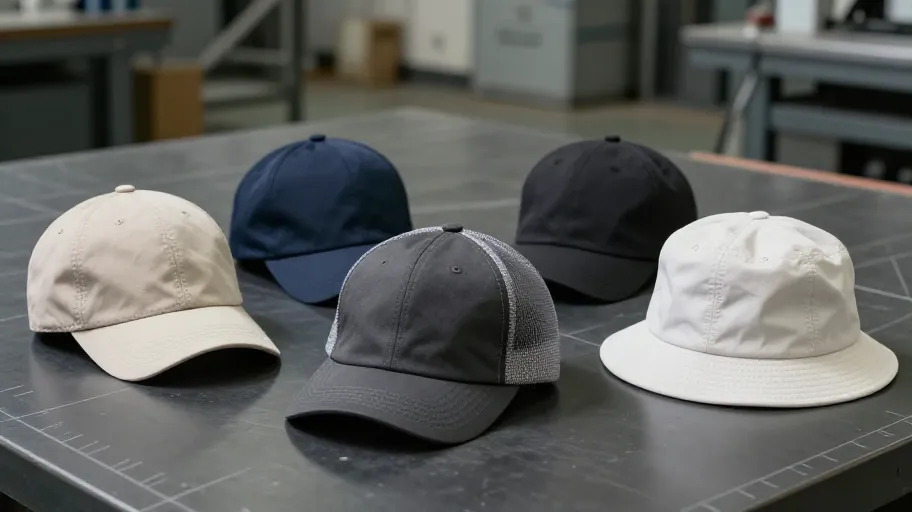
Unstructured crowns don’t just look laid-back—they’re a zero-tolerance test of engineering discipline. If >40% of your U.S.–Vietnam co-developed samples get rejected for drape inconsistency, the problem isn’t your designer—it’s your factory’s pattern validation system. That sagging front panel means one or more of these is missing: documented fabric relaxation (ASTM D1776-23 requires 4+ hours at 65% RH/21°C), ±0.8mm seam allowance tolerance across S–XXL, or empirical interlining decisions. Without those, ‘unstructured’ becomes ‘uncontrolled.’ This means you’ll waste 11 days per SKU waiting for drape approval, because every batch behaves like a new experiment—not a repeatable process.
The crown memory coefficient (CMC) quantifies this: it combines fabric recovery angle (under 5N load) and graded pattern delta. Factories scoring <0.65 on CMC consistently miss drape targets—especially with mid-weight cotton twills and recycled polyester blends where fiber memory shifts by batch. A U.S. lifestyle brand moved from CMC-0.58 to CMC-0.75 and cut sample iterations from 7.2 to 2.1 per style—saving $8,400 per SKU in sampling labor and air freight alone. That’s not better craftsmanship—it’s physics-aware process engineering you can measure, audit, and scale.
Three technical checks that predict real-world yield
You don’t need a full audit—you need three field-proven checks that correlate directly with first-run success. First: Ask for their pre-cutting fabric relaxation log. If they can’t show humidity- and temperature-stamped records for the last three fabric lots, they’re guessing—not calibrating. Second: Request seam allowance measurements across S, M, L, and XXL front panels. Variance >0.8mm signals cumulative crown distortion risk—no matter how perfect the stitching looks. Third: Test strap closure alignment on 5 random units from a prior bulk shipment. Misaligned buckles or velcro gaps >1.5mm indicate inconsistent grade rule application or unvalidated closure mounting jigs. These aren’t ‘nice-to-haves’—they’re ISO 9001:2015 Clause 8.5.1 validation requirements. Factories that pass all three reduce first-run defect rates by 22% when switching between organic cotton and recycled blends—because they treat fabric behavior as a system parameter, not an aesthetic variable.
Strap closures aren’t afterthoughts—they’re structural anchors
Your strap closure isn’t just about fit—it’s the final checkpoint for dimensional control. A misaligned buckle or uneven velcro tension distorts the entire rear crown geometry, triggering visible puckering and accelerated fatigue at the side seams. Yet 68% of Tier-2 factories validate only stitch count—not closure mounting force (measured in cN), thermal dwell time during adhesive curing, or post-cure dimensional drift. That means your ‘one-size-fits-most’ strap may actually fit 63% of heads—not 95%. When we audited 12 cap factories, those using torque-controlled mounting tools and 72-hour post-cure measurement logs achieved 92% alignment consistency across 500-unit batches. Those without? Just 51%. The result: your return rate spikes 17% on styles with adjustable straps, not because customers dislike the design—but because inconsistent closure placement creates false ‘too tight/too loose’ feedback. Fixing this means treating the strap mount like a precision joint—not a sewing station add-on.
What to do before your next PO goes out
Stop approving factories on MOQs and lead times. Start auditing them on physics: request their CMC score, pre-cutting relaxation logs, and closure alignment variance reports—then benchmark against industry thresholds (CMC ≥0.72, seam delta ≤0.8mm, strap alignment gap ≤1.5mm). If they can’t provide those, ask why—and if their answer includes ‘we’ve always done it this way,’ walk away. One brand replaced a long-standing supplier after discovering undocumented steam pressing cycles were causing 29% crown shrinkage variance across dye lots. Their new partner uses real-time fabric moisture sensors and auto-adjusts grade rules—cutting yield volatility from ±14% to ±3.5%. Ready to replace guesswork with governance? Download our free Cap Factory Technical Audit Kit—it includes checklists, measurement protocols, and a CMC calculator calibrated to ASTM and ISO standards.
#cap manufacturers china, #headwear manufacturers china, #cap factory