


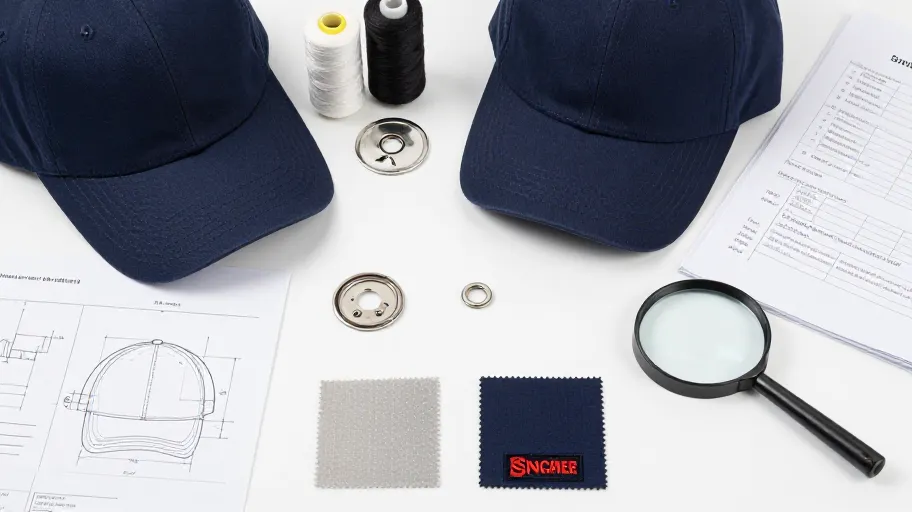
Manufacturing origin matters because it determines who actually controls stitching, materials, closure assembly and quality consistency — the details that decide whether bulk caps match your approved sample. Origin is verifiable evidence, not a label. Compare it across suppliers using documentation, not promises.
That is the short answer. Below is a working method for putting it into practice before you place an order.
What "manufacturing origin" actually means in cap sourcing
When buyers ask why manufacturing origin matters when buying high-quality caps, the question behind the question is: can I hold the actual maker accountable for the goods I receive?
Origin is not just a country name on a quote. For a custom cap order, origin information tells you:
- Who executes your design. A factory that cuts, embroiders and assembles in-house carries different accountability than a broker who subcontracts each stage.
- Where your sample was made. If the sample comes from one facility and bulk production from another, your approval may not transfer.
- Which processes are in-house. Embroidery, printing, washing, closure attachment and packing each affect the finished cap. Which are done where is a question you should ask and document.
- What you can audit. Origin clarity determines whether a pre-shipment inspection has a physical address to visit or a report you can cross-check.
None of this tells you a given factory is good or bad. It tells you whether your quality controls have somewhere to land. A supplier who answers origin questions precisely gives you more to work with than one who answers smoothly but vaguely.
The O.R.I.G.I.N. Check: a six-point comparison framework
Use these six points to compare suppliers on evidence, in writing, before any payment discussion.
O — Origin transparency. Ask directly: where will my caps be manufactured, and is that the same facility that produced my sample? Request the answer in writing.
R — Requested evidence. Ask what documentation the supplier can provide about the manufacturing site — business licence scope, facility address, audit reports if any exist. Confirm what is available for your specific project.
I — Inspection gates. Agree before ordering: at what points can you or a third party inspect — after sample approval, during production, before shipment? Confirm the current policy directly with the supplier.
G — Grain and construction. Compare physical construction details (panel alignment, stitching density, brim shape, closure type) against the drawing, point by point.
I — Iteration discipline. Track every revision. Which sample version is the approved one, and how is the supplier binding bulk production to it?
N — Note-keeping. Keep a written record of every origin claim, sample approval and drawing revision. If a dispute arises, your notes are your position.
Decision table: comparing two suppliers on origin evidence
| Comparison point | Supplier A shows | Supplier B shows | What to do |
|---|---|---|---|
| Named manufacturing facility | Full address, confirmed in writing | "Our partner factory" | Weight A higher on accountability |
| Sample–production link | Confirms same facility, in writing | No written confirmation | Ask B to confirm before proceeding |
| In-house processes listed | Embroidery, assembly specified | Vague scope | Request a written process list from B |
| Inspection access | Offers defined inspection points | Defers discussion | Confirm inspection terms before order |
| Sample-to-drawing fidelity | Marked-up drawing returned with sample | Sample only, no annotation | Request annotated drawings from B |
| Revision control | Version numbers and dated approvals | Email threads only | Agree a revision log format |
This table is a template, not a verdict. A supplier who scores lower may still be the right partner if they improve their answers when asked — but the answers must exist in writing.
Comparing samples against drawings: approval questions that protect you
A drawing and a physical sample are two different promises. Your job at approval stage is to find every gap between them. Ask and document:
- Panels and crown: Does the sample's panel count and crown shape match the drawing exactly? Any deviation must be re-drawn, not verbally excused.
- Stitching: Where does the drawing imply reinforced stitching — sweatband, visor seam, button? Verify on the sample and note the stitch type used.
- Closure and sizing: Is the closure type (snapback, strapback, fitted, elastic) the exact model specified? Confirm the sizing range matches your specification document.
- Materials: Does the fabric weight, texture and colour reference match the drawing's material callouts? Request material confirmation in writing.
- Decoration: Does embroidery or print placement match the drawing's measurements? Measure the sample yourself against the artwork positions.
- Branding and labelling: Are internal labels, care tags and packaging exactly as specified? Confirm every printed element.
- Bulk linkage: Ask directly — how will you guarantee bulk production matches this approved sample? Request the mechanism (sealed reference sample, production hold points) in writing.
For every question where the supplier's answer depends on policy — sample fees, shipping arrangements, timelines, minimums — confirm the current terms directly with them. Do not rely on assumptions from prior orders or other suppliers.
Pre-approval checklist
Run this before you sign off any sample or drawing:
- Manufacturing facility named and confirmed in writing
- Sample production facility and bulk facility confirmed as the same (or difference documented)
- Every drawing dimension checked against the physical sample
- Materials, colours and closure types verified against specification
- All deviations logged and re-drawn, not waived verbally
- Approved sample version numbered, dated and sealed
- Inspection points agreed in writing before order
- Sample policy, fees, timelines and minimums confirmed directly with supplier
- Revision log established with agreed format
- Bulk-to-sample linkage mechanism documented
FAQ
Does a lower origin price always mean lower cap quality? No rule applies. Price differences can reflect process scope, materials, order complexity or margin structure — none of which you can judge from origin alone. Compare what each quote includes, in writing, and ask each supplier to itemise.
Should I visit the factory before ordering? A visit is one strong verification method, but not the only one. Written facility confirmation, audit documentation where available, and defined inspection gates can serve buyers who cannot travel. Choose verification methods proportionate to your order's risk and size.
What if the supplier won't confirm where the caps are made? Treat an unwillingness to answer in writing as a sourcing risk to weigh, not a reason to walk away immediately. Ask once more, in writing, with the specific questions above. If the answer still cannot be documented, that gap belongs in your supplier comparison.
How many sample rounds should I approve? That is project-specific. What matters is that each round has a documented reason, a marked-up drawing, and a dated approval — so bulk production is tied to a specific, identifiable sample version.
Is a trading company a problem for origin clarity? Not inherently. A trading company that discloses the manufacturing facility, secures inspection access and documents sample approval can be workable. What matters is whether accountability for bulk quality has a clear, written chain.
Download the sourcing checklist
The questions and gates above only protect you if you apply them consistently across every supplier you compare. We have compiled them, with the O.R.I.G.I.N. Check and the pre-approval checklist, into a single document you can print and use at your next supplier call.
[下载核对清单 — Download the sourcing and sample-approval checklist]
Prefer to start with a live conversation about a specific cap project? Send us your drawings and we will walk through the sample-comparison questions together — with answers in writing, before anything is ordered.
#cap manufacturers china, #headwear manufacturers china, #cap factory








