

Sourcing custom hats from China cheap means controlling cost through precise specifications, staged sampling and documented approval — not chasing the lowest quote. Written specs, prototype evaluation and a formal pre-production sign-off are what protect a budget-conscious order. This guide gives B2B buyers a framework, a comparison table and the approval questions to ask before any production commitment.
What "cheap" should mean for an importer or brand
For a corporate buyer, wholesaler or brand, "cheap" is only useful when it survives shipping, customs inspection and repeat orders. A low unit price backed by vague specifications is expensive: it produces rework, disputes and inventory you cannot sell. The productive definition of cheap is cost discipline — buying exactly the specification your market needs, at a price verified through like-for-like quotes, with every change documented before production starts.
That is a sourcing process question, not a bargaining question. The rest of this guide is built around one.
The SPEC-APPROVE framework
Use this five-stage framework to move from inquiry to production release without leaving quality to assumption:
| Stage | What it means | Buyer action | Output |
|---|---|---|---|
| S — Specification | Define the product in writing | Send a full spec sheet (below) | RFQ document |
| P — Prototype | First physical interpretation of the spec | Evaluate construction, fit, decoration | Prototype notes |
| E — Evaluation | Judge against your written spec, not taste | Mark deviations, request corrections | Revision list |
| C — Confirmation | Lock materials, colours, decoration, sizing | Approve changes in writing | Approved spec revision |
| APPROVE | Pre-production sign-off gate | Approve the pre-production sample as the contract reference | Signed approval record |
The key discipline: no stage advances without written confirmation, and the approved pre-production sample becomes the reference standard for the production run.
The specification package: what to send a supplier
A supplier can only quote accurately against a complete spec. Include, at minimum:
- Style and construction: crown panel count, visor shape, crown profile, seams.
- Materials: shell fabric composition and weight, lining, sweatband, visor material, closure type.
- Decoration method: embroidery (stitch count and placement), printing (method and ink), woven or PVC patch, appliqué — with artwork files.
- Sizing and fit: sizing system, closure or fitted sizing, any fit references.
- Colour management: colour references (e.g., Pantone) rather than screen approximations, and how colour will be verified at sampling.
- Labelling and packaging: main label, care label, hangtag, interior taping, polybag or carton requirements, and any barcode or country-of-origin marking obligations in your destination market.
- Compliance questions: ask the supplier to confirm which tests or documentation they can support for your target market, and verify against your own regulatory obligations.
For anything you do not know, ask the supplier for their recommendation and document it — an unanswered spec line becomes a dispute line later.
Sampling and approval: the questions that matter
Concrete approval questions for any sample you evaluate:
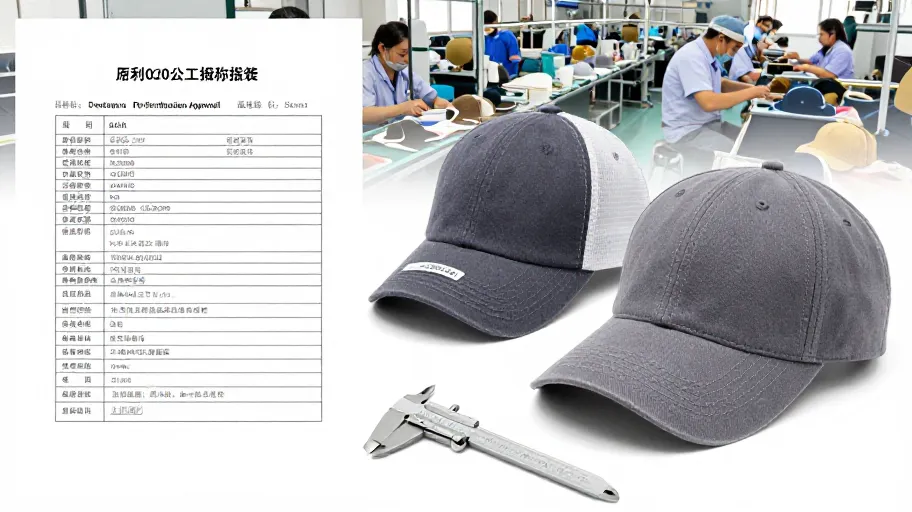
- Does the construction match the spec sheet line for line — panels, seams, visor, closure?
- Does the decoration match the artwork in placement, density and colour against the agreed reference?
- Do the materials match what was quoted, and can material composition be evidenced?
- Does sizing fall within your acceptance criteria, and how was it measured?
- What deviations exist versus the spec, and has each been corrected or accepted in writing?
- Has this exact revision been designated the approved pre-production reference for production?
- What inspection and defect criteria will apply to bulk production, and how will they be documented?
Whatever the answers, capture them in writing. An email trail attached to an approved sample is the cheapest insurance in this process.
Comparing suppliers on "cheap": a decision table
When you compare quotes, force them onto the same spec basis first, then judge on these dimensions:
| Dimension | What to compare | What to document |
|---|---|---|
| Specification match | Does the quote reference your full spec sheet? | Quoted spec revision per supplier |
| Sample quality | Prototype evaluation against your spec | Deviation notes and corrections |
| Communication quality | Clarity, speed and willingness to answer technical questions | Response record |
| Documentation | Test support, labelling and packaging answers | Written confirmations |
| Change management | How revisions are quoted and approved | Change log |
| Total landed view | Unit price plus your freight, duty and inspection assumptions | Your own landed-cost model |
Note that unit price alone is not a comparable number until the spec, packaging terms and trade terms are identical. Confirm Incoterms, packaging and payment terms with each supplier in writing.
Pre-production approval checklist
Release production only when every box is checked:
- Full written spec sheet sent and acknowledged
- Prototype evaluated against spec, deviations documented
- All corrections confirmed in writing
- Colour approved against the agreed reference
- Decoration method and placement approved on the physical sample
- Sizing verified within your acceptance criteria
- Labelling, packaging and compliance answers documented
- Pre-production sample approved and designated the production reference
- Inspection and defect criteria agreed in writing
- Signed approval recorded before production release
Frequently asked questions
How do I get a genuinely low price without sacrificing quality? By specifying precisely, comparing quotes on an identical spec basis, and approving samples before production. Cost control comes from removing ambiguity, not from accepting vague specs at a lower number.
What should I send a Chinese hat factory to get an accurate quote? A complete spec sheet: style and construction, materials, decoration method with artwork, sizing, colour references, labelling and packaging requirements, plus your target market's compliance questions.
Which sample stage proves production quality? Ask your supplier which stages they provide and what each verifies. Only a pre-production sample approved against your written spec — and designated as the production reference — serves as your sign-off gate.
How do I avoid disputes on a budget custom hat order? Document everything: spec revisions, sample approvals, change log, inspection criteria. When the approved sample and written record align, disagreement has a reference point instead of an argument.
Is "cheap" compatible with corporate or brand orders? Yes, when it means disciplined specification and staged approval rather than lowest-bid sourcing. Brands protect margin by controlling exactly what they buy.
获取采购 Brief — download the sourcing brief with the spec sheet template, approval questions and comparison worksheet to run your next RFQ.
Low-friction option: start with the pre-production approval checklist above and send it to your shortlisted suppliers as your first qualifying question.
#cap manufacturers china, #headwear manufacturers china, #cap factory