


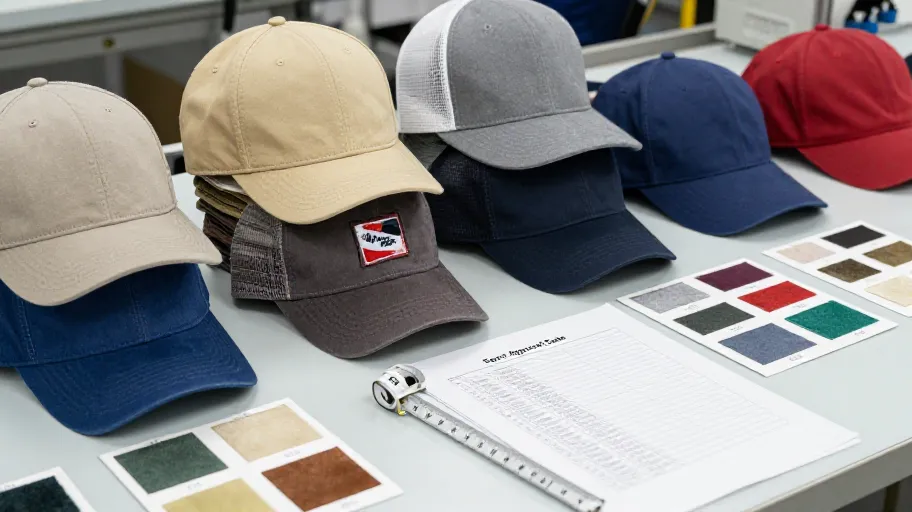
Most rework in custom cap sourcing traces back to specification gaps: details left undefined in the quote and unconfirmed in writing before production. A baseball cap manufacturer can only build to what is documented. Buyers who apply a gate-based approval process — construction, materials, decoration, tolerances — catch gaps at the spec stage, when changes are cheap, instead of at inspection.
This article is a procurement tool, not a product pitch. It maps where cap specifications go silent, which questions close each gap, and how to compare two manufacturers' quotes on genuinely equal terms. Where a policy, cost or capability is not something we can state on evidence, it appears as a question for you to confirm directly.
Rework starts where the spec sheet stops
A quotation for custom caps is a compressed document. It names a product, a quantity and a price. What it omits — panel count, crown lining, brim material, closure type, embroidery stitch density, sweatband attachment, wash/labelling instructions — becomes a decision the factory makes on your behalf during production.
That transfer of decision-making is the root cause of rework. It is not that the factory cannot execute; it is that two parties approved different mental images of the same cap. When the goods arrive and the image doesn't match, the correction conversation starts from a weaker position: the goods exist, the deposit exists, and the calendar has moved.
The discipline that prevents this is simple to describe: every specification line that affects form, fit, finish or label compliance gets written down, confirmed, and signed off before the PO. The Spec-Gate Framework below organises that work into four gates you can apply to any baseball cap manufacturer you are evaluating.
The Spec-Gate Framework: four approval gates
Gate 1 — Construction. The structural anatomy of the cap: panel count and seam placement, crown profile, brim shape and curvature, eyelet treatment, sweatband construction, lining, and closure type (for example plastic snap, metal buckle, elastic, velcro or fitted sizing). Construction gaps show up as fit and silhouette differences between sample and bulk.
Gate 2 — Materials. Fabric type and composition for crown and brim, brim boarding, sweatband material, button construction, thread type, and any lining or interlining. Material gaps surface as hand-feel, drape and colour-appearance differences, and they interact with your decoration method — a fabric that takes embroidery well may behave differently under heat transfer.
Gate 3 — Decoration. Logo method (embroidery, print, patch, woven label, heat transfer, silicone), placement coordinates measured from a fixed reference point, stitch density or print colour references, backing treatment, and backing-show-through rules. Decoration is the most reworked area in custom headwear because "logo on front-left panel" leaves a dozen sub-decisions unassigned.
Gate 4 — Tolerances and documentation. Acceptable variation for the dimensions you care about, colour approval references, inspection criteria, packing and labelling requirements, and which documents constitute approval. Never accept a numeric range suggested by an article like this one — negotiate tolerances that fit your market and document them.
Each gate ends with a written confirmation from the manufacturer: "We will build it as specified on lines X–Y, and any deviation requires your written approval before production." That single sentence, in your PO or spec sheet, converts vague expectations into an auditable record.
Decision table: what to demand at each gate
| Gate | What the quote should state | What to demand in writing | Red flag if absent |
|---|---|---|---|
| Construction | Panel count, crown profile, brim type, closure type, sweatband | Confirmed construction sheet referencing your approved sample | "Same as sample" with no attached construction detail |
| Materials | Crown/brim fabric composition, sweatband material, thread | Material confirmation per component; swatch retention for both parties | Generic fabric names with no composition or reference number |
| Decoration | Method, position, size, colour references for every logo | Placement measured from a fixed point; density or Pantone/print references approved | Logo position described only in words ("front, slightly left") |
| Tolerances & docs | Dimension tolerances, inspection standard, packing, labels | Signed tolerance sheet and inspection checklist as PO attachments | No inspection criteria beyond "AQL standard" with no number or level agreed |
A quote that refuses to be filled into the right-hand column of this table is telling you something. Compare what each baseball cap manufacturer is willing to document, not what each one promises.
Approval questions to send before the PO
Send these in writing and require written answers. Attach the answers to your PO.
- Please confirm the construction details of our cap panel by panel, brim, closure, sweatband and lining, and state any deviation from the approved sample.
- Please confirm the exact fabric composition and reference for every component, and confirm we will retain mutual swatches.
- For each logo, please confirm method, dimensions, placement measured from a defined reference point, and colour references.
- What dimensional tolerances will you commit to in writing, and against what inspection criteria and level will the goods be checked?
- What is your current sample policy — cost, sample scope, shipping responsibility and timing? (Confirm directly; no assumption should be carried over from a previous project.)
- What is your current MOQ, lead time and capacity position for our product type in our requested window? (Project-specific; confirm in the quotation.)
- Which certifications or test reports can you provide current evidence for relevant to our destination market? (Ask for documents, not assurances.)
- What is your change-order and rework process if bulk goods deviate from the signed spec sheet?
Questions 5–7 matter because they are exactly the areas where articles and sales pages overstate. A manufacturer's willingness to answer them with documents — not adjectives — is itself comparison data.
Comparing two manufacturers fairly
When two quotes arrive, lay them side by side and fill both into the same spec sheet. Gaps appear immediately: one quote names a closure, the other doesn't; one names thread type, the other doesn't. Every blank line is a decision the supplier will make for you.
Two practical rules:
- Compare on identical spec lines, never on price alone. A lower price on an undefined spec is not a lower price; it is an unpriced decision.
- Score documentation willingness. Track how many lines each manufacturer confirms in writing versus answers verbally. This is one of the strongest predictive signals of how rework conversations will go later.
This is precisely the workflow a structured scorecard supports: identical criteria, written evidence, and a comparable score for each supplier under review.
FAQ
Which specification area causes the most rework? We can't cite a defect statistic without evidence, but the structural cause is clear: any line left undefined becomes the supplier's decision. Decoration details and placement measurements deserve the most attention, because they carry the largest number of hidden sub-decisions.
How do I lock a spec if I only have a reference sample? Ask the manufacturer to reverse-document the sample: a component-by-component construction and material sheet that you then approve in writing. The reference sample becomes a controlled document, not a shared impression.
What should I do about verbal agreements during development? Convert them. After every call, send a written summary: "Per our discussion, we agreed X." Ask for written confirmation. Verbal agreements have no place at inspection, where the signed spec sheet is the only reference both parties share.
How many samples should I approve before mass production? Confirm the supplier's current sampling stages directly — for example whether they offer a pre-production sample for approval, and on what terms. What matters is that at least one approved sample exists, is referenced in the PO, and is retained by both parties.
Get the comparison tool
Download the Supplier Scorecard and turn the Spec-Gate Framework into a side-by-side evaluation you can send to every baseball cap manufacturer on your shortlist.
Not ready to download? Run this quick pre-check on your current quote: (1) panel and closure confirmed in writing? (2) fabric composition per component named? (3) every logo positioned by measurement? (4) tolerances and inspection criteria attached to the PO? Four yes answers means your spec sheet is doing its job.
#cap manufacturers china, #headwear manufacturers china, #cap factory








