

When a baseball cap manufacturer proposes changing your agreed fabric or trim, treat it as a formal engineering change, not a casual chat message. Ask three things in order: why the substitution is being suggested, what evidence shows the replacement meets your specification, and who approves the change in writing. Then decide — approve, negotiate, or reject — before any production step proceeds. Confirm the current policy directly.
Why material substitutions deserve a formal process
Mid-project material changes arrive in many forms: a different cotton blend, an alternative lining, a substituted buckle or eyelet material, or a replacement sweatband. The change itself is not the problem. The problem is approving it verbally, on a messaging app, without documentation — then discovering the finished caps photograph differently, feel different in hand, or behave differently after washing.
For private-label brands and wholesale buyers, the fabric is part of the brand promise. A substitution made without your approval shifts quality risk onto you while the savings or convenience may accrue elsewhere. The goal is not to refuse every change; some substitutions are legitimate and can even improve the product. The goal is to make every change explicit, evidenced and approved.
The S.U.B. Framework: three gates for any substitution
When a supplier proposes a material change, run it through three gates before you respond:
S — Substitute reason. Ask the manufacturer to state, in writing, why the original material cannot be used. Is it availability, production feasibility at your quantity, or something else? A clear, specific reason is itself a signal. A vague one is a reason to slow down and ask again.
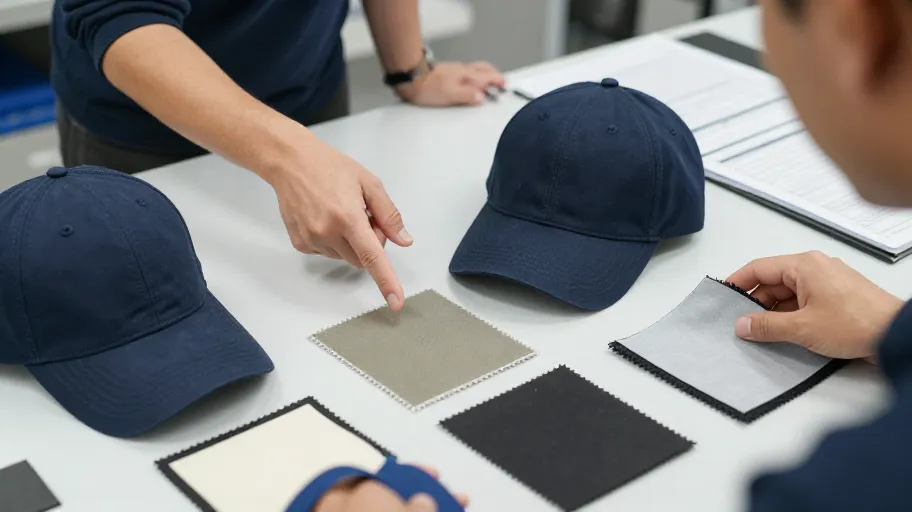
U — Usable evidence. Request a physical sample of the substitute material, ideally incorporated into a pre-production sample cap, plus a written comparison against the agreed specification: composition, weight, finish, colourfastness behaviour, and care implications. Do not approve on photographs alone. What a swatch looks like on a screen and what a finished crown looks like under retail lighting are different questions.
B — Binding approval. Define who signs off on your side and on the supplier's side, and record the decision — approved, approved with conditions, or rejected — in the project file, with the affected PO or contract referenced. An approval that lives only in a chat thread is difficult to rely on if a dispute arises later.
Decision table: approve, negotiate or reject
| Situation | What the evidence shows | Recommended action | Documentation to require |
|---|---|---|---|
| Supplier gives a specific, verifiable reason and a physical sample matching your spec sheet | Substitute meets the agreed specification | Approve in writing | Signed change note; updated spec sheet; retained sample |
| Substitute is close but differs in a measurable attribute (e.g., weight, finish, composition) | Deviation is visible or tactile | Negotiate: request a corrected sample or a documented concession on your side | Revised sample approval; deviation record; your written conditions |
| Substitute arrives without reason, sample or comparison | No usable evidence | Pause and reject the change until Gate U is satisfied | Written request for reason and sample; hold confirmation |
| Change is discovered after production began without approval | Process failure on the supplier side | Escalate to contract remedies; independent inspection before shipping | Inspection report; change timeline; contractual reference |
The fourth row is the one to engineer out of existence. Every instance of the first three handled well reduces the chance of the fourth.
Concrete approval questions to send the manufacturer
Copy these into your next reply to a substitution request:
- What is the specific reason the originally agreed material cannot be used for this order?
- Can you provide a physical sample of the substitute material, and a pre-production sample cap using it?
- How does the substitute compare to the agreed specification in composition, weight, finish and colour — attribute by attribute?
- What are the care and washing implications of the substitute, and do they differ from the original material?
- Does the substitution affect the agreed price, quantities or delivery terms for this order? Confirm the current policy directly.
- Who on your side is accountable for this change, and who will countersign the change note?
- If the finished goods do not match the approved substitute sample, what is your corrective process? Confirm the current policy directly.
- Will this substitution apply only to this order, or to future repeat orders under the same specification?
Questions 7 and 8 are the ones buyers forget. A substitution quietly becomes the new baseline on repeat orders unless the change note states its scope.
Material-change documentation checklist
- Written reason for the substitution received from the baseball cap manufacturer
- Physical swatch of the substitute material received and archived
- Pre-production sample cap using the substitute approved or rejected
- Attribute-by-attribute comparison against the agreed spec sheet
- Impact on care labelling and any brand claims reviewed
- Change note signed by named approvers on both sides
- Scope of the change (this order only vs. future orders) recorded
- Retained reference sample stored for dispute comparison
A single retained, signed-off sample resolves more disputes than any amount of correspondence.
How this protects the relationship, not just the buyer
A structured process is not adversarial. Manufacturers benefit when substitutions are documented: the change note protects them from later claims that they deviated without authority, and a clear approval gate prevents expensive rework discovered at final inspection. Framing the S.U.B. process as a shared quality tool — introduced at project kickoff, before any change is proposed — positions you as a professional buyer, not a suspicious one.
When evaluating a new custom headwear supplier, ask directly: "If a material becomes unavailable during my order, what is your change-approval process?" The quality of the answer tells you a great deal about how the factory handles exceptions — and exceptions are where sourcing relationships are defined.
Frequently asked questions
Can a supplier change materials without my approval? They can propose it; whether they may implement it depends on your contract and purchase order terms. Verify what your agreements say about specification changes before ordering, and require written approval for any substitution. Confirm the current policy directly with your supplier.
Should I always reject a proposed material change? No. Some substitutions are well-reasoned and evidenced, and may even improve the product. The point of the S.U.B. Framework is to evaluate each change on documented evidence, not to refuse changes reflexively or accept them passively.
What if the change is only to trims, not the main fabric? Run the same process at proportionate depth. Trims — buckles, eyelets, buttons, sweatbands — carry their own durability and branding implications, so the reason, evidence and approval gates still apply.
How do I prevent unapproved substitutions on repeat orders? Record the scope of every approved change (this order only vs. all future orders) and re-verify the specification at each repeat-order kickoff with a reference sample comparison.
Do I need a third-party inspection after a material change? For an evidenced, approved and sampled change, your own sample comparison may suffice. For changes discovered late, or where evidence is thin, an independent inspection before shipment gives you an objective record. Decide based on the risk the change carries to your brand.
Compare suppliers before the next change request arrives
Material-change behaviour is one of the most revealing tests of a baseball cap manufacturer — but you can only judge it if you have criteria defined in advance. Download the Supplier Scorecard to structure your next supplier evaluation across communication, documentation, quality process and change management.
Not ready for a full evaluation? Start with the eight-point material-change documentation checklist above — copy it into your next sourcing project file today.
#cap manufacturers china, #headwear manufacturers china, #cap factory