

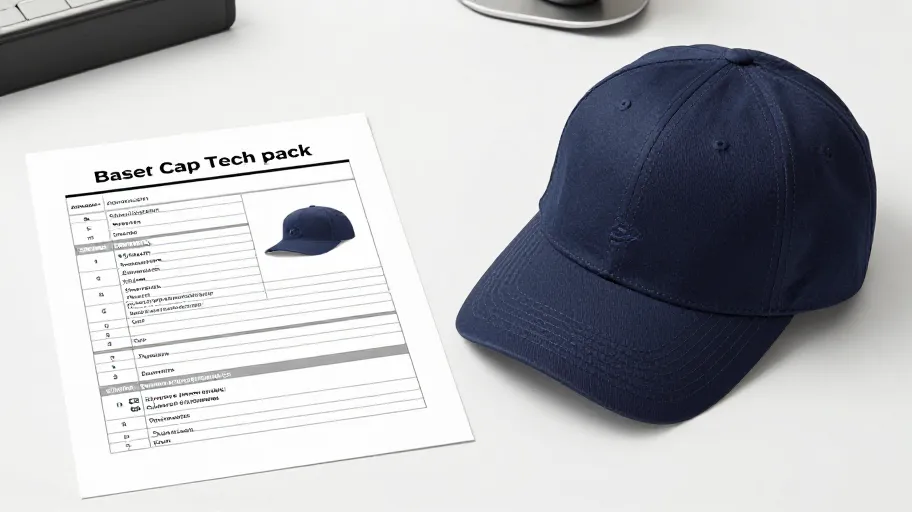
A baseball cap tech pack is the written specification that converts your brand requirements into a document a factory can quote, sample and produce against without guessing. It defines construction, materials, sizing, closure, decoration and tolerance expectations in one place, so every supplier you contact answers the same RFQ with comparable information. Below, the CLEAR RFQ Framework shows how to build that document section by section — and which approval questions to settle before you request a single quote.
Why the tech pack is a procurement document, not a design file
Most failed cap projects trace back to the same root cause: the buyer sent visuals, the factory made assumptions, and both sides discovered the gap after sampling. A tech pack removes that gap by forcing decisions into writing before money changes hands.
For an overseas buyer working with a Shenzhen OEM/ODM partner, the tech pack serves three procurement functions:
- It makes quotations comparable, because each supplier prices the same documented scope
- It creates a reference for sample approval, so "approved" has a defined meaning
- It protects both parties during bulk production, because deviations from the document are identifiable
None of this requires design skills. It requires decision discipline.
What a baseball cap tech pack must contain
Work through these specification categories in order. Where you have not decided, write "supplier to propose options" rather than leaving a blank — an open field invites an assumption.
- Construction and panels: six-panel vs five-panel, structured vs unstructured crown, seam placement, eyelet style and quantity
- Bill/visor: pre-curved, flat or custom shape; binding or raw edge
- Materials: shell fabric type and weight, lining or none, sweatband material, visor insert
- Closure: adjustable types (e.g. strap-and-buckle, snapback, hook-and-loop), fitted sizing, or stretch construction — specify which and any brand preference on hardware finish
- Sizing and measurements: target head-size range and the key measurement points you want the supplier to hold, defined as your project requirement rather than a universal tolerance
- Decoration method: embroidery (stitch count and placement), printing, patches, woven labels, heat transfer — with artwork files and placement diagrams
- Colour management: colour references (e.g. Pantone codes) and how colour will be approved
- Trims and labels: interior labels, hangtags, care labelling expectations
- Packing: individual polybags, carton quantity assumptions, labelling for your logistics chain
- Approval workflow: who signs off the sample, and what document version is authoritative
For every category where you hold a requirement, encode it. For every category where you want options, say so explicitly.
The CLEAR RFQ Framework
Use these five steps to turn the spec list above into an RFQ a supplier can act on:
- C — Confirm your own requirements internally before contacting any factory. An internal disagreement discovered mid-project costs a revision round.
- L — Lock the decisions you have made into the tech pack document, versioned and dated.
- E — Encode open points as explicit questions ("please propose two closure options with pros and cons") rather than blank fields.
- A — Align with the supplier: walk through the document together, confirm they can meet each documented requirement, and record their written responses as part of the RFQ.
- R — Release the RFQ to multiple suppliers only when the document is identical for all of them — that is what makes quotes comparable.
Decision table: how spec choices affect your RFQ
| Spec decision | What it changes | Approval question to settle first |
|---|---|---|
| Structured vs unstructured crown | Material list, packing behaviour, perceived price tier | Which silhouette matches our brand positioning — and can the supplier document both options? |
| Closure type | Hardware sourcing, adjustability range, decoration placement | Do we want adjustability or fitted sizing, and what closure options can this supplier offer? |
| Decoration method | Artwork file format, sampling sequence, cost drivers | Which decoration method best carries our logo at the intended size, and what file formats does the supplier require? |
| Material specification | Hand-feel, colour consistency approach, approvals needed | Do we specify exact materials or ask for proposed options with samples for comparison? |
| Sizing approach | Measurement points to hold, inspection basis | Which measurement points do we require the supplier to hold, and how will deviations be handled? |
| Packing and labelling | Landing costs, retail readiness, customs documentation | What packing format does our distribution chain need, and can the supplier confirm it? |
Approval questions to send with your RFQ
Before requesting a quotation, send these questions and require written answers:
- Can you confirm in writing that you can meet each requirement in the attached tech pack, item by item?
- Where we have marked "supplier to propose options", what options do you recommend and on what basis?
- What is your current sample policy — cost, shipping responsibility, and terms — that we should confirm before proceeding?
- What is your current MOQ, lead time and quotation validity for the documented specification?
- What documentation can you provide on materials, construction quality and any certifications relevant to our market — and is that documentation current?
- What is your process for sample approval, revision rounds and bulk production sign-off?
- Who is our named contact for technical questions during development?
Treat any answer that is not in writing as not yet given. Verbal commitments cannot be compared across suppliers.
How New Generation works with your tech pack
As a Shenzhen-based OEM/ODM manufacturer of custom caps and headwear, New Generation works from the document you bring. Where your tech pack is complete, we quote against it. Where it has open fields, we propose options for your comparison and record your approvals in the project file. Because sample policy, MOQ, lead times and material documentation are project-specific and subject to change, we ask every buyer to confirm current terms directly with our team rather than relying on published generalities — the same discipline this article asks of you.
That symmetry matters: a supplier who documents answers is a supplier you can hold to them.
Pre-send checklist for your tech pack
- Every spec category either decided or marked "supplier to propose options"
- Construction, closure and decoration choices written, not assumed
- Colour references and artwork files attached
- Sizing measurement points defined as your project requirement
- Approval workflow and sign-off owner named
- Open questions listed separately from requirements
- Document versioned and dated
- Identical document sent to every supplier being compared
FAQ
Do I need a tech pack for a small first order? The order size does not change the documentation logic. A written spec is what makes any quote comparable and any sample approvable. Scale affects commercial terms, which you must confirm with each supplier directly.
What if I don't know which materials to specify? Mark the field "supplier to propose options" and ask for two or three proposals with reference samples. You are comparing documented options rather than guessing.
How many suppliers should I send the RFQ to? Enough to compare meaningfully — but only with the identical document. Comparing quotes built on different assumptions is worse than not comparing at all.
Should the tech pack include tolerances? Yes — define the measurement points you want held and state your expectations as project requirements. Ask each supplier to confirm in writing that they can hold them, and how deviations are handled.
Who owns the tech pack during production? Agree this in writing: which version is authoritative, who can change it, and how changes are recorded. Put it in your approval questions.
Next step
Before your next RFQ, run your draft through the structure above — then download the Tech Pack Checklist to confirm nothing is left as an unstated assumption.
Short on time? Grab the one-page quick checklist and send your documented RFQ today.
#cap manufacturers china, #headwear manufacturers china, #cap factory