


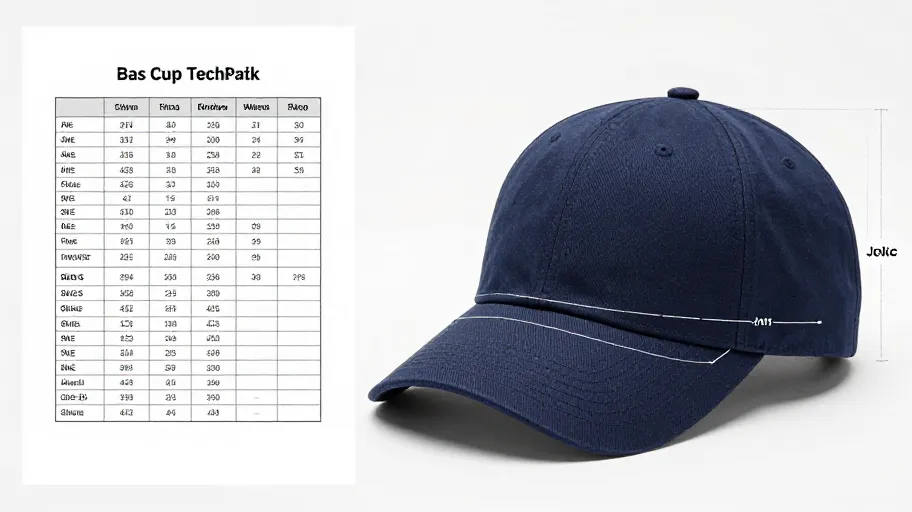
A baseball cap tech pack must specify overlooked measurements like crown panel curvature, visor binding edge width, and sweatband drop depth to prevent sampling delays. Product developers and brand founders should utilize a structured measurement matrix to document every dimensional variable, verify construction details, and approve physical samples before proceeding to bulk production.
When sourcing custom headwear from an OEM/ODM manufacturer, the initial brief sets the trajectory for the entire project. Product developers and brand founders attempt to communicate design intent, but certain measurements remain undocumented because they feel intuitive or negligible. Omitting these specifications forces the factory to make independent assumptions, which leads to unexpected sampling rounds and misaligned physical products.
To mitigate this, utilize the Crown-Seam-Matrix (CSM) Framework. This decision framework directs product developers to evaluate a cap not as a single garment, but as an intersection of three structural domains: the crown geometry, the seam interactions, and the hardware integration. By categorizing measurements within this matrix, buyers can identify gaps in their baseball cap tech pack before submitting it for production.
The Crown-Seam-Matrix Framework
The CSM Framework forces a comprehensive audit of physical dimensions. Instead of documenting basic size metrics, it requires buyers to define the interaction between materials, panels, and structural components.
| Measurement Category (CSM Domain) | Specific Metric to Document | Decision Obstacle | Verification Action |
|---|---|---|---|
| Crown Geometry | Front panel seam drop | Assumed uniform across all sizes | Document the exact depth from the crown apex to the front panel seam intersection. |
| Crown Geometry | Side panel flare angle | Vague descriptions of "high" or "low" profiles | Specify the lateral angle at which the side panels meet the front panel. |
| Seam Interaction | Visor joining stitch placement | Left to factory discretion | Define the exact distance from the bottom edge of the front panel to the visor attachment seam. |
| Seam Interaction | Sweatband drop depth | Overlooked back-end measurement | Specify how far the sweatband drops below the internal seam at the rear closure. |
| Hardware Integration | Rear closure hardware width | Mismatched fabric and closure proportions | Document the exact width of the strap relative to the back panel opening. |
| Hardware Integration | Eyelet diameter and placement | Assumed purely decorative | Specify the hole diameter and the distance from the crown apex to each eyelet. |
Deep dive into missed measurements
A baseball cap tech pack needs exhaustive dimensional data. Buyers must move beyond standard circumference measurements and document the micro-dimensions that determine fit and structure.
Crown geometry metrics The crown dictates the visual identity of the cap, yet developers omit specific geometric instructions. The front panel seam drop dictates how the cap sits on the forehead. If this measurement is absent, the factory selects a default dimension that might not align with the brand's design intent. Document the exact depth from the crown apex to the front panel seam intersection.
Additionally, specify the side panel flare angle. Vague descriptions of "high" or "low" profiles lead to inconsistent outputs. Define the lateral angle at which the side panels meet the front panel to ensure the crown maintains its intended silhouette.
Seam interaction metrics Seams dictate the structural integrity of the headwear. The visor joining stitch placement is a measurement left to factory discretion. To maintain control, define the exact distance from the bottom edge of the front panel to the visor attachment seam. This ensures the visor sits at the correct angle.
Sweatband drop depth is another overlooked metric. Buyers document the width of the sweatband but forget to specify how far it drops below the internal seam at the rear closure. This measurement affects interior comfort and how the cap retains its shape over time.
Hardware integration metrics Hardware dimensions must correlate with the fabric panels. Document the exact width of the rear closure strap relative to the back panel opening. If the strap is too wide or narrow, it distorts the back panel.
Eyelet placement requires equal attention. Do not assume eyelets are purely decorative. Specify the hole diameter and the exact distance from the crown apex to each eyelet to ensure consistent ventilation and aesthetic alignment.
Concrete approval questions for your OEM/ODM partner
To verify that your supplier understands the dimensions in your baseball cap tech pack, present these concrete approval questions during the initial consultation:
- How do you interpret the front panel seam drop measurement in this brief, and what happens if the specified depth conflicts with the selected fabric weight?
- What internal tolerance do you apply when constructing the sweatband drop depth, and how will you document this during the prototype phase?
- Can you confirm your capability to match the specified visor joining stitch placement without altering the intended panel proportions?
- How do you measure and verify the side panel flare angle during the cutting process?
- What steps will you take if the requested rear closure hardware width does not match the dimensions of the back panel pattern?
These questions shift the conversation from generic manufacturing capabilities to specific project verification.
FAQ: Baseball cap tech pack preparation
1. What is a baseball cap tech pack? It is a comprehensive document containing all technical specifications, measurements, materials, and construction details required to manufacture a custom cap. It serves as the primary communication tool between the brand and the OEM/ODM factory.
2. Why do buyers miss specific measurements in the first brief? Product developers focus on high-level design and aesthetics, assuming that structural details like sweatband drop depth or visor joining stitch placement are standard. This leads to undocumented dimensions and forces the factory to make independent decisions.
3. How does the Crown-Seam-Matrix improve the sourcing process? The framework breaks the cap down into crown geometry, seam interaction, and hardware integration. This ensures product developers audit every physical intersection of the garment, preventing omissions and reducing the need for multiple sample revisions.
4. What should a buyer do if a supplier questions a specific measurement? Buyers should treat supplier questions as an opportunity to verify construction capabilities. Use concrete approval questions to ask the factory how they interpret the measurement and request documented evidence of how they will achieve the specified dimension during cutting and sewing.
5. When should a buyer confirm production policies? Buyers must confirm all project-specific variables directly with the supplier. Do not assume any production policy. Before finalizing the baseball cap tech pack, ask the factory to outline their specific sample policy, lead time, and capacity constraints in writing.
Call to action
Before you submit your initial brief, ensure you have documented every critical dimension. Download the Tech Pack Checklist to verify your measurements and prevent unexpected development delays.
[下载 Tech Pack Checklist]
#cap manufacturers china, #headwear manufacturers china, #cap factory








