

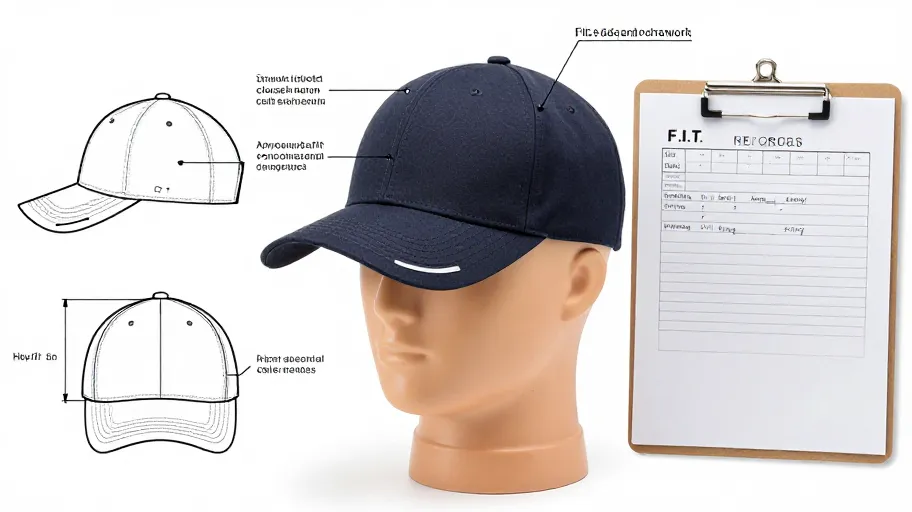
A baseball cap tech pack should record, during fit and compatibility checks, every observation that a supplier cannot reconstruct from a drawing alone: how the crown sits on reference heads, where the brim returns after flexing, how the closure engages at different sizes, whether trims and panels interfere, and which measurements drifted between samples. Use the F.I.T. Record Framework — Fit, Interchangeability, Tolerances-in-question — so each check produces a written, comparable entry rather than a memory.
Why fit checks belong in the tech pack, not in your head
Most sourcing teams run fit sessions. Far fewer convert those sessions into data. The result is a tech pack that describes the cap's geometry but not its behaviour — how it responds when worn, adjusted, flexed or washed. That gap is where sample rounds multiply.
The fix is procedural, not creative. Treat every fit session as a data-capture event. Before the session, define what you will observe. During the session, write it down in a fixed format. After the session, transfer the entries into the tech pack as attachments or annotated callouts.
This also protects you commercially. When a later sample differs from an approved one, a documented fit record lets you point to a written baseline instead of debating impressions.
The F.I.T. Record Framework
| Element | What it covers | What you write down |
|---|---|---|
| F — Fit | How the cap performs on reference heads or forms at rest and in use | Crown contact points, brim behaviour, strap position at each closure setting, pressure or gap observations |
| I — Interchangeability | Whether components, materials and trims work together as assembled | Closure-to-strap engagement, eyelet-to-panel behaviour, sweatband seam alignment, label placement against seams |
| T — Tolerances-in-question | Every measurement where you need the supplier to state an acceptable range | The measurement name, the observed values, and a written question asking the factory to confirm the working tolerance — never an assumed number |
The third element matters most. As a buyer, you should not write a numeric tolerance into a tech pack unless your supplier has confirmed it in writing for your project. Instead, record the measurement, your observation, and the open question. That converts an unknown into a documented dialogue.
What to record during fit checks
Use this checklist in every session, whether you are evaluating a first sample from your OEM partner or comparing samples from candidate factories:
Fit session record checklist
- Date, session number and which sample (by revision code) was evaluated
- Reference head size(s) or form used, and how many wearers/testers participated
- Crown: where it contacts, where it gaps, symmetrical or asymmetric
- Brim: shape retention after flexing, any permanent crease or warpage observed
- Closure: engaged position at each tester's preferred setting; whether the strap end sits cleanly
- Sweatband: sits flat or rolls; comfort observations recorded in the tester's own words
- Wash or wear test performed (if any): what was done, and what changed afterwards
- Photos taken from fixed angles with a scale reference, labelled with the sample revision code
- Every open question written as a numbered item to send to the supplier
One rule keeps this useful: record observations, not verdicts. "Brim returns slowly and sits 3 degrees off-plane at the left temple" is transferable data. "Brim feels wrong" is not. Even so, avoid quoting a numeric tolerance as a requirement — describe the observation and ask the factory to confirm the acceptable range.
Compatibility checks: what must work together
Compatibility failures are quieter than fit failures. Each component can pass inspection alone and still fail as an assembly. During checks, examine these pairings explicitly:
| Pairing | What to verify |
|---|---|
| Closure × strap | Engagement at the smallest and largest settings; strap stiffness versus closure type; edge finish where they meet |
| Eyelets × panel fabric | Whether the fabric shows distortion, fraying or wavering around the eyelet after assembly and after flexing |
| Sweatband × crown seam | Seam alignment, bulk at joins, whether the band lies flat after the cap is flexed |
| Brim × crown attachment | Even attachment tension, no puckering, consistent curve on both sides |
| Labels, embroidery or prints × panel seams | Placement clear of seams and closures; backing material does not interfere with drape or comfort |
| Packing method × cap shape | Whether folding or stuffing in the intended packing format deforms the crown or brim — confirm the packing method with the supplier in writing |
For each pairing, record what you observed, which sample revision it applied to, and whether the observation was consistent across all samples in the session.
Decision table: record it, question it, or leave it out
| Item | Record in tech pack | Send as a written question to supplier | Leave out |
|---|---|---|---|
| Fit observation with photo and revision code | ✅ | ||
| Compatibility observation between named components | ✅ | ||
| Numeric tolerance for a measurement | ✅ Ask the factory to confirm the working range for your project | ||
| Sample fees, shipping responsibility, refund treatment | ✅ Confirm current policy directly with the supplier | ||
| Production lead time or capacity figures | ✅ Confirm per order | ||
| Internal tester opinions with no observable detail | ✅ | ||
| Assumed "standard" specs you have not verified | ✅ Replace with a question |
Approval questions to send your supplier
Before you lock the tech pack, send these as a numbered list and require written answers that you then attach to the pack:
- For each measurement flagged in our fit record, what working tolerance can you confirm for this project?
- Which of the compatibility observations above relate to your assembly process, and which depend on our specified materials?
- What is your current sample policy — including any fees, shipping responsibility and how fees are treated? Please confirm in writing for this project.
- What lead time and order quantity apply to this specification at present? Please quote for this project.
- Which fit or compatibility points do you recommend verifying at a pre-production sample stage rather than at first sample?
- If a production piece deviates from the approved fit record, what is your process for reviewing and resolving it?
None of these questions presumes a policy. They convert every unknown into a documented answer you can approve against.
FAQ
How many fit sessions should a baseball cap tech pack document? There is no fixed number. Document every session you actually run, each tied to a sample revision code. What matters is that every session produces comparable entries, so you can trace how the fit evolved across revisions and which observations the supplier resolved.
Should the tech pack include photos from fit checks? Yes. Photographs from fixed angles with a scale reference, labelled with the revision code, are among the most transferable data in the pack. They let a supplier's sample room see exactly what you saw without translation.
Can I specify numeric tolerances myself in the tech pack? Only if a measurement tolerance has been confirmed with your supplier in writing for your project. Otherwise, record the measurement and your observation, and attach the supplier's confirmation when it arrives. Assumed numbers create disputes later.
Who owns compatibility checks — the buyer or the factory? Both, for different pairings. Ask the supplier the question directly (see approval question 2) so responsibility is assigned in writing before production, rather than negotiated after a problem appears.
How do fit records help if a dispute arises? A documented, photo-supported fit record gives both parties a written baseline tied to an approved sample revision. That makes deviation a comparison exercise rather than an argument about recollection.
Get the recording format right, every time
Fit and compatibility data is only useful if it is captured the same way every session and travels with the tech pack. A standardised checklist removes the guesswork from what to write down and what to ask.
[Download the Tech Pack Checklist] — the primary download for this article, built around the F.I.T. Record Framework.
Prefer to start smaller? Grab the one-page fit session recording sheet included in the same checklist set, and use it at your next sample review. [Get the free fit session sheet]
#cap manufacturers china, #headwear manufacturers china, #cap factory