


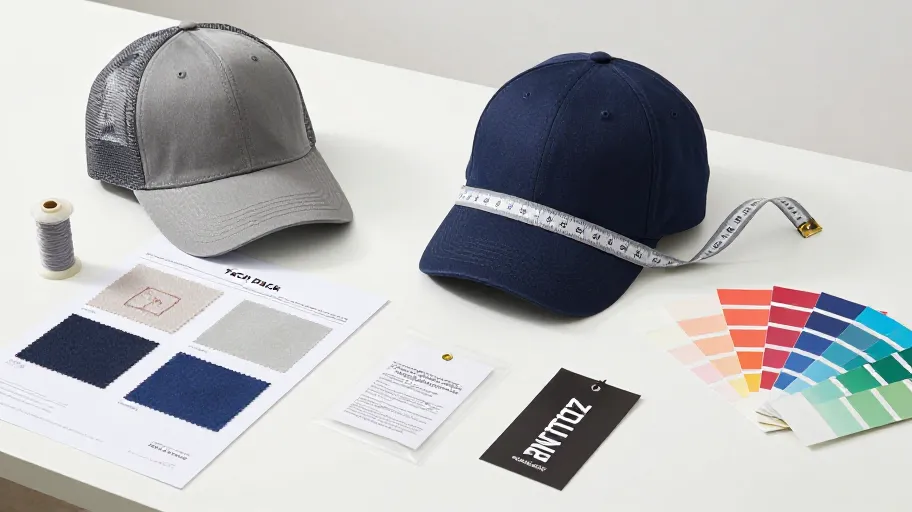
A baseball cap tech pack is the structured document — measurements, materials, construction, embellishment, labelling and packaging specifications — that lets a supplier quote your custom caps with defined assumptions instead of guesses. Before any credible quote, your supplier needs style references, panel and closure choices, decoration methods, colour standards, size spec, and labelling requirements, all documented in one approvable package. The more complete the document, the more comparable the quotes you receive.
Why vague enquiries produce unusable quotes
When a buyer sends only a logo and a mood image, the supplier has to fill in every unknown: the crown construction, the fabric, the closure, the embroidery coverage, the labelling. Each guess widens the quote's margin of safety, and different suppliers guess differently — which is why "the same cap" can come back with quotes that aren't comparable at all.
A baseball cap tech pack removes that ambiguity. It is not decoration; it is the reference document against which the supplier prices, samples, produces and is later judged. It also becomes your approval record: if the pre-production sample matches the tech pack, you have documented grounds for sign-off. If it doesn't, you have documented grounds for correction.
The SPEC-LOCK framework
To make sure nothing is missing, run your baseball cap tech pack through SPEC-LOCK — eight categories that together "lock" the specification:
- S — Style reference. Base cap silhouette and references (structured/unstructured, profile, visor shape, seam style).
- P — Panels and construction. Panel count, buckram/structure approach, visor material, eyelets, top button, sewing details.
- E — Embellishment. Decoration method per position (embroidery, printing, patches, woven labels), artwork files, stitch types, placement measurements.
- C — Colour and materials. Fabric type and weight, colour standards (e.g., Pantone references), thread and trim colours, lining or sweatband materials.
- L — Labelling and branding. Main label, care label, hangtag, size sticker, country-of-origin marking, and who supplies each item.
- O — Options and variants. Closure type (snapback, strapback, fitted, elastic), colourways, size range, packaging and carton marking requirements.
- C — Confirmations. Tolerances, inspection criteria, approval stages, and which documents govern when opinions differ.
- K — Key measurements. Crown height, visor length and curvature, cap circumference by size, sweatband height — presented as a measurement chart per size.
A tech pack that answers all eight categories gives a supplier everything needed to build a quote around your decisions rather than their assumptions.
Decision table: what each spec choice requires from you
| SPEC-LOCK category | Decision you own | What the supplier needs to quote | What to confirm with them |
|---|---|---|---|
| Style | Silhouette and structure level | Reference images or a comparable base model | Which base constructions they can produce |
| Panels & construction | Panel layout and structure approach | Diagram or annotated reference | Construction methods they recommend for your design |
| Embellishment | Decoration method per position | Vector artwork, placement and size per position | Stitch count/thread limits, artwork feasibility |
| Colour & materials | Fabric, trims, colour standards | Swatch codes or Pantone references per component | Dye-lot matching process and approvals |
| Labelling | Brand labels, tags, origin marking | Label artwork, dimensions, attachment method | Which labels they supply vs. which you ship |
| Options | Closure, sizes, packaging | Variant matrix (colour × size × closure) | How variants affect quoting and sampling |
| Confirmations | Tolerances and approval stages | Your acceptance criteria in writing | Their inspection and approval workflow |
| Key measurements | Target dimensions per size | Measurement chart with reference points | Their measurement conventions and check points |
Approval questions to ask before you sign off the tech pack
Before you approve a baseball cap tech pack and request a quote, put these questions in writing to your supplier:
- Which specification points in this document are unclear, missing, or in tension with each other?
- Which elements of the design constrain construction or decoration feasibility, and what alternatives would you propose?
- What reference materials (swatches, base samples, Pantone standards) do you need from us to match colour accurately?
- What is your approval workflow from tech pack to pre-production sample, and who signs off each stage?
- How do you document deviations from the tech pack, and what is the correction process if a sample doesn't match?
- Which labelling and marking items must we supply, and in what format?
Documented answers to these questions turn the tech pack into a shared contract rather than a one-sided wish list.
Working with an OEM/ODM partner on gaps
You don't need to arrive with a factory-grade tech pack. A capable OEM/ODM partner should help you convert references and rough specifications into a documented, quotable spec — proposing constructions, flagging infeasible decoration, and confirming colour-matching methods. What you do need to bring is decisions: the style direction, the branding elements, the variant plan, and your acceptance criteria.
Approach the process iteratively. Send your draft tech pack, collect the supplier's questions, resolve each open point in writing, and version the document. When both sides reference "tech pack v3, approved", you remove the most expensive source of sourcing conflict: two parties remembering different agreements.
Sample policy, pricing, lead times, minimums and every production condition vary by supplier and project. Confirm the current policy directly with each supplier you contact, and compare documented answers rather than assumptions.
FAQ
What file formats should artwork be in a baseball cap tech pack? Provide vector files for embroidery and print artwork, with placement and dimensions specified per position. Confirm the exact formats your supplier's production team prefers before finalising the pack.
Can a supplier quote from reference photos alone? A supplier can produce an indicative range, but a comparable quote needs documented specifications — construction, materials, decoration, measurements and variants. Photos supplement a tech pack; they don't replace it.
Who creates the tech pack: the buyer or the supplier? Either, collaboratively. The buyer owns brand decisions and acceptance criteria; the supplier contributes construction knowledge and feasibility confirmation. The output must be a document both parties approve.
How detailed should the measurement chart be? Detailed enough that a third party could measure the finished cap the same way you would: reference points, measurement direction, and target values per size. Agree tolerances with your supplier in writing before production.
What happens if I change the spec after quoting? Quote assumptions no longer hold. Update the tech pack, version it, and ask the supplier to re-confirm the quote against the revised document.
Download the Tech Pack Checklist
Before you send your next enquiry, run it through our Tech Pack Checklist — a one-page, SPEC-LOCK-aligned list of every item a supplier needs to quote your custom caps accurately. Download the Tech Pack Checklist and make your next quote comparable, documented and decision-ready.
For a lighter start, use the quick checklist below:
- Style reference and structure level defined
- Panel and construction details annotated
- Embellishment method, artwork and placement per position
- Fabric, trims and colour standards specified
- Labelling and origin marking plan agreed
- Closure, sizes and variant matrix listed
- Approval stages and acceptance criteria written
- Measurement chart per size attached
- All policy questions confirmed directly with the supplier
#cap manufacturers china, #headwear manufacturers china, #cap factory








