
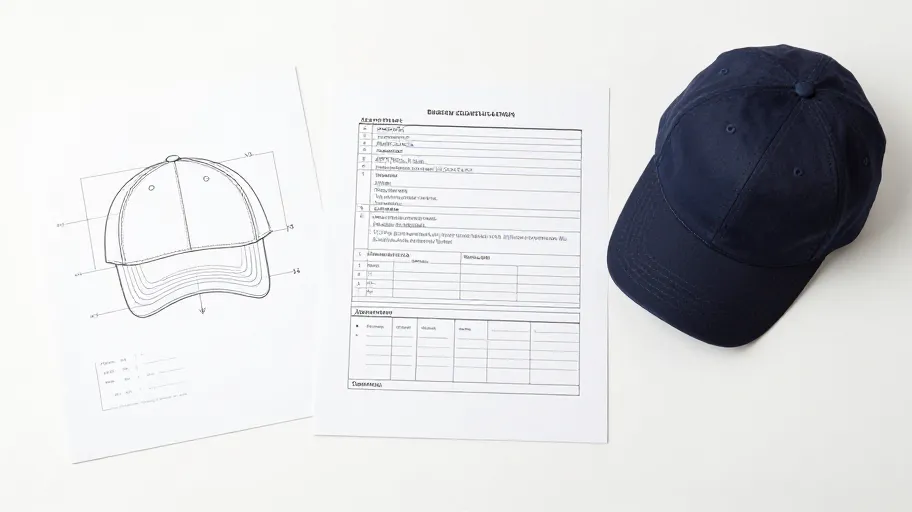
A complete baseball cap tech pack separates every specification into three documents: a construction drawing for geometry and visual intent, a bill of materials for every fabric, trim and consumable, and approval notes that record what you agreed to, revision by revision. Use the Draw–Bill–Approve (DBA) framework: if a detail affects shape, it belongs in the drawing; if it affects what the factory buys, it belongs in the BOM; if it affects what you accept, it belongs in the approval notes.
Why placement matters more than volume
Most sourcing disputes about custom caps are not caused by missing information — they are caused by information that exists but lives in the wrong place. A closure spec buried in a message thread cannot be checked on the production floor. A material note written on a sketch cannot be costed accurately. The DBA framework exists to remove ambiguity about where each fact lives, so that when a question arises, both you and the manufacturer look at the same document.
Treat the tech pack as the single source of truth for the project. Every later stage — quoting, sampling, revisions, production — should reference it rather than the conversation history.
The drawing: construction geometry and visual intent
The drawing is where the cap's shape and construction are defined. At minimum, include:
- Front, side, back and top views, plus a crown cross-section if the profile is unusual.
- Panel count and seam placement — where each seam sits relative to the visor and eyelets.
- Visor shape and curvature — describe the intended profile and, if you have a reference cap, include photographs from multiple angles.
- Closure type and position — which closure system, where it sits on the back panel, and how it interacts with any back embroidery.
- Eyelet count and placement.
- Crown structure — structured or unstructured intent, and how the front panel should behave visually.
- Stitching intent — topstitch density direction, contrast stitching, decorative seams. Describe the visual outcome you want and ask the factory to propose construction methods.
- Sweatband configuration and any internal labelling position.
- Closure-hole row alignment and matching thread colour.
One practical habit: annotate every arrow and callout with a plain-language sentence. A drawing that the sample room can read without calling you is a drawing that works.
The BOM: materials, trims and consumables
The BOM tells the factory exactly what to source. Each line should name the component, the specification, the position on the cap, and the quantity per unit:
| Component | What to specify |
|---|---|
| Shell fabric | Fibre content, weight class, weave/knit type, finish, colour reference |
| Visor material | Structure intent and whether a pre-curved or flat finish is expected |
| Undervisor | Colour and material (contrast is a visible design decision) |
| Sweatband | Material, width, closure method |
| Closure | Type, colour, branding |
| Eyelets | Matched or contrast, stitched or hardware |
| Thread | Colour per seam zone |
| Labels and tags | Woven label, care label, country-of-origin label position and content |
| Packaging | Folding method, inner support, polybag, carton marking |
For colour, use a physical reference or a named colour standard rather than a screen colour — screens vary, references do not. Where you are open to the factory's proposal, say so explicitly in the BOM and mark the line as "supplier to propose, buyer to approve."
Approval notes: what you agreed to, in writing
The approval notes are the most neglected document and the most valuable. They record decisions, open questions and the current revision status of the tech pack.
Structure them as:
- Revision log — version, date, what changed, who approved.
- Open questions — items you have asked the factory to confirm, with owner and due status.
- Approval references — which sample or swatch each approved detail is tied to.
- Project-specific questions — dimensional tolerances, MOQ, pricing, sampling terms, lead times and shipping arrangements are all project-specific. Do not pre-fill assumptions; write each one as a question for the supplier and record the written answer in this section. Confirm the current policy directly for anything involving samples or fees.
- Golden sample designation — once a sample is approved, name it in the notes as the reference standard for production.
Decision table: where each detail belongs
| Detail | Drawing | BOM | Approval notes |
|---|---|---|---|
| Panel count and seam placement | ✔ Primary | — | Note if revised |
| Visor curvature profile | ✔ Primary | — | — |
| Fabric composition and weight | — | ✔ Primary | Confirm swatch approval |
| Colour references | — | ✔ Primary | Record approved swatch ID |
| Closure type | ✔ Position | ✔ Specification | — |
| Stitching intent | ✔ Primary | Thread in BOM | — |
| Labels and branding placement | ✔ Position | ✔ Content/spec | — |
| Dimensional tolerances | Raise as question | — | ✔ Record answer |
| Sampling and fee terms | — | — | Confirm the current policy directly |
| MOQ, pricing, timelines | — | — | Ask supplier; record written answer |
| Golden sample designation | — | — | ✔ Primary |
Approval questions to put in writing
Before you sign off on any sample, ask and document:
- Which dimensions will the factory measure on every sample, and against which reference?
- What happens when a sample detail differs from the drawing — who flags it, and how is it logged?
- Which swatch is the approved colour standard, and where is it physically held?
- Which revision of the tech pack does this sample correspond to?
- What are the current sampling terms, MOQ, pricing and delivery arrangements for this project? Confirm the current policy directly.
- Who on each side has authority to approve a revision?
FAQ
Do I need a tech pack before requesting a quote? Yes. A quote based on an incomplete spec is an estimate of a cap you have not defined. A drawing plus BOM lets the factory quote the cap you actually intend to make.
Can I reference an existing cap instead of drawing one? A physical reference is valuable, but pair it with a drawing that names what you want to keep and what you want to change. Reference caps alone leave interpretation open.
How detailed should material specifications be? Detailed enough that the factory does not need to guess. Where you lack a specification, mark the line "supplier to propose, buyer to approve" — this is a documented decision, not a gap.
Who owns the tech pack during development? Agree this explicitly. Most friction comes from two versions circulating at once. The approval notes should state which revision is current at any moment.
What if the factory's tech pack differs from mine? Reconcile it into a single document before sampling. Conflicting documents are the root cause of most sample-round surprises.
Download the Tech Pack Checklist
Turn this framework into a working document: download the Tech Pack Checklist and use it to brief your next cap project — every line mapped to the drawing, the BOM or the approval notes.
Prefer to start lighter? Grab the one-page pre-brief checklist first, then move to the full pack when you're ready to request samples.
#cap manufacturers china, #headwear manufacturers china, #cap factory